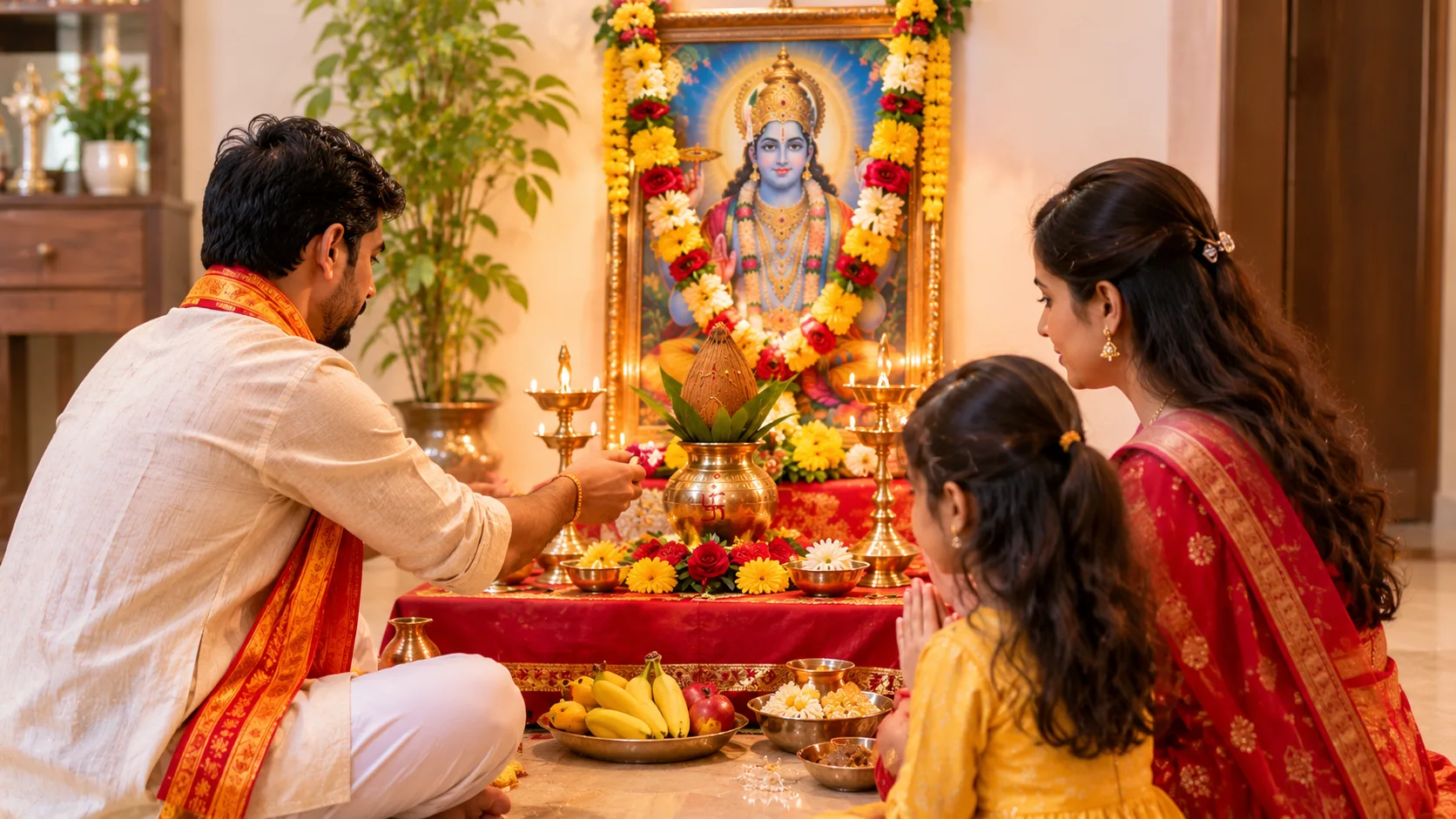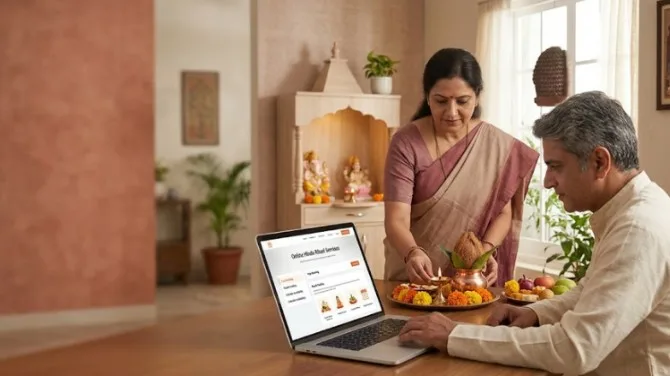
Many devotees now arrange rituals through online puja booking, whether they live in another city, work long hours, or simply cannot travel to a temple. A common doubt follows: can a puja performed at a distance still feel personal?
Tradition suggests the answer lies in the Sankalp. This short resolve at the start of a ritual ties the ceremony to you, your family, and your purpose. When it is done thoughtfully, even a puja you follow from your phone can feel like your own offering rather than a distant event.
What Is Sankalp in a Hindu Puja?
A Sankalp is a formal statement of intent made at the start of a puja, homam, or other ritual. The priest recites it in Sanskrit, naming the person on whose behalf the ritual is performed, along with the purpose of the worship. Traditionally, it also references the place and the time, according to the Hindu Panchangam.
Think of it as an address on an envelope. The mantras, offerings, and prayers are the contents, and the Sankalp tells them who they are for and why. Without it, a ritual can still be performed, but it is not directed to a particular devotee or intention.
Why Personalization Matters in Online Hindu Puja
In an online Hindu puja, you are not physically in the room. The Sankalp is the main thing that connects you to the ritual, which is why it matters more here than in many other settings.
A personalized Sankalp gives you three things:
- Identity: your name and your gotra, if you know it, are spoken during the ritual.
- Intention: your reason for the puja is stated clearly, whether it is gratitude, a new beginning, peace for the family, or an observance on a special tithi.
- Participation: you are not a spectator. Your details are part of the ceremony itself.
This is also why a generic booking with no personal details can feel hollow. Good online puja services treat your information as part of the ritual, not as an afterthought in a checkout form.
What Goes Into a Personalized Online Sankalp
When you book puja online, you are usually asked for a few details. Each one has a purpose:
- Full name: the main person on whose behalf the ritual is performed.
- Gotra: the lineage, traditionally mentioned in the Sankalp. If you do not know your gotra, say so, as priests commonly follow a standard practice in that case.
- Nakshatra and rashi (optional): some devotees share these for traditional reasons. Provide them only if you know them.
- Names of family members: many platforms let you include more than one person in a booking.
- Your intention: a short, sincere line such as health, a new home, exam success, gratitude, or removal of obstacles.
A tip: keep your intention simple. A clear, honest purpose is easier for the priest to include than a long list of wishes. A Sankalp expresses devotion and intent. It does not guarantee a specific outcome, and a trustworthy service will never promise one.
How an Online Sankalp Works in Practice
The process for online pandit booking is usually straightforward:
- You choose a puja and a date.
- You enter your name, Sankalp details, and, if known, your gotra at checkout.
- You receive a confirmation.
- On the puja day, the pandit recites the Sankalp with your details, then performs the ritual as per Vedic vidhi.
- Afterwards, you receive photos, videos or a recording, and prasad where it is part of the package.
ePuja by Satvik follows this pattern. Devotees enter their name, Sankalp, and gotra while booking, and the details are shared with the pandits for the ceremony. Always read each puja's description, since dates, temples, and inclusions differ between services.
Live Puja: Staying Connected to Your Sankalp
A live puja adds a lot to the experience. When you watch the ceremony as it happens, you can hear the priest begin with the Sankalp, notice your own name being taken, and follow the mantras and offerings to the end.
Live streaming is not always possible. Temples work to their own schedules, and network issues can interrupt a stream. For this reason, many services also share a recording afterwards. Check the booking page to see whether a live stream, a recording, or both are offered, so your expectations match the service.
Online NRI Puja: Keeping Traditions Alive Across Distance
For families abroad, an online NRI puja is often the easiest way to stay connected to rituals back home. Birthdays, anniversaries, death anniversaries, housewarmings, and festival days can all be observed through a temple ritual in India, with your family's names included in the Sankalp.
Two practical points help NRI devotees:
- Check the time zone. Temple rituals follow the Indian Panchangam, so the live timing may fall at an unusual hour where you live.
- Keep your details ready. Names, gotra, and the purpose of the puja make booking quicker and the Sankalp more accurate.
Individual vs Group Puja: Does Sankalp Still Apply?
Yes. In an individual puja, the ritual is performed only for you or your family. In a group puja, one ceremony is held for many devotees, and the Sankalp includes each participant's name. Both can be meaningful. Choose individual puja if you want a dedicated ritual, or a group puja if you want to join a temple ceremony on a fixed date.
How to Choose a Reliable Online Puja Service
Since you are trusting someone with a religious ritual, look for services that are transparent. A few checks before you book:
- Does the page name the temple, location, and deity?
- Does it explain how your name and gotra are included in the Sankalp?
- Does it say clearly whether you get a live stream, a recording, photos or prasad?
- Is there a support channel you can contact before you book?
- Does it avoid exaggerated promises or guaranteed results?
A service that answers these clearly is usually easier to trust. Whether you are exploring online puja services booking for the first time or returning for a family occasion, these questions help you pick with confidence.
Conclusion
A puja is meaningful because of the devotion behind it, and the Sankalp is where that devotion is spoken aloud. A personalized Sankalp makes an online ritual feel like yours, with your name, your family, and your intention placed at the centre of the ceremony.
If you are ready to take part in a Vedic puja online, you can explore temple-based rituals and complete your booking through the online puja booking options at ePuja services by ePuja by Satvik. Take a few minutes to prepare your details, state your intention clearly, and let the Sankalp make the puja your own.