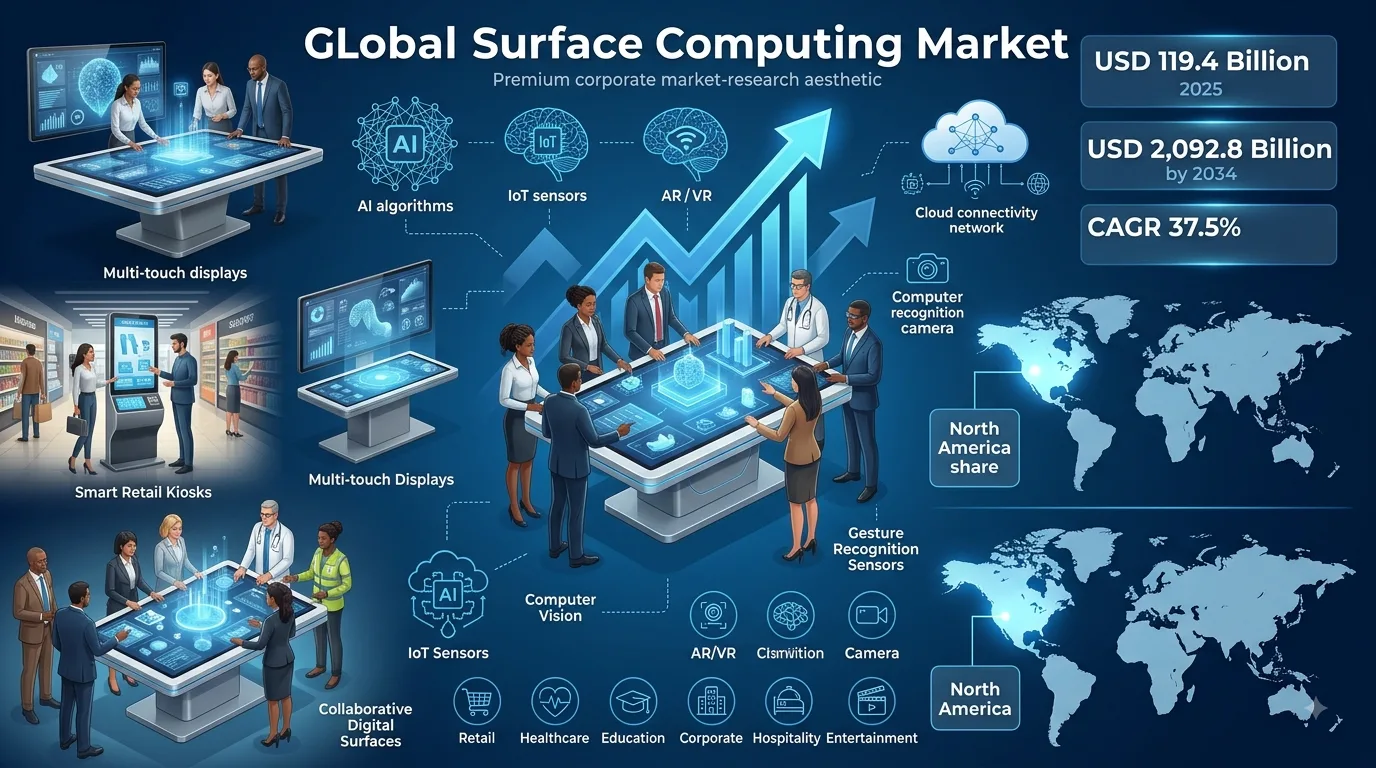
The Global Surface Computing Market is entering a high-growth phase as businesses increasingly adopt interactive digital surfaces that enable users to engage with information through touch, gestures, objects, and multi-user interfaces. Surface computing combines advanced displays, sensors, computer vision, artificial intelligence, and intuitive software to transform conventional screens, tables, kiosks, walls, and other physical surfaces into intelligent interactive environments. Growing demand for immersive customer experiences, collaborative workplaces, smart classrooms, digital healthcare environments, and technology-enabled retail is accelerating adoption worldwide.
The Global Surface Computing Market is predicted to be valued at USD 119.4 billion in 2025 and is expected to reach USD 2,092.8 billion by 2034, registering a remarkable compound annual growth rate (CAGR) of 37.5% from 2025 to 2034. This rapid expansion reflects the increasing integration of touch-sensitive interfaces, gesture recognition, augmented reality, artificial intelligence, Internet of Things technologies, and advanced visualization systems across commercial and institutional environments.
Surface computing is also benefiting from a broader shift toward natural user interfaces. Organizations increasingly want digital systems that reduce dependence on traditional keyboards and mice while supporting direct and collaborative interaction. Interactive tables, touch-enabled kiosks, digital walls, smart displays, and large-format collaborative surfaces are becoming valuable tools for improving customer engagement, employee productivity, visualization, training, and real-time information access.
Download a Complimentary PDF Sample Report:
https://dimensionmarketresearch.com/request-sample/surface-computing-market/
Market Overview
Surface computing refers to computing environments in which users interact directly with digital content through physical or virtual surfaces. Unlike conventional computing systems, these solutions can support multi-touch inputs, gesture-based commands, object recognition, simultaneous users, and contextual interaction. Modern surface computing platforms integrate hardware such as displays, cameras, sensors, processors, projectors, and connectivity modules with software for visualization, analytics, recognition, and application management.
The market is expanding beyond conventional interactive displays. Advanced solutions are increasingly capable of recognizing physical objects placed on surfaces, tracking movements, interpreting gestures, and connecting interactions with cloud platforms and enterprise systems. Artificial intelligence and computer vision are further enhancing recognition accuracy and enabling interfaces to respond intelligently to user behavior.
Retail, hospitality, education, healthcare, banking, transportation, entertainment, government, and corporate environments represent important areas of deployment. Retailers can use interactive tables and displays for product discovery, while educational institutions can support collaborative learning through multi-user digital surfaces. Healthcare organizations can deploy interactive visualization systems for patient engagement, medical training, and collaborative review of complex information.
Key Findings
- The Global Surface Computing Market is projected to reach USD 119.4 billion in 2025.
- Market value is anticipated to increase to approximately USD 2,092.8 billion by 2034.
- The industry is expected to expand at a 37.5% CAGR between 2025 and 2034.
- North America is projected to account for approximately 45.5% of global revenue in 2025, making it the leading regional market.
- Increasing deployment of interactive displays, smart kiosks, digital tables, and collaborative interfaces is strengthening commercial adoption.
- Integration with AI, IoT, AR/VR, computer vision, and cloud computing is expanding the capabilities of surface computing platforms.
- Retail, education, healthcare, corporate, hospitality, and entertainment applications are expected to create substantial growth opportunities.
Market Dynamics
The surface computing industry is influenced by rapid developments in display technologies, human-machine interaction, artificial intelligence, sensing technologies, and enterprise digitization. Organizations are increasingly replacing static displays and conventional information terminals with interactive systems capable of delivering personalized and immersive experiences.
Declining display technology costs and improvements in processing capabilities are also making sophisticated interactive systems more commercially accessible. At the same time, businesses are increasingly prioritizing digital experiences that can attract customers, simplify navigation, support collaboration, and differentiate physical environments.
However, market expansion requires substantial investment in specialized hardware, integration, software development, cybersecurity, maintenance, and employee training. These considerations can slow adoption among smaller organizations despite strong long-term demand.
Growth Drivers
Rising Demand for Interactive and Immersive Digital Experiences
Consumers increasingly expect intuitive and engaging interactions with digital technology. Surface computing allows users to manipulate digital content directly through touch, gestures, and physical objects, providing a more natural experience than traditional input systems.
Retailers can deploy interactive surfaces for virtual catalogs, product comparison, customized recommendations, and self-service applications. Hotels, airports, museums, entertainment venues, and public facilities can similarly use interactive interfaces to improve navigation and information delivery.
Rapid Digital Transformation Across Enterprises
Digital transformation is another major driver of the Surface Computing Market. Businesses are investing in intelligent workplaces, connected stores, digital customer-service platforms, collaborative meeting environments, and automated information systems.
Interactive tables and large-format displays allow teams to simultaneously review information, manipulate visual content, and collaborate on projects. These capabilities are particularly useful in architecture, engineering, manufacturing, design, healthcare, and other sectors where visualization and group interaction are important.
Integration of AI, IoT, and Computer Vision
Artificial intelligence is substantially improving surface computing functionality. AI-powered systems can interpret gestures, recognize objects, analyze user behavior, and personalize displayed information.
IoT connectivity allows interactive surfaces to communicate with connected devices, sensors, cloud platforms, and enterprise systems. Computer vision enables systems to understand movements and physical objects, creating opportunities for increasingly intelligent and context-aware environments.
Expansion of Smart Retail and Self-Service Technologies
Retail digitization represents an important growth opportunity. Interactive tables, touchscreen kiosks, smart mirrors, digital shelves, and product visualization displays allow retailers to combine physical shopping with digital information.
These systems can help consumers explore inventories, compare specifications, configure products, access promotions, and complete self-service activities. The continued expansion of omnichannel retail strategies is expected to strengthen demand for interactive technologies that connect digital commerce with physical stores.
Market Trends
Shift Toward Multi-Touch and Multi-User Interfaces
Surface computing platforms are increasingly designed to recognize multiple simultaneous touch points and users. This capability makes them suitable for collaborative environments such as classrooms, design studios, control rooms, corporate meeting spaces, and interactive entertainment facilities.
Growing Adoption of Gesture Recognition
Touchless interaction is becoming increasingly important. Gesture-recognition systems allow users to control digital content without physically touching a display, supporting convenience and innovative user experiences.
Integration with Augmented and Virtual Experiences
Surface computing is increasingly converging with augmented reality and extended reality technologies. Interactive surfaces can complement immersive environments by providing shared control interfaces and visual information layers.
Increasing Use of Cloud-Connected Platforms
Cloud connectivity enables organizations to centrally manage interactive content, applications, analytics, and system updates across multiple locations. This trend is particularly valuable for retail chains, educational networks, hospitality businesses, and multinational enterprises.
Challenges
High Initial Investment
Advanced surface computing platforms may require significant spending on interactive displays, sensors, processors, software, installation, customization, and supporting infrastructure. High upfront investment can limit adoption among small and medium-sized organizations.
Integration and Compatibility Issues
Organizations frequently operate multiple legacy systems and software platforms. Integrating interactive surfaces with existing enterprise applications, databases, IoT networks, and content-management systems can create technical complexity.
Data Security and Privacy Concerns
Connected interactive systems may collect user behavior, preferences, interaction patterns, or other information. Organizations must therefore implement appropriate cybersecurity, authentication, data protection, and privacy controls.
Maintenance and Technical Expertise
Advanced displays and sensor-based interfaces require maintenance and technical support. Ensuring consistent responsiveness, calibration, connectivity, software compatibility, and security updates can increase operating requirements.
Market Segmentation Overview
The Surface Computing Market can be evaluated across multiple dimensions, including type, component, display technology, application, end-use industry, and region.
By Type
The market includes flat surface computing and curved surface computing solutions. Flat interactive surfaces remain widely applicable across digital tables, kiosks, displays, classrooms, retail environments, and corporate collaboration systems. Curved surfaces are gaining attention for specialized immersive installations, automotive applications, entertainment environments, and advanced visualization.
By Component
Surface computing solutions generally consist of hardware and software. Hardware includes displays, sensors, cameras, processors, projectors, connectivity modules, and supporting components. Software manages user interaction, content, recognition, visualization, analytics, security, and application integration.
By Application
Important applications include retail, hospitality, healthcare, education, entertainment, banking and financial services, corporate environments, transportation, and public infrastructure. Retail applications are particularly attractive due to growing investment in immersive stores and self-service experiences.
By Technology
Key technologies include multi-touch sensing, infrared sensing, capacitive touch, optical recognition, computer vision, gesture recognition, object recognition, and projection-based interaction. Continuous innovation is improving precision, responsiveness, durability, and scalability.
Purchase the report for comprehensive details:
https://dimensionmarketresearch.com/checkout/surface-computing-market/
Regional Analysis
North America
North America is expected to hold the largest share of the Global Surface Computing Market by the end of 2025, accounting for approximately 45.5% of the overall market. The region's leadership is supported by its strong technology ecosystem, widespread adoption of advanced user interfaces, mature digital infrastructure, and significant investment in enterprise digital transformation.
The United States represents a major contributor, with interactive displays increasingly deployed across retail stores, corporate offices, healthcare facilities, educational institutions, entertainment venues, and public environments. Early adoption of artificial intelligence, IoT, augmented reality, virtual reality, and advanced display technologies further supports market expansion.
Smart city initiatives and increasing deployment of intelligent public systems are also creating opportunities for interactive kiosks, information displays, navigation systems, and citizen-service interfaces.
Europe
Europe represents an important market supported by digitalization across retail, transportation, education, corporate workplaces, and public services. Growing investment in smart infrastructure and interactive customer experiences is expected to encourage further adoption.
Asia-Pacific
Asia-Pacific is positioned for substantial long-term expansion due to rapid urbanization, growing technology investment, expanding retail infrastructure, smart city programs, and rising digital adoption. Increasing deployment of interactive technologies across China, Japan, South Korea, India, and Southeast Asian economies is creating significant opportunities.
Competitive Landscape
The competitive landscape of the Surface Computing Market is characterized by continuous technological innovation and increasing convergence between display technologies, AI, computer vision, IoT, cloud computing, and enterprise software.
Market participants are concentrating on improving touch sensitivity, display resolution, object recognition, gesture control, durability, energy efficiency, and multi-user functionality. Product differentiation increasingly depends on creating intuitive interfaces while ensuring seamless connectivity with cloud services and enterprise applications.
Strategic partnerships between hardware manufacturers, software developers, system integrators, AI technology providers, and industry-specific solution providers are becoming increasingly important. Companies are also focusing on customizable solutions tailored to retail, healthcare, education, hospitality, transportation, and corporate requirements.
Future Market Outlook
The outlook for the Surface Computing Market remains highly promising as computing continues moving toward more natural, spatial, and context-aware interfaces. The projected expansion from USD 119.4 billion in 2025 to USD 2,092.8 billion by 2034 demonstrates the significant commercial potential of interactive surface technologies.
Future systems are expected to incorporate increasingly sophisticated AI capabilities, enabling interfaces to understand user intent, gestures, physical objects, environmental conditions, and behavioral patterns. Advances in flexible displays, transparent screens, projection systems, edge computing, spatial computing, and connected sensors could further expand potential applications.
Surface computing may increasingly become part of broader intelligent environments rather than functioning as a standalone technology. Smart stores, connected hospitals, digital classrooms, intelligent workplaces, autonomous transportation environments, and smart cities can integrate interactive surfaces with connected devices and real-time data platforms.
Frequently Asked Questions
1. What is the size of the Global Surface Computing Market?
The Global Surface Computing Market is predicted to reach USD 119.4 billion in 2025 and is projected to grow to approximately USD 2,092.8 billion by 2034.
2. What is the expected CAGR of the Surface Computing Market?
The market is expected to register a CAGR of 37.5% from 2025 to 2034, supported by rapid adoption of interactive displays, AI-powered interfaces, IoT connectivity, and immersive digital technologies.
3. Which region dominates the Surface Computing Market?
North America is expected to dominate the global market with approximately 45.5% share in 2025, driven by advanced technology infrastructure, strong enterprise digitalization, and extensive adoption of interactive systems.
4. What factors are driving Surface Computing Market growth?
Major drivers include rising demand for immersive digital experiences, enterprise digital transformation, smart retail expansion, collaborative workplace technologies, and integration with AI, IoT, computer vision, and AR/VR.
5. What are the major challenges facing the Surface Computing Market?
Key challenges include high initial investment, integration complexity, cybersecurity and privacy concerns, maintenance requirements, and the need for specialized technical expertise.
Summary of Key Insights
The Global Surface Computing Market is positioned for exceptional expansion as interactive technologies transform how people engage with digital information. With market value projected to increase from USD 119.4 billion in 2025 to USD 2,092.8 billion by 2034 at a CAGR of 37.5%, the industry offers substantial opportunities across retail, healthcare, education, hospitality, corporate, entertainment, transportation, and public infrastructure.
North America is expected to maintain its leading position with approximately 45.5% market share in 2025, while Asia-Pacific presents considerable future growth potential. Continued advances in artificial intelligence, IoT, computer vision, multi-touch interfaces, gesture recognition, augmented reality, and cloud connectivity will expand surface computing capabilities. As organizations increasingly prioritize intuitive, collaborative, and immersive digital experiences, surface computing is expected to evolve into a fundamental component of next-generation intelligent environments.