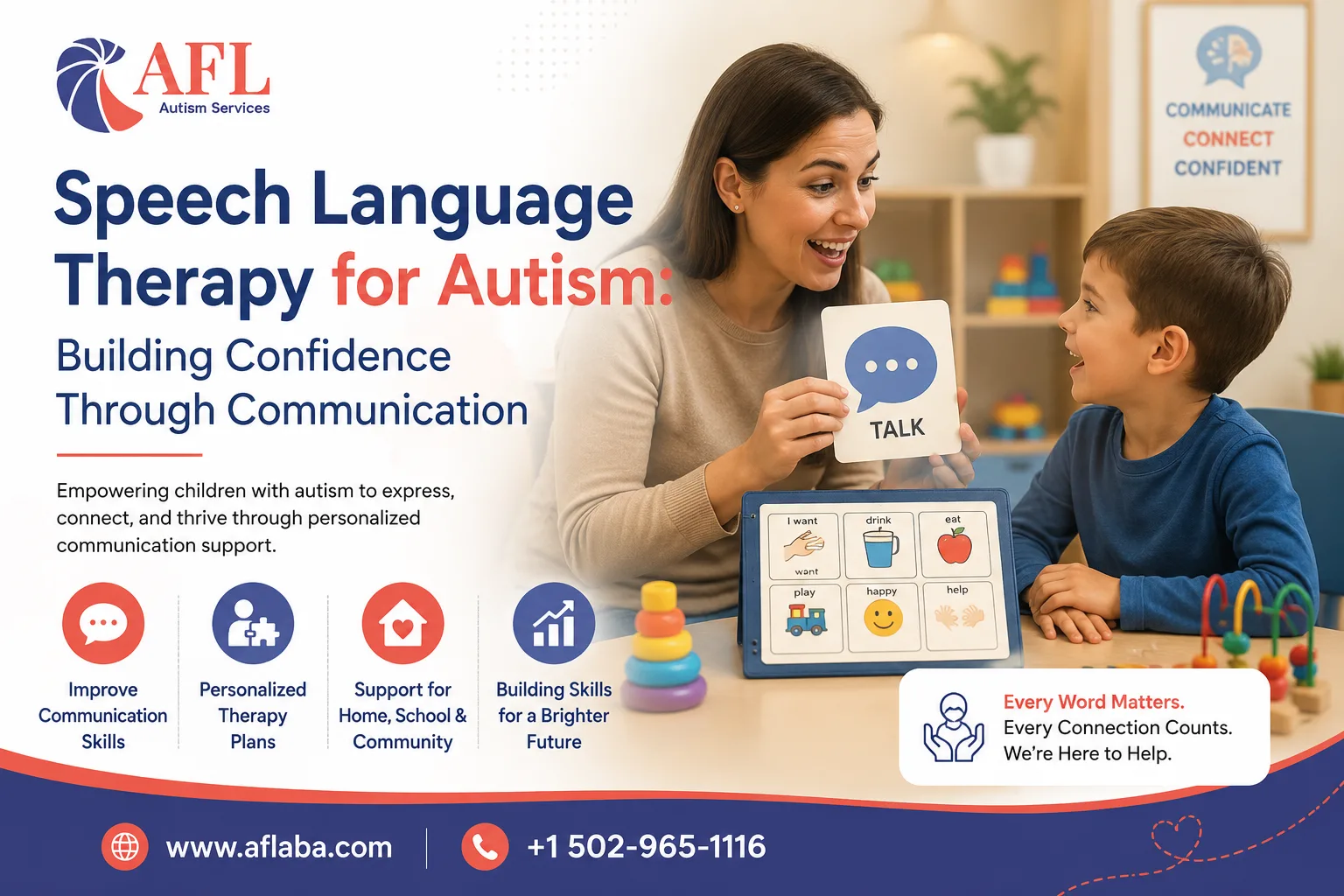
When a child with autism finds a way to express a need, share a thought, or connect with someone they love, it changes everything, not just for the child but for the entire family. That moment rarely happens by accident. It usually comes after months of consistent, targeted speech language therapy for autism, led by clinicians who understand how differently autistic brains process, interpret, and produce language.
This article goes beyond the basics. If you already know what a speech-language pathologist (SLP) does and you're here for a deeper look at how communication therapy actually works for autistic children, including how it connects to ABA, what the evidence says, and how to make the most of it, you're in the right place.
Why Communication in Autism Is More Than Just Speech
The instinct is to think of autism speech therapy as teaching kids to "talk more." But language is only one layer of communication, and not even the first one that breaks down in autism.
Most communication challenges in autism stem from differences in social communication, which covers the unspoken rules of conversation: knowing when to take a turn, reading a listener's face, adjusting volume and topic based on context, and understanding that language is always embedded in social intent.
A child might have strong expressive vocabulary and still struggle profoundly with pragmatics. They know what words mean but not how words work between people. Speech language therapy for autism targets all of these layers simultaneously: articulation, yes, but also receptive language, expressive language, augmentative and alternative communication (AAC), and social communication skills.
The American Speech-Language-Hearing Association (ASHA) recognizes autism-related communication differences as a primary area of SLP scope of practice, and early, intensive intervention in this space has a strong evidence base behind it. Research consistently shows that children who receive communication therapy before age 5 show better long-term language outcomes, but meaningful gains are achievable across all ages and support levels.
What Speech-Language Pathologists Actually Do (Beyond the Surface)
An SLP working with an autistic child is not running flashcard drills. A skilled clinician conducts a full communication profile assessment first, because two children with the same diagnosis can have almost nothing in common in terms of how they communicate.
That profile typically includes:
Functional communication assessment: What does the child currently use to communicate needs, wants, rejection, protest, and comments, whether that's words, gestures, sounds, pictures, or devices?
Receptive language testing: How much does the child understand versus respond to contextual cues like tone, routine, or familiar setting?
Pragmatic language observation: How does the child initiate, maintain, and close interaction? Do they struggle with topic shifts, scripting, or turn-taking?
AAC evaluation: Does the child need a low-tech or high-tech communication system to supplement or replace speech while verbal skills develop?
This assessment drives everything. Without it, therapy becomes generic, and generic doesn't move the needle for autistic learners.
Once goals are set, sessions are structured around functional communication outcomes, meaning skills the child can actually use in their daily life at home, school, and in the community. A goal isn't "produce 10 novel utterances per session." A goal is "request a preferred snack using a 3-word phrase in 4 out of 5 opportunities across two settings."
Speech Therapy vs. ABA: Not the Same Thing, Not in Competition
Parents navigating autism services often encounter both ABA therapy and speech language therapy for autism at the same time, and understandably want to know the difference and whether one replaces the other.
They don't replace each other. They work at different levels.
ABA (Applied Behavior Analysis) addresses behavior broadly: how a child learns, responds to their environment, builds independence, and reduces behaviors that interfere with daily life and learning. ABA sessions might address communication, but that's one component within a much wider behavioral curriculum.
Speech language therapy has a specialized, narrow focus: the mechanics and functional use of communication across all modalities. An SLP's entire training and clinical lens is pointed at how a child communicates and why it isn't working as expected.
When both are in place, the best outcomes happen when ABA and SLP teams actively collaborate. An ABA program can reinforce communication targets set by the SLP using the same language, prompting hierarchy, and reinforcement strategies. The SLP can flag when a child's communication profile is influencing behaviors that the ABA team is trying to address.
At Adapt For Life, the clinical teams at Louisville East and Louisville South provide both ABA therapy and speech therapy under one roof, which means families don't have to coordinate between separate providers or worry about conflicting approaches. It's integrated support built around your child's whole communication profile.
How Language Develops Differently in Autism
Understanding the atypical pathways language takes in autism helps parents and clinicians set realistic, meaningful goals.
Echolalia: Many autistic children repeat phrases from media, previous conversations, or routines. This used to be dismissed as non-functional. We now understand that echolalia is often meaningful, a form of communication that can be shaped into more flexible, spontaneous language over time. SLPs trained in autism know how to work with echolalia rather than trying to eliminate it.
Script reliance: Some children use memorized scripts to navigate social situations. While this can look like competent communication, it often breaks down when the script doesn't match the situation. Therapy addresses script flexibility and teaching children to modify language to fit novel contexts.
Late talking and then a burst: Some children have very limited verbal output early and then show a rapid expansion of language. SLPs monitor for this and adjust targets so the child isn't held back by goals that were appropriate six months ago.
Non-speaking or minimally verbal profiles: For children who are unlikely to develop functional speech as their primary communication mode, AAC isn't a fallback. It's a full communication system. Research strongly supports robust AAC implementation even when verbal speech development is ongoing, as AAC does not suppress speech and often accelerates it.
What Parents Can Do Between Sessions
A weekly or biweekly therapy session is the starting point, not the whole intervention. Communication development happens in the moments between sessions: at the dinner table, in the car, at bedtime. Parents who understand the therapy targets and how to support them at home see significantly better outcomes.
Practical things that make a real difference:
Follow the child's lead. Naturalistic communication development happens when children are engaged and motivated. If your child is fixated on a spinning toy, that's your entry point. Comment on it, name it, pause and wait for a response, then expand on whatever they give you.
Create communication opportunities, don't remove them. Parents sometimes unintentionally make things too easy by anticipating every need. A child who never has to request anything never practices requesting. Placing a preferred item in sight but out of reach, pausing during a familiar routine, or "forgetting" a step in a game are all ways to create natural motivation to communicate.
Use consistent language. If the SLP is teaching your child to use a specific phrase or AAC symbol, use the same one at home. Inconsistency across environments is one of the biggest barriers to skill generalization in autistic learners. Parent training through your child's therapy team can make this consistency much easier to maintain.
Narrate without pressure. Talking about what you're doing as you do it (parallel talk) builds receptive language without requiring the child to perform. "I'm opening the juice. The juice is cold." Low demand, high input.
Honor the AAC device. If your child uses a speech-generating device or a PECS system, treat it the way you'd treat their voice. Respond to every communication attempt, even incomplete ones, and never remove device access as a consequence. Using positive reinforcement when your child reaches for their device builds the habit of using it consistently.
Social Communication Skills: The Long Game
For many autistic children, particularly those who develop functional speech, the long-term challenge is pragmatics: using language appropriately in social contexts.
Speech language therapy for autism increasingly incorporates structured social communication groups, which allow children to practice skills like initiating conversation, interpreting nonliteral language (sarcasm, idioms, indirect requests), managing unexpected situations verbally, and building repair strategies when communication breaks down.
These skills don't come from one-on-one drills. They develop through repeated exposure in contexts that feel real enough to generalize from. A well-designed social communication group gives children a safe, supported environment to practice with peers before taking those skills into higher-stakes settings.
Parents often report that their child "knows the rules" but can't apply them under pressure. That's not a motivation problem. It's a fluency problem. The skills are there but they haven't been practiced enough in varied contexts to become automatic. Consistent group participation over months, not weeks, is where fluency develops.
When to Seek a Communication Evaluation
If you're uncertain whether your child needs speech language therapy, the following are clinical red flags that warrant a formal evaluation regardless of whether an autism diagnosis is already in place:
- Not meeting early language milestones (no babbling by 12 months, no single words by 16 months, no two-word phrases by 24 months)
- Loss of previously acquired language at any age
- Significant difficulty being understood by unfamiliar adults by age 3
- Communication that feels "rote" or scripted with limited spontaneous language
- Strong vocabulary but marked difficulty with back-and-forth conversation
- Heavy reliance on behavior to communicate needs (meltdowns as communication)
- A school-age child who struggles socially in ways that don't respond to behavioral support alone
A diagnosis of autism is not required to access a communication evaluation. SLPs assess the profile in front of them, and early identification of communication differences leads to earlier intervention.
5 FAQs Parents Ask About Speech Language Therapy for Autism
1. How is speech therapy different from autism speech therapy?
Standard speech therapy covers a wide range of communication disorders including stuttering, articulation errors, and voice disorders across all ages and populations. Autism speech therapy is a specialized focus within that field. Clinicians who specialize in autism have deep training in areas like social communication, AAC, echolalia, and the sensory and cognitive factors that affect how autistic individuals process and produce language. Not every SLP has this specialization, and it matters when selecting a provider.
2. At what age should speech therapy start?
As early as possible. The window between ages 2 and 5 is particularly important for language development, and early intervention during this period has the strongest evidence base. That said, meaningful progress is possible across the lifespan. School-age children, adolescents, and adults with autism can all benefit from communication therapy tailored to their current goals and life context.
3. My child is non-speaking. Will speech therapy help them?
Yes, though the goals look different. For non-speaking or minimally verbal autistic individuals, therapy focuses on building a reliable, robust communication system using AAC. This might be a high-tech speech-generating device, a low-tech symbol board, or a combination. The goal is functional communication independence, and for many individuals, a strong AAC foundation also supports the development of spoken words over time.
4. How does speech therapy coordinate with ABA?
Ideally, the SLP and ABA team meet regularly to align on shared targets, language, and strategies. When both therapies share a consistent approach, children don't have to manage conflicting expectations across settings. If your child receives services at a center that offers both, ask explicitly how the teams collaborate and how progress is shared.
5. How long does speech therapy take?
There's no universal timeline. Progress depends on the child's starting point, the intensity of therapy, how well skills are reinforced outside of sessions, and the nature of the communication challenges being addressed. Some children show rapid gains in a focused area within months. Others need years of consistent support across different communication domains. The goal isn't to complete therapy, it's to build functional communication skills that improve daily life.
6. What's the difference between expressive and receptive language goals?
Expressive language is what a child produces: words, phrases, sentences, or AAC output. Receptive language is what they understand. Autistic children often have an uneven profile where one area is significantly stronger than the other. An SLP will assess both and set goals in whichever area is limiting the child's functional communication most. Addressing one without the other often leads to plateaus.
7. Will my child always need speech therapy?
Not necessarily. Many children develop sufficient communication skills to transition out of formal therapy. Others benefit from periodic check-ins as demands change, particularly around school transitions, puberty, or major life changes that require new communication skills. The aim of good speech language therapy for autism is to build skills that transfer and last, not to create ongoing dependence on clinicians.
Helping Your Child Find Their Voice
Communication is how children access learning, friendship, safety, and belonging. For autistic children, the path to confident communication is rarely linear, but with the right support, it moves forward.
If your child is working toward communication goals alongside their ABA program, or if you're wondering whether adding speech language therapy to their support plan makes sense, the teams at Adapt For Life's Louisville East and Louisville South centers offer both services in a coordinated, integrated model. You don't have to piece together a plan from separate providers. The clinical team builds it together, around your child.