
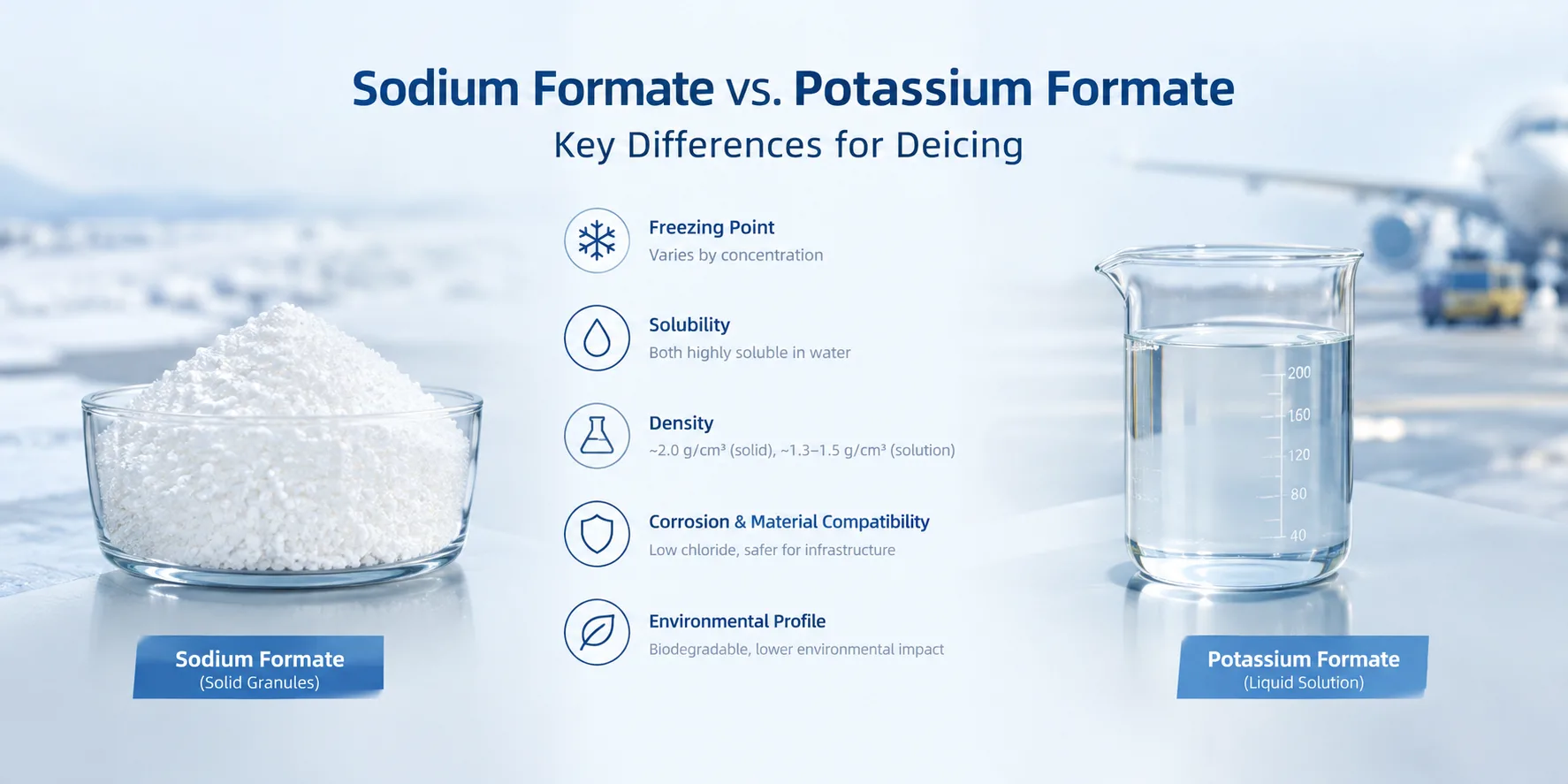
Sodium Formate vs. Potassium Formate: How to Select a Deicing Agent
Choosing a deicing chemical is not simply a matter of finding the lowest price per ton. For airport operators, infrastructure contractors, and chemical distributors, the decision also affects storage, handling, equipment compatibility, and winter operating costs.
Sodium formate and potassium formate are two formate-based chemicals used in industrial applications, including certain deicing formulations. Although they share the same formate ion, their commercial forms, concentrations, and handling requirements can differ significantly.
The most suitable option depends on the application, operating temperature, equipment, product specifications, and applicable approval requirements.
1. Understanding Sodium Formate and Potassium Formate
Sodium formate (CAS 141-53-7) has the chemical formula HCOONa. It is commonly supplied as a white crystalline powder or granules. Solid grades can suit operations that use dry materials or prepare solutions on site.
Potassium formate (CAS 590-29-4), with the formula HCOOK, can be supplied as a solid or an aqueous solution. Concentrated liquid grades may be convenient for facilities equipped with storage tanks, pumps, and metered dosing systems.
Both chemicals contain no chloride as an intended active ingredient. However, this does not automatically make every commercial grade non-corrosive or suitable for every environment.
Buyers should distinguish between a raw chemical and a formulated deicer that has been tested and approved for a specific application.
2. Solid or Liquid: Which Form Fits Your Operation?
The physical form of a chemical can influence its total operating cost as much as its purchase price.
When sodium formate may be a practical choice
Sodium formate in solid form may suit buyers who:
- Use dry spreading equipment or prepare solutions at their facilities.
- Prefer to transport a concentrated solid rather than ship additional water.
- Have suitable dry storage and material-handling equipment.
- Need a solid chemical for industrial distribution or further formulation.
The actual suitability depends on particle size, moisture content, purity, and the requirements of the intended application.
When potassium formate solution may be preferable
A potassium formate solution may be worth considering when an operation:
- Already uses liquid storage tanks and dosing equipment.
- Wants to avoid dissolving solid material on site.
- Requires a specified concentration and predictable liquid-handling properties.
- Can manage storage temperatures and potential crystallization.
A concentrated solution may simplify dosing, but its water content increases the amount of material transported for each kilogram of active salt. Buyers should therefore compare equivalent quantities of active chemical rather than comparing quoted prices per ton alone.
Solid potassium formate may also be an option when a buyer needs the potassium salt but prefers solid logistics.
3. Compare Technical Specifications Before Ordering
Product names alone are insufficient for a reliable procurement decision. Buyers should request a current Technical Data Sheet (TDS) and Certificate of Analysis (COA) for the exact grade being quoted.
Key comparison points include:
Assay and purity: Confirm the stated concentration and test method. Do not assume that different suppliers use identical specifications.
Moisture and impurities: Check moisture content for solids and relevant impurity limits for both solid and liquid products. Chloride limits may be particularly important for sensitive applications.
Density and pH: For liquid potassium formate, confirm density at a specified temperature and pH at a specified concentration. Values from different grades are not necessarily interchangeable.
Solubility and crystallization: Review the temperature-dependent solubility of solid products and the storage or crystallization conditions of concentrated solutions.
Packaging and storage: Confirm bag or bulk packaging for solids, and suitable drums, intermediate bulk containers, or bulk transport arrangements for liquids. Actual availability depends on the supplier and grade.
These details help determine whether a product can be handled safely and consistently within the buyer's existing operating system.
4. Chloride-Free Does Not Mean Risk-Free
Formate-based products may be considered where chloride-based chemicals are undesirable. Nevertheless, the absence of chloride as an intended ingredient does not establish that a product has zero corrosion risk or negligible environmental impact.
Corrosion behaviour can depend on concentration, exposure duration, temperature, substrate material, impurities, and the complete formulation. Environmental performance also depends on application rates, drainage, local conditions, and discharge requirements.
Before selecting a deicer for an airport, bridge, vehicle-related facility, or other sensitive infrastructure, buyers should review relevant material-compatibility and corrosion-test data.
For aviation applications, procurement teams must verify that the actual product and formulation meet the applicable requirements. A commodity raw material should not be assumed to satisfy an airport's operational or qualification standards simply because it is a formate salt.
5. How to Compare the Real Cost of Each Product
A fair initial comparison calculates the cost per kilogram of active chemical.
Use the following formula:
Cost per kg of active salt = Delivered product price ÷ (Product mass × Assay fraction)
Consider a hypothetical comparison between one metric ton of a 96% solid product and a 75% potassium formate solution.
- One metric ton of 96% solid contains 960 kg of active salt.
- One metric ton of 75% solution contains 750 kg of active salt.
- To obtain 960 kg of active salt from a 75% solution, a buyer needs approximately 1,280 kg of solution.
These figures illustrate the calculation method; they are not market prices or a claim that the two products provide identical field performance.
The final comparison should also include freight, packaging, storage, handling, solution preparation, equipment requirements, and replenishment frequency. Where reliable performance data are available, comparing cost per treated area under equivalent operating conditions can provide a more useful result than comparing chemical cost alone.
6. A Practical Selection Checklist for B2B Buyers
Before requesting a quotation, define the following requirements:
- Application: Specify whether the product is intended for airport pavement, roads, bridges, industrial use, or further formulation.
- Operating conditions: State the expected temperature range, precipitation conditions, and required treatment performance.
- Product form: Identify whether solid material or liquid solution is compatible with the existing equipment.
- Technical specification: Confirm assay, moisture, impurities, particle size where relevant, density, pH, and storage conditions.
- Compliance: Identify applicable approval standards, material-compatibility requirements, and environmental restrictions.
- Logistics: Specify the required quantity, packaging, destination, delivery terms, and storage capabilities.
- Documentation: Request the TDS, lot-specific COA, Safety Data Sheet (SDS), and relevant performance-test reports.
Providing these details at the quotation stage helps suppliers recommend an appropriate grade and reduces the risk of comparing products with different specifications.
7. Making a Better Purchasing Decision
Sodium formate and potassium formate should not be ranked by price or chemical name alone. Solid sodium formate may fit operations that favour concentrated solid handling, while potassium formate solution may suit facilities designed for liquid dosing.
Neither choice is universally superior. The decision should follow the actual application, verified technical specifications, operating conditions, compliance requirements, and total delivered cost.
For a product-level comparison, buyers can review this technical guide to sodium formate and potassium formate for deicing, which discusses product forms, specification checks, and purchasing considerations.
The most reliable procurement process starts with a defined application and comparable technical data—not a price-per-ton figure in isolation.