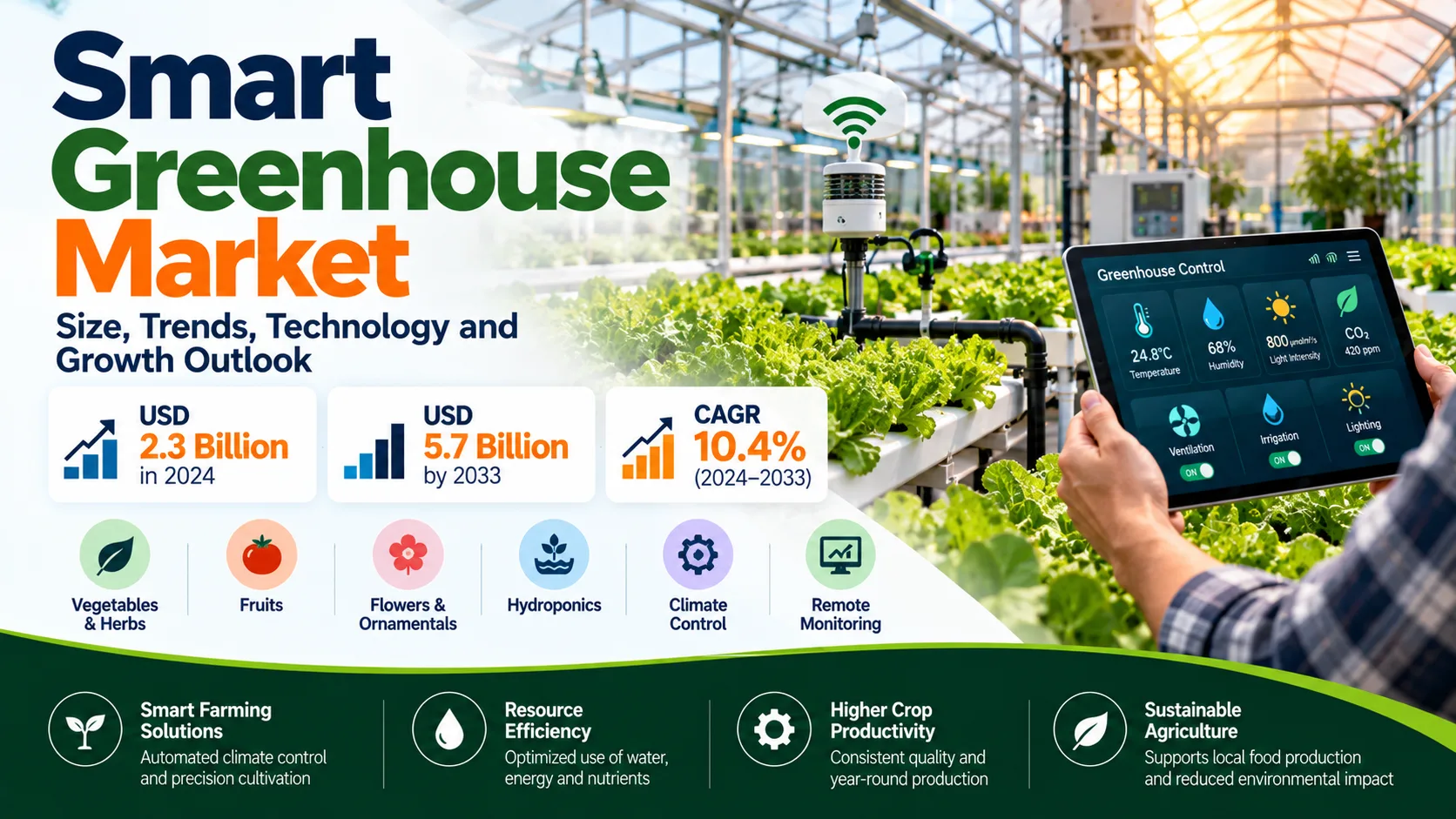
The Smart Greenhouse Market is expanding as growers adopt automation, sensors, artificial intelligence, connected controls, and precision agriculture technologies to improve crop production. Smart greenhouses create controlled growing environments where temperature, humidity, lighting, irrigation, carbon dioxide levels, and plant health can be monitored and adjusted with limited manual intervention.
The market was valued at USD 2.3 billion in 2024 and is projected to reach USD 5.7 billion by 2033, expanding at a CAGR of 10.4%. Rising demand for sustainable farming, year-round crop production, resource efficiency, locally grown food, and advanced controlled environment agriculture is supporting market development.
Smart greenhouse systems are increasingly combining IoT sensors, AI, machine learning, smart lighting, hydroponics, climate controls, and farm management software. These technologies help growers improve yield consistency while reducing water, energy, and labor requirements.
What Is the Smart Greenhouse Market?
A smart greenhouse is an advanced greenhouse equipped with automated systems that monitor and manage growing conditions. Sensors continuously measure environmental factors such as temperature, humidity, soil moisture, carbon dioxide, and light intensity.
Connected control systems can respond to these measurements by adjusting ventilation, irrigation, lighting, heating, and other equipment. This allows growers to maintain more consistent growing conditions while reducing the need for continuous manual monitoring.
The market includes hydroponic and non-hydroponic greenhouse systems along with hardware, software, and services. Important components include HVAC systems, LED grow lights, irrigation equipment, valves and pumps, and sensor and control systems.
Why Is the Smart Greenhouse Market Growing?
Rising Demand for Sustainable Agriculture
Agricultural producers are under increasing pressure to improve productivity while using water, land, energy, and other resources more efficiently.
Smart greenhouses support precision irrigation, controlled nutrient delivery, environmental monitoring, and automated climate management. These capabilities can help reduce unnecessary resource consumption while maintaining crop quality and production consistency.
Technology Adoption
Artificial intelligence, IoT, machine learning, and automation are becoming increasingly important in greenhouse operations. These technologies can analyze environmental and crop data to support faster decisions and automate routine processes.
AI and machine learning can also support disease prediction, resource optimization, and automated adjustments to growing conditions.
Growing Demand for Year-Round Produce
Consumers increasingly expect access to fresh vegetables, herbs, fruits, and other produce throughout the year.
Smart greenhouses allow growers to reduce dependence on outdoor weather conditions and seasonal production cycles. This makes controlled environment agriculture especially relevant in urban areas and regions facing climate uncertainty.
Get a Free Sample of the Smart Greenhouse Market Report
Growers, agritech companies, investors, technology providers, and other stakeholders can review the sample report for additional insights into market size, technology adoption, segmentation, regional performance, and competitive developments.
https://dimensionmarketresearch.com/request-sample/smart-greenhouse-market/
Key Trends Shaping the Smart Greenhouse Market
AI and Machine Learning Integration
AI is increasingly being integrated into greenhouse management platforms to analyze growing conditions and support automated decisions.
Machine learning tools can help identify crop stress, predict disease risks, optimize resource consumption, and improve cultivation schedules. These capabilities are making greenhouse management more data-driven and proactive.
Smart Sensors and Remote Monitoring
Connected sensor networks allow growers to monitor temperature, humidity, moisture, lighting, and plant conditions in real time.
Remote monitoring platforms can provide access through cloud-based systems or mobile applications, allowing operators to manage greenhouse conditions even when they are not physically present at the facility.
Renewable Energy Integration
Solar panels, wind energy, energy storage, and efficient lighting systems are increasingly being considered in smart greenhouse projects.
Reducing energy costs is important because heating, cooling, ventilation, and artificial lighting can represent significant operating expenses. Renewable energy integration can improve both sustainability and long-term operating efficiency.
Major Applications of Smart Greenhouses
Automated climate control helps maintain appropriate temperature, humidity, and carbon dioxide levels throughout the growing cycle.
Precision irrigation uses soil moisture and environmental information to optimize watering schedules and reduce over-irrigation.
Smart lighting allows growers to control light intensity and timing according to crop requirements.
Remote management enables greenhouse operators to monitor environmental conditions and control systems from digital platforms.
Hydroponic production combines smart greenhouse technology with soilless cultivation to improve water and nutrient management while supporting high-density crop production.
Key Factors Driving Market Growth
Climate instability is encouraging producers to look for cultivation systems that provide greater control over growing conditions. Smart greenhouses can reduce exposure to extreme temperatures, irregular rainfall, and changing seasonal patterns.
Labor availability is another factor. Automated irrigation, climate control, lighting, and monitoring systems can reduce the amount of repetitive manual work required in large commercial facilities.
The demand for locally grown and pesticide-conscious food is also contributing to adoption. Urban agriculture and controlled environment farming can shorten supply chains and support production closer to consumers.
Government support and private investment in agricultural innovation are further encouraging smart farming adoption in several markets.
Market Segmentation
The market is segmented by type, offering, component, and end user.
By Type
Major types include:
- Hydroponic
- Non-Hydroponic
Hydroponic systems are expected to lead the market, supported by their ability to produce crops in controlled environments while using less space and enabling precise nutrient delivery.
Non-hydroponic smart greenhouses remain important for growers who want to combine conventional cultivation with automation, sensors, and smart environmental controls.
By Offering
The market includes:
- Hardware
- Software
- Services
Hardware was expected to lead in 2024, driven by demand for sensors, actuators, climate control equipment, lighting, and other physical infrastructure required to create automated greenhouse environments.
Software supports data analytics, remote monitoring, crop management, and automated control, while services include installation, integration, maintenance, and technical support.
By Component
Major components include:
- HVAC Systems
- LED Grow Lights
- Irrigation Systems
- Valves and Pumps
- Sensor and Control Systems
- Other Components
HVAC systems are particularly important because temperature and humidity management directly influence crop health, yield consistency, and growing conditions.
By End User
Key end users include:
- Commercial Growers
- Research and Educational Institutes
- Retail Gardens
- Others
Commercial growers are expected to hold the largest revenue share because they benefit from improved productivity, resource efficiency, crop quality, and year-round cultivation.
Regional Outlook
North America accounted for approximately 46.4% of market revenue in 2024, making it the leading region. Strong technology infrastructure, precision agriculture adoption, demand for locally produced food, and government support for sustainable farming contribute to regional growth.
The United States Smart Greenhouse Market was projected at USD 1.0 billion in 2024, supported by investment in precision farming, AI, IoT, renewable energy integration, and controlled environment agriculture.
Asia Pacific is expected to gain importance during the forecast period due to urbanization, population growth, food security requirements, government incentives, and rapid adoption of smart farming technologies.
Europe remains an important smart greenhouse market because of its established horticulture sector, advanced agricultural technologies, sustainability policies, and extensive use of controlled environment agriculture.
Key Challenges
High initial investment is one of the most significant barriers to adoption. Smart greenhouse projects can require substantial spending on sensors, automation equipment, LED lighting, climate controls, software, and renewable energy systems.
Technical complexity is another challenge. Integrating multiple systems requires expertise in agriculture, automation, data management, environmental control, and equipment maintenance.
Smaller farms may find it difficult to justify advanced installations unless productivity improvements and resource savings provide a clear return on investment.
Future Outlook
The Smart Greenhouse Market is expected to become increasingly connected, automated, and data-driven.
AI-based decision support, machine learning, smart sensors, cloud platforms, robotics, renewable energy, hydroponics, and vertical farming are likely to play larger roles in future greenhouse operations. Integration with vertical farming can also help improve land utilization in densely populated urban areas.
With the market projected to increase from USD 2.3 billion in 2024 to USD 5.7 billion by 2033, smart greenhouse technologies are positioned to become an increasingly important part of controlled environment agriculture and resource-efficient food production.
Explore the Complete Smart Greenhouse Market Analysis
The complete report provides deeper insights into market size, greenhouse types, hardware and software offerings, component demand, end users, regional opportunities, technology developments, and competitive activity.
https://dimensionmarketresearch.com/checkout/smart-greenhouse-market/
Frequently Asked Questions
1. What is the Smart Greenhouse Market?
It includes automated greenhouse systems that use sensors, software, climate controls, irrigation technologies, lighting, and connected devices to optimize plant-growing conditions.
2. What is driving the Smart Greenhouse Market growth?
Growth is supported by sustainable farming, demand for year-round food production, AI and IoT adoption, precision agriculture, resource efficiency, and controlled environment farming.
3. What are the major applications of smart greenhouses?
Major applications include automated climate control, precision irrigation, smart lighting, hydroponic cultivation, remote monitoring, crop management, and resource optimization.
4. Which regions or segments are important in the Smart Greenhouse Market?
North America held approximately 46.4% of revenue in 2024. Hydroponics, hardware, and commercial growers are identified as leading market segments.
5. What is the future outlook for the Smart Greenhouse Market?
The market is projected to reach USD 5.7 billion by 2033, supported by AI, machine learning, smart sensors, renewable energy, hydroponics, automation, and vertical farming.
Conclusion
The Smart Greenhouse Market is transforming controlled environment agriculture by combining plant science with automation, data, sensors, and intelligent environmental management. These technologies help growers improve crop quality, stabilize production, and use water, energy, and labor more efficiently.
Future development will increasingly focus on intelligent automation, renewable energy integration, remote management, hydroponics, and data-driven crop optimization. These capabilities are likely to strengthen the role of smart greenhouses in modern agricultural production.