You have arrived in Havelock Island, watched the turquoise waves roll onto the beach and decided that you want to see what lies beneath them. But one question remains: which scuba diving experience should you choose?
For first-time visitors, that decision can be surprisingly confusing. Shore diving, boat diving, introductory programs and certification courses may sound similar, but they offer very different experiences.
The good news is that Havelock Island has options for people with different interests and experience levels. Some introductory programs can even accommodate eligible participants who do not know how to swim.
This guide explains how to choose an appropriate dive, what non-swimmers should understand and how to prepare for an enjoyable underwater adventure.
Why Havelock Island Is a Popular Diving Destination
Havelock Island, officially called Swaraj Dweep, is one of the established scuba diving destinations in the Andaman and Nicobar Islands.
The surrounding waters contain coral reef habitats, tropical fish and varied underwater landscapes.
One of the island's advantages is its range of diving locations. Some can be accessed directly from the shore, while others require a boat journey.
For travellers researching Scuba Diving in Havelock Island, understanding these different experiences is a useful first step.
A beginner interested in seeing reef fish may prefer a supervised shore dive, while someone seeking a different underwater environment might consider an appropriate boat diving program.
The ideal choice is not necessarily the deepest or most expensive dive. It is the one that matches your qualifications, comfort level and the day's sea conditions.
Shore Diving vs Boat Diving: Which Experience Makes Sense?
Shore Diving: A Gradual Introduction
Shore diving begins from a beach or another suitable coastal entry point.
At Nemo Reef, one of Havelock Island's popular beginner diving locations, participants can enter the water from the shoreline after completing their safety briefing and initial training.
This approach can be particularly appealing to nervous first-time divers because it avoids a boat journey and provides a gradual introduction to scuba equipment.
However, a shore entry does not eliminate the risks associated with scuba diving. Medical screening, professional supervision and appropriate training remain essential.
Boat Diving: Exploring Another Underwater Environment
Boat diving involves travelling to a selected site away from the immediate shoreline.
Locations around Havelock Island, including Tribe Gate, offer diving opportunities under suitable environmental conditions.
Depending on the program, participants may explore different coral formations and marine habitats.
Boat diving requires additional planning, including travel arrangements, entry procedures and consideration of changing sea conditions.
Some boat diving programs accommodate beginners, while others require recognised certification.
The diving professional should determine whether a particular site is appropriate for each participant.
Can You Go Scuba Diving If You Cannot Swim?
One of the biggest misconceptions about scuba diving is that every participant must already be a confident swimmer.
The reality is more nuanced.
Certain introductory scuba programs accept non-swimmers who meet the required medical, safety and water-comfort criteria.
These experiences involve direct professional supervision rather than independent underwater exploration.
According to Scuba Diving for Non-Swimmers and Beginners, introductory participants should feel comfortable in the water and be able to maintain themselves at the surface.
This distinction is important. An introductory experience is not the same as becoming a certified scuba diver.
A full PADI Open Water Diver course includes swimming and water-survival requirements.
Travellers who want to understand the available options can explore Scuba Diving for Non-Swimmers and Beginners, including shore-entry experiences and selected introductory boat diving programs around Havelock Island.
What First-Time Divers Should Expect
Knowing the process in advance can help beginners approach their first underwater experience with realistic expectations.
1. Medical Screening and Safety Briefing
Before participating, you complete the required medical questionnaire.
Your diving professional explains the program, safety procedures and equipment.
Certain medical conditions may require clearance from an appropriately qualified medical professional.
2. Learning to Breathe Through Scuba Equipment
Breathing underwater feels different from breathing normally on land.
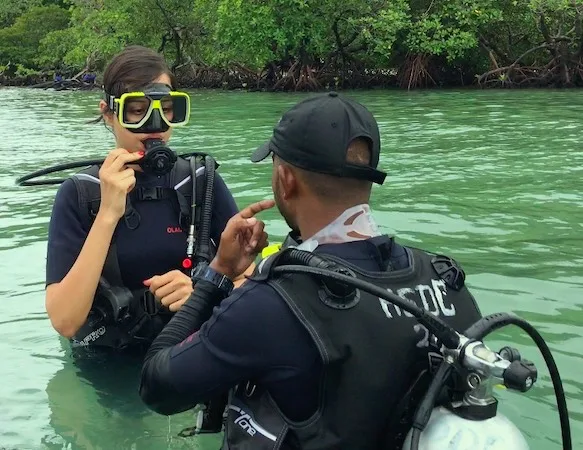
Participants learn how to use a regulator, breathe continuously and communicate through hand signals.
They also learn how to respond if they feel uncomfortable.
3. Practising Essential Skills
Before proceeding with an open-water dive, participants complete the required skills practice.
This may include breathing, regulator procedures, mask skills and basic underwater communication.
The professional assesses whether the participant is ready to continue.
4. Exploring the Underwater Environment
After completing the necessary preparation, eligible participants can begin their supervised underwater exploration.
The aim is to observe the surroundings, maintain comfort and follow professional guidance.
A successful first dive does not need to involve considerable depth.
Even relatively shallow reef environments can offer rewarding opportunities to observe marine life.
What Marine Life Can You See Around Havelock?
The underwater ecosystems surrounding Havelock Island support many kinds of marine organisms.
Depending on the site and conditions, divers may encounter clownfish, butterflyfish, angelfish, parrotfish and other tropical reef species.
Coral formations also provide habitats and shelter for marine life.
However, wildlife encounters are unpredictable, and visibility can change throughout the day.
Responsible diving means observing without interfering.
Avoid touching coral, chasing marine animals or collecting objects from the seabed.
Protecting these ecosystems helps preserve the natural environment that makes diving around Havelock so appealing.
Five Questions to Ask Before Booking
Instead of choosing a package based on photographs or advertised depth alone, ask the diving centre these practical questions.
1. Is this program appropriate for my experience level?
Explain whether you have previously tried scuba diving and describe your comfort in the water.
2. What training is included?
Confirm the safety briefing, practical skills session and supervision arrangements.
3. Where will the dive take place?
Ask whether the experience involves shore entry or boat transport and how weather may affect the planned location.
4. What is included in the price?
Check whether equipment, transportation, photographs, videos and other services are included.
5. What happens if the sea conditions are unsuitable?
Understand the rescheduling and cancellation policy before making a payment.
These questions can help you compare programs based on suitability and value rather than promotional claims.
When Should You Schedule Your Dive?
October to May is generally a favourable period for many scuba diving activities around Havelock Island.
However, seasonal expectations cannot guarantee good conditions on a particular day.
Wind, currents, rainfall and underwater visibility may influence whether a planned site can be used.
Travellers should also consider their onward flight schedule.
The Divers Alert Network's flying-after-diving guidelines recommend at least 12 hours before flying after a single no-decompression dive and at least 18 hours after multiple dives, with longer intervals required in some circumstances.
Follow your dive professional's advice and allow extra time when appropriate.
Frequently Asked Questions
Is Havelock Island suitable for beginner scuba diving?
Yes. Havelock Island offers introductory programs at suitable sites, including supervised shore diving at Nemo Reef.
Can non-swimmers participate in scuba diving in Andaman?
Certain introductory experiences may accept eligible non-swimmers. Participants must meet medical and water-comfort requirements and complete the necessary safety preparation.
Do I need a PADI certificate for my first scuba dive?
No. Certain introductory diving programs do not require previous certification. More advanced recreational diving activities generally require appropriate training and certification.
Is shore diving better than boat diving for beginners?
Shore diving can provide a gradual introduction, but the better option depends on individual comfort, program requirements and environmental conditions.
What if I feel nervous underwater?
Communicate immediately with your diving professional using the signals taught during training. You should never feel pressured to continue if you are uncomfortable.
Can couples experience scuba diving together?
Yes. Couples may book suitable introductory diving programs, provided both participants independently meet the applicable medical and safety requirements.
Final Thoughts
Havelock Island offers more than beautiful beaches. Its surrounding underwater environments provide opportunities for visitors to discover coral reefs, observe tropical marine life and experience scuba diving for the first time.
For beginners and non-swimmers, choosing the right program is far more important than selecting the deepest dive.
Understand your options, ask about safety procedures and choose an experience that matches your abilities.
With professional guidance and careful preparation, your first underwater adventure can become a memorable part of your Andaman holiday.