Market Overview
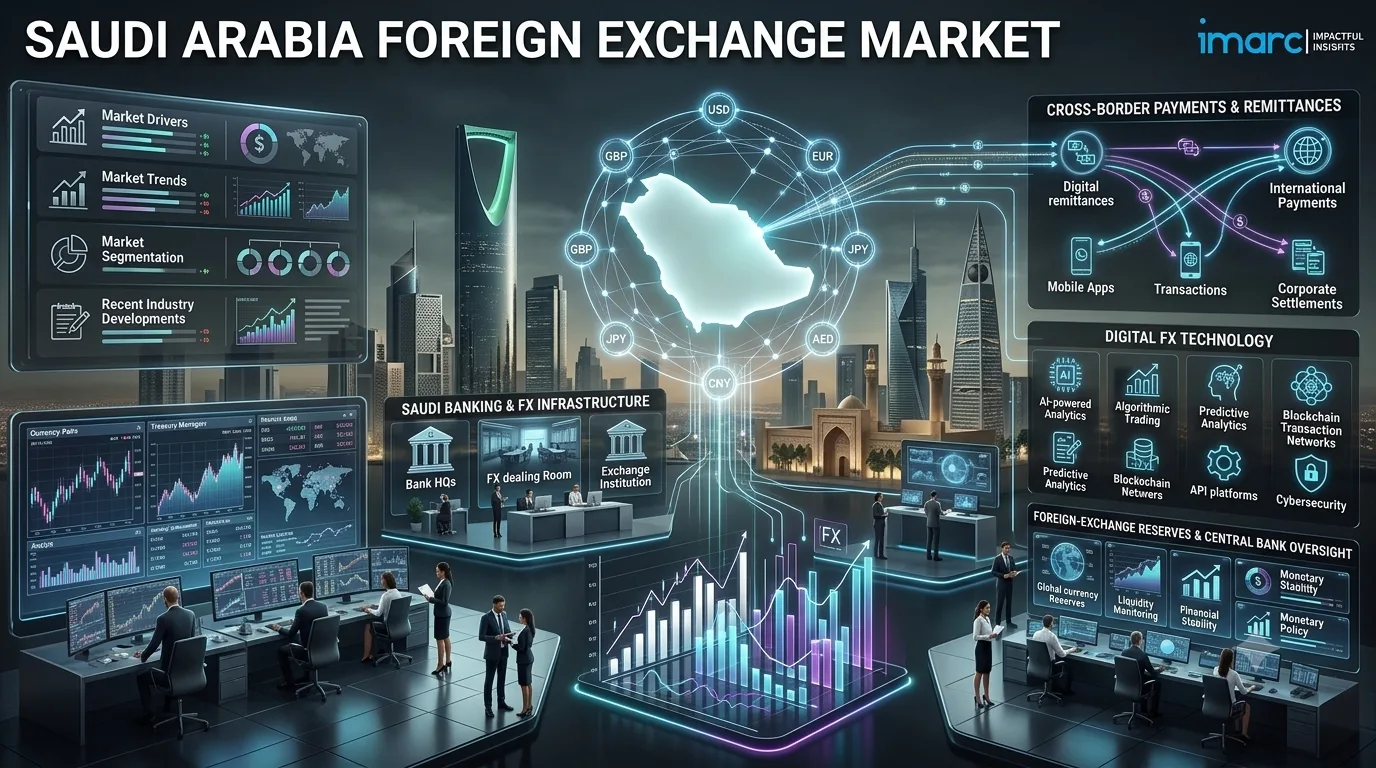
The Saudi Arabia foreign exchange market size increased from USD 6.5 Billion in 2025 to USD 6.8 Billion in 2026. Looking forward, IMARC Group expects the market to reach USD 10.4 Billion by 2034, exhibiting a growth rate (CAGR) of 5.35% during 2026-2034. Growth is being driven by rising adoption of automated and algorithmic trading systems, expanding use of AI-based trading tools, and an evolving regulatory landscape that is encouraging deeper participation from banks, corporates, and institutional investors. The Kingdom's continued push to diversify its economy away from oil under Vision 2030, alongside greater integration with global capital markets and rising cross-border trade and investment flows, is further widening the scope for currency hedging, swaps, and forward transactions across the domestic financial system.
How AI is Reshaping the Future of Saudi Arabia Foreign Exchange Market:
- AI-powered algorithmic trading platforms are enabling banks and brokerages to execute currency trades at speed and scale, helping desks capture pricing inefficiencies while reducing manual intervention in routine trade execution.
- Machine learning-based risk and forecasting models are helping treasury teams and financial institutions anticipate currency movements more accurately, supporting better-informed hedging and liquidity management decisions.
- AI-driven fraud detection and compliance monitoring tools are being deployed across trading desks and payment networks to flag irregular transaction patterns in real time, strengthening oversight as trading volumes rise.
- Robo-advisory and automated trading robots are lowering the barrier to entry for smaller institutional and retail participants, broadening access to currency markets that were previously dominated by large banks and dealers.
Grab a sample PDF of this report: https://www.imarcgroup.com/saudi-arabia-foreign-exchange-market/requestsample
Market Growth Factors
Broader global economic conditions are continuing to shape the trajectory of Saudi Arabia's foreign exchange market. Episodes of financial-market uncertainty, shifting global inflation trends, and geopolitical tension are steering foreign investors toward safe-haven positioning, which in turn affects demand for the Riyal and prompts periodic central bank intervention to preserve currency stability. Since global economic cycles also drive oil demand, swings in worldwide growth expectations continue to flow through to the Kingdom's foreign exchange reserves and trading activity.
Regional geopolitical dynamics are also weighing on market sentiment, with tensions involving neighboring states periodically triggering shifts in investor risk appetite and short-term currency volatility. At the same time, Saudi Arabia's evolving diplomatic and trade relationships with major global powers continue to influence capital flows into and out of the Kingdom, adding another layer of sensitivity to Riyal demand.
Rising foreign direct investment inflows tied to Vision 2030 reforms are supporting sustained activity in the foreign exchange market. Continued regulatory easing, streamlined business registration, and new incentives for international investors are encouraging greater capital inflows, which is lifting demand for the Riyal, while any slowdown in FDI momentum could weigh on liquidity and put downward pressure on the currency.
Market Segmentation
IMARC Group provides an analysis of the key trends in each segment of the market, along with forecasts at the country level. The market has been categorized based on counterparty and type.
Counterparty Insights:
- Reporting Dealers
- Non-financial Customers
- Others
Type Insights:
- Currency Swap
- Outright Forward and FX Swaps
- FX Options
Regional Insights:
- Northern and Central Region — largest market, anchored by Riyadh
- Western Region
- Eastern Region
- Southern Region
Key Players:
The market exhibits competitive intensity with domestic commercial banks, regional forex brokerages, and international financial institutions competing across counterparty and product segments. Some of the key players active in the market include Saudi National Bank, Al Rajhi Bank, Saudi Awwal Bank (SAB), Riyad Bank, Banque Saudi Fransi, Arab National Bank, and Bank Aljazira, alongside global payment and remittance networks such as MoneyGram that are expanding their currency-exchange and cross-border payment reach through partnerships in the Kingdom.
Recent Development & News
- September 2025: MoneyGram, a leading global payment network, signed a memorandum of understanding with Enjaz Payment Services, one of Saudi Arabia's largest remittance-focused fintech firms, with the partnership unveiled at the first edition of Money20/20 Middle East.
- August 2025: The Saudi Exchange (Tadawul) proposed a set of rule changes aimed at broadening investor access to its Parallel Market, including redefined qualified-investor criteria and relaxed listing requirements, opening the changes for public review.
- May 2025: AstroLabs, a leading business growth platform in the Gulf, partnered with Saudi Awwal Bank (SAB) to support fast-growing companies entering and scaling operations in the Kingdom, reinforcing efforts to lift private-sector participation in the economy.
If you require any specific information that is not covered currently within the scope of the report, we will provide the same as a part of the customization.
About Us
IMARC Group is a global management consulting firm that helps the world's most ambitious changemakers to create a lasting impact. The company provides a comprehensive suite of market entry and expansion services. IMARC offerings include thorough market assessment, feasibility studies, company incorporation assistance, factory setup support, regulatory approvals and licensing navigation, branding, marketing and sales strategies, competitive landscape and benchmarking analyses, pricing and cost research, and procurement research.
Contact Us
IMARC Group,
134 N 4th St. Brooklyn, NY 11249, USA,
Email: [email protected],
Tel No: (D) +91 120 433 0800,
United States: +1-201971-6302