For most procurement teams, an RFP means weeks of chasing. Requirements get written in a hurry, the document goes out over email, vendors reply in ten different formats, and the comparison ends up in a spreadsheet that only one person understands. By the time a decision is made, nobody is fully sure why one vendor won over another.
It does not have to be this hard. A Request for Proposal (RFP) is simply a structured way of asking vendors to show how they would solve your problem, at what price and with what risk. When the process is clear and the tools are right, it becomes one of the most valuable things a procurement team can do.
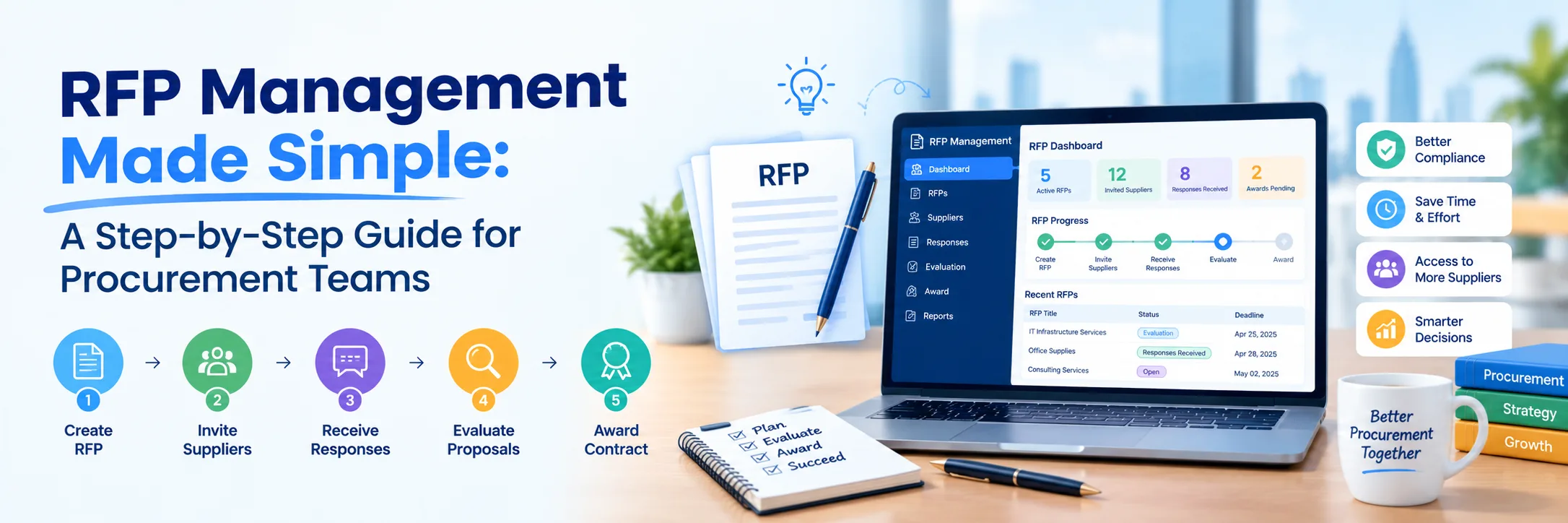
This guide walks you through RFP management step by step, from deciding whether you need one to awarding the contract, and shows how RFP management software can take the manual work out.
What Is an RFP?
An RFP, or Request for Proposal, is a formal document sent to potential vendors that explains what you need and asks them to propose a solution, a price and their terms. It is typically used for complex or high-value purchases where price alone cannot decide the outcome, such as software, construction packages, facility services, large equipment or long-term supply contracts.
RFP vs RFQ vs RFI
These three terms are often mixed up:
DocumentFull formWhen to use itRFIRequest for InformationEarly stage, to understand the market and what vendors can offerRFQRequest for QuotationWhen specifications are fixed and you mainly need price comparisonRFPRequest for ProposalWhen you need vendors to propose a solution, approach and priceA common sequence is RFI to shortlist vendors, then RFP to evaluate solutions, then negotiation and contract. For simple, standard items, a plain RFQ is enough.
When Should You Issue an RFP?
Issue an RFP when:
- The purchase is high in value or strategic importance
- Requirements are complex and multiple solutions are possible
- You need to compare approach, quality, timeline and risk, not just price
- Internal policy or client rules require a competitive, documented process
- You want a defensible record of why a vendor was selected
Skip the RFP and use a quotation or rate contract when the item is standard, the specification is fixed and the value is modest.
The RFP Process: 8 Steps
Step 1: Define the need and set objectives
Start with the business problem, not the solution. What are you trying to achieve? What does success look like in numbers (cost, time, quality, compliance)? Involve the teams who will actually use the outcome, whether that is projects, operations, finance or IT.
Step 2: Gather and prioritise requirements
List requirements and separate them into must-have, should-have and nice-to-have. Be specific. "Fast delivery" is vague. "Delivery within 14 days of PO at all three sites" can be evaluated. Clear priorities also make scoring much easier later.
Step 3: Write the RFP document
A good RFP usually includes:
- Introduction and company background
- Project overview and objectives
- Scope of work and detailed requirements
- Technical and compliance requirements (GST, statutory registrations, certifications, safety norms)
- Vendor eligibility criteria (experience, turnover, references)
- Response format and pricing template so every vendor answers in the same structure
- Evaluation criteria and weightage
- Timeline (query deadline, submission deadline, presentations, decision date)
- Commercial terms (payment terms, penalties, warranty, validity)
- Contact person and submission instructions
Publish your evaluation criteria in the document. Vendors then focus on what matters to you, and the process stays transparent.
Step 4: Build the vendor shortlist
Select vendors from your approved vendor master based on category, past performance, compliance status and capacity. Add new vendors if needed, but run them through verification first. Three to seven vendors is a practical range for most RFPs.
Step 5: Release the RFP and manage vendor queries
Send the RFP to all vendors at the same time, with the same information. Collect questions through a single channel and share answers with every vendor, so nobody has an unfair advantage. Keep a record of every clarification.
Step 6: Receive and evaluate proposals
Set a clear submission deadline and collect responses in a standard format. Evaluate against a weighted scorecard, ideally with more than one evaluator scoring independently.
A sample weighting might look like this:
CriteriaWeightageTechnical fit and solution quality30%Commercial proposal (price, payment terms)25%Experience and references15%Delivery timeline and capacity15%Compliance and risk10%Support and after-sales5%Adjust weights to your priorities. For a construction package, delivery and safety may carry more weight. For software, technical fit and support may matter most.
Step 7: Shortlist, clarify and negotiate
Invite the top two or three vendors for presentations or clarification meetings. Use the scorecard to focus on gaps, then negotiate on price, terms, timelines and service levels. Competitive tension between finalists is your biggest leverage.
Step 8: Award, document and onboard
Get internal approvals, issue the award with a purchase order or contract, and inform unsuccessful vendors politely. Record the final decision and reasoning. Then move into onboarding, kick-off and performance tracking.
Common RFP Mistakes to Avoid
- Vague requirements: vendors guess, and proposals become impossible to compare.
- Too many or too few vendors: too many creates evaluation overload, too few weakens competition.
- Hidden evaluation criteria: vendors cannot respond to what they cannot see.
- Price-only decisions: the lowest bid often costs more in delays, rework and risk.
- Unstructured responses: without a fixed response and pricing template, comparison becomes manual and error-prone.
- Scattered communication: email and WhatsApp trails create disputes and leave no audit record.
- Single evaluator bias: one person scoring alone invites subjective decisions.
- No post-award review: without feedback, the next RFP repeats the same mistakes.
Why Spreadsheets and Email Fall Short
Manual RFP management usually breaks down in the same places:
- Version confusion when documents are sent and revised over email
- No single view of which vendors have responded, queried or declined
- Manual copy-paste of vendor prices into comparison sheets
- Difficulty collaborating across evaluators
- Weak audit trail for approvals and decisions
- No link between the RFP outcome and the later PO, GRN and invoice
For a team running just one RFP a year, that may be manageable. For teams running many across projects and sites, it becomes a bottleneck and a compliance risk.
Key Features of RFP Management Software
Good RFP management software replaces scattered files with one controlled workflow. Look for:
- RFP and RFQ templates that can be reused and customised by category
- Vendor invitation and portal access so vendors receive, query and respond in one place
- Structured response and pricing formats to enable like-for-like comparison
- Q&A management with answers shared to all vendors
- Side-by-side comparison of technical and commercial responses
- Weighted scoring and multi-evaluator input
- Approval workflow for award decisions
- Audit trail with time-stamped actions and documents
- Seamless conversion to purchase order once a vendor is selected
- Integration with vendor management, GRN and accounts payable
- Reports and analytics on savings, cycle time and vendor participation
- AI-assisted intake to convert emailed or PDF responses into structured data
Benefits You Can Measure
Teams that move RFP management into a proper system usually track improvements in:
- RFP cycle time: from requirement to award
- Cost savings: difference between initial and final awarded price
- Vendor participation rate: more qualified responses per RFP
- Evaluation consistency: scoring based on agreed criteria rather than opinions
- Compliance and audit readiness: every decision is documented
- Team productivity: fewer hours spent chasing responses and building comparison sheets
Set baselines before you start so you can show the improvement later.
A Simple RFP Checklist
Before you send out your next RFP, check that you have:
- A clearly stated objective and success measures
- Must-have, should-have and nice-to-have requirements
- A standard response and pricing template
- Published evaluation criteria with weightage
- A vendor shortlist from verified vendors
- A clear timeline with query and submission deadlines
- Named evaluators and a scoring method
- An approval path for the award decision
- A plan for post-award onboarding and review
How ZYNO Procurement Simplifies RFP Management
ZYNO Procurement by EliteMindz brings RFP and quotation management into the same platform as purchase requests, vendor management, purchase orders, GRN, invoice processing and accounts payable. Teams can invite vendors, collect responses in a standard format, compare proposals side by side and move the winning vendor straight into a purchase order, without rekeying data or losing the audit trail.
With ZYNO AI Intake, proposals and quotations that arrive as emails or PDFs can be converted into structured records, which reduces manual entry and speeds up evaluation. And because it is part of the wider ZYNO ecosystem, including Construction ERP and other enterprise modules, RFP decisions stay connected to projects, budgets and finance.
Want to see how it works for your RFPs? Book a demo with the EliteMindz team and walk through your own process.
Frequently Asked Questions
What is RFP management?
It is the end-to-end process of planning, issuing, collecting, evaluating and awarding vendor proposals in a structured, documented way. It is often supported by software that standardises templates, responses and scoring.
What is the difference between RFP and RFQ?
An RFQ asks vendors for a price against a fixed specification. An RFP asks vendors to propose a solution, approach and price, and is used when quality, approach and risk matter as much as cost.
How many vendors should receive an RFP?
For most purchases, three to seven qualified vendors is practical. It gives real competition without overloading the evaluation team.
How long should an RFP process take?
It depends on complexity. A straightforward RFP may take two to four weeks. Large or technical RFPs can take two to three months, including clarifications and negotiation.
How should we score RFP responses?
Use a weighted scorecard with criteria agreed before the RFP is released. Have multiple evaluators score independently, then discuss differences before finalising.
Can RFP management software integrate with purchase orders and vendor management?
Yes. The best platforms link RFP outcomes to vendor records, purchase orders, goods receipt and invoice processing, so there is one continuous record from sourcing to payment.
Is RFP software only for large companies?
No. Mid-sized businesses that run regular RFPs across projects or sites benefit significantly, especially when cloud-based tools allow quick, phased rollout.
Final Thoughts
A good RFP is not about creating more paperwork. It is about asking the right questions in a consistent way so that the best vendor, not just the cheapest or the most familiar, wins the work.
Define your needs clearly, publish your criteria, standardise responses, score fairly and keep a clean record. With the right process and the right tools, RFP management becomes simple, faster and far easier to defend.