From Boardrooms to Algorithms: A New Business Paradigm
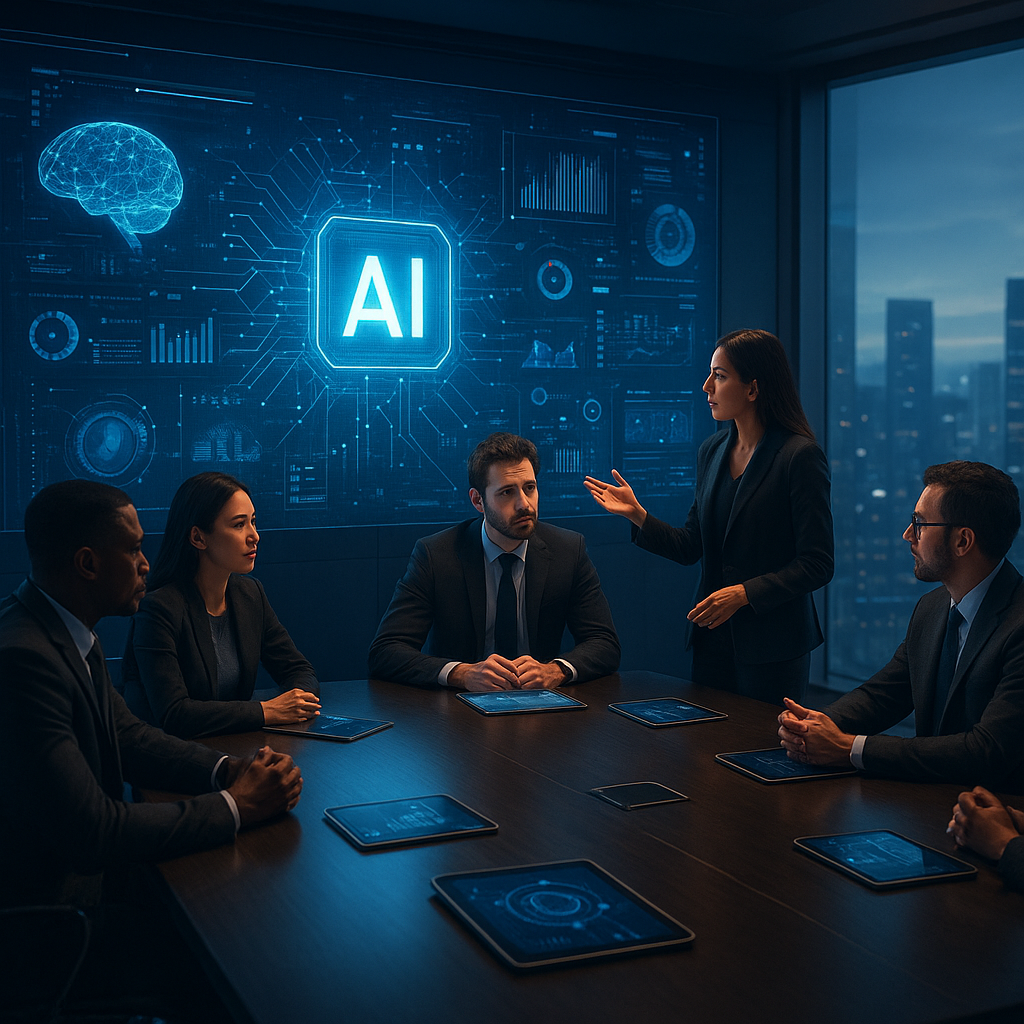
In a bustling conference room at a Fortune 500 company in early 2026, executives gathered around a sleek table, not to discuss quarterly earnings or marketing campaigns, but a new AI-driven initiative promising to revolutionize their entire supply chain. This scene, repeated across industries worldwide, encapsulates the profound transformation artificial intelligence (AI) is imposing on business. Far beyond mere automation, AI now underpins strategic decision-making, customer engagement, product innovation, and operational efficiency at an unprecedented scale.
The commercial landscape in 2026 is marked by AI's integration into core business functions, yielding measurable gains. According to industry reports, companies that have embedded AI into their workflows report a 35% increase in productivity and a 29% boost in profit margins on average. These figures underscore a seismic shift from earlier decades, where AI’s role was largely experimental or supplementary.
As AI technologies evolve, their business impact deepens, challenging traditional models and demanding new strategic approaches. This article explores how AI is reshaping business, tracing its journey, analyzing current trends, and anticipating the future trajectory.
Tracing the Trajectory: How AI Became a Business Imperative
The roots of AI’s influence on business extend back several decades, but the leap from academic concept to corporate necessity accelerated dramatically in the 2010s and 2020s. Early applications focused on rule-based automation, such as robotic process automation (RPA), which streamlined repetitive tasks but offered limited strategic insight.
The breakthrough arrived with machine learning (ML), enabling computers to identify patterns and predict outcomes without explicit programming. This shift, chronicled in TheOmniBuzz’s detailed timeline of AI breakthroughs (Decoding Artificial Intelligence: From Origins to 2026 Breakthroughs), marked a turning point. Businesses harnessed ML for customer segmentation, fraud detection, and demand forecasting with increasing sophistication.
By 2024, the proliferation of large language models (LLMs) and generative AI expanded AI’s domain to creative tasks, natural language understanding, and personalized experiences. These advances coincided with vast improvements in data availability, cloud computing, and AI-specialized hardware, laying the groundwork for the current AI business renaissance.
“The journey from automation to augmentation defines the AI evolution in business — it’s no longer about replacing humans but amplifying their capabilities,” notes Dr. Helena Torres, AI strategist at a leading consultancy.
Core AI Business Applications Driving Transformation
Today, AI’s business applications span an expansive spectrum. While automation remains vital, the emphasis has shifted towards decision intelligence and customer-centric innovation. Key areas include:
- Operational Efficiency and Predictive Analytics: AI-driven analytics enable real-time optimization of supply chains, predictive maintenance of assets, and dynamic pricing strategies. For example, global manufacturer Siemens reported a 25% reduction in downtime after deploying AI-powered predictive maintenance across its factories.
- Customer Experience and Personalization: AI algorithms analyze consumer behavior across channels to tailor marketing, product recommendations, and support. Companies like Amazon and Alibaba have set high bars, with competitors worldwide adopting similar AI-driven personalization engines.
- Product Development and Innovation: Generative AI models assist in rapid prototyping, design generation, and scenario simulation, accelerating innovation cycles. Pharmaceutical firms now routinely use AI to identify promising drug candidates faster than ever before.
- Risk Management and Compliance: AI tools analyze regulatory changes, detect anomalies, and ensure adherence, reducing compliance costs and risks. Financial institutions leverage AI to monitor transactions for fraud and money laundering with greater accuracy.
- Human Resources and Talent Management: AI streamlines recruitment by evaluating candidate fit, predicting employee attrition, and supporting personalized learning and development.
Evidence from multiple sectors confirms these applications are not theoretical but practical engines of growth. A recent survey by McKinsey Global Institute highlights that 60% of companies integrating AI into these domains report significant competitive advantages.
“AI has become the connective tissue linking data, insights, and action across enterprises,” explains Rajiv Malhotra, CTO at a leading AI solutions provider.
2026: A Landmark Year for AI-Driven Business Innovation
The current year marks a turning point where AI’s impact transcends incremental improvements to reshape entire industries. Several developments underline this shift:
- Generative AI Adoption Explodes: In 2026, over 80% of Global 2000 firms have adopted generative AI models in one or more business functions, according to recent industry surveys.
- AI-Enabled Autonomous Systems: From warehouses using AI-guided robotics for inventory management to autonomous delivery vehicles, businesses are deploying AI agents that operate with minimal human oversight.
- Hybrid Human-AI Collaboration Models: Organizations are redesigning workflows to optimize the complementary strengths of humans and AI, boosting creativity and problem-solving.
- Regulatory and Ethical Frameworks Mature: Governments and industry bodies have introduced clearer standards, fostering trust and wider adoption.
- AI-Powered Decision Platforms: Next-generation platforms integrate diverse AI models to support strategic decisions, blending predictive analytics with scenario planning.
These trends align with insights from TheOmniBuzz’s recent comprehensive analysis (Artificial Intelligence in 2026: Advances, Impact, and Future Directions), which highlights AI’s expanding role as a strategic asset rather than merely a technical tool.
Real-World Case Studies: AI Transforming Business at Scale
Examining concrete examples reveals AI’s tangible impact across sectors:
- Healthcare: Moderna’s AI-driven drug discovery platform accelerated vaccine development timelines by 40%, enabling rapid responses to emergent diseases.
- Retail: Walmart’s AI-powered inventory system predicts regional demand fluctuations daily, reducing waste and stockouts by 30%.
- Financial Services: JPMorgan Chase uses AI to analyze legal documents and contracts, cutting review times from weeks to hours, improving compliance and efficiency.
- Manufacturing: Bosch integrates AI-enabled robotics with IoT sensors across plants, achieving a 20% increase in throughput and enhanced quality control.
- Energy: Shell’s AI analytics optimize drilling operations, improving yield predictions and reducing environmental impact.
These cases illustrate AI’s multifaceted contributions—from speeding innovation to enhancing sustainability. They also underscore the importance of organizational readiness and data infrastructure in realizing AI’s full potential.
Expert Perspectives: Navigating Opportunities and Challenges
While AI offers vast opportunities, experts caution against overlooking risks and complexities. Ethical considerations, data privacy, and workforce displacement remain central concerns.
Industry leaders emphasize the necessity of transparent AI governance frameworks that balance innovation with accountability. According to Dr. Mei Lin, AI ethics advisor, “Trust is the currency of AI adoption. Without robust safeguards, businesses risk reputational damage and regulatory penalties.”
Moreover, the human element is crucial. Upskilling employees to work effectively alongside AI systems is imperative. Forward-thinking companies are investing heavily in training programs and fostering cultures that embrace continuous learning and adaptation.
These insights resonate with findings in How Machine Learning Is Redefining Intelligence and Industry in 2026, which stresses the symbiosis between human expertise and AI capabilities as a driver of sustainable competitive advantage.
What Lies Ahead: The Future of AI in Business
Looking forward, several trends will define AI’s ongoing business transformation:
- Explainable and Trustworthy AI: Advances in interpretability will make AI decisions more transparent, facilitating adoption in regulated industries.
- AI-Driven Ecosystems: Businesses will increasingly collaborate across AI-enabled platforms, sharing data and insights to co-create value.
- Custom AI Solutions: Tailored AI applications will proliferate, addressing niche industry challenges with precision.
- Integration with Quantum Computing: As quantum technologies mature, they will amplify AI’s computational power for complex problem-solving.
- Sustainability and Social Impact: AI will play a pivotal role in achieving corporate sustainability goals and addressing societal challenges.
To capitalize on these developments, executives must rethink business models, invest in data and AI infrastructure, and cultivate ethical, inclusive AI cultures.
“The future belongs to organizations that treat AI not as a tool but as a strategic partner in innovation and value creation,” observes Maria Gomez, CEO of an AI consultancy.
In conclusion, AI’s transformation of business is neither a fleeting trend nor a simple upgrade; it is a fundamental redefinition of how companies operate, compete, and create value. As explored here and in related TheOmniBuzz analyses (Rethinking Intelligence: What AI Really Means in 2026), understanding this transformation is vital for leaders seeking to thrive in the AI era.