Artificial intelligence has quickly moved from being a futuristic concept to an everyday business tool. Today, professionals, students, marketers, and entrepreneurs rely on AI to speed up research, improve productivity, and create content faster than ever before. As the number of AI platforms grows, choosing the right one can make a noticeable difference in efficiency and results.
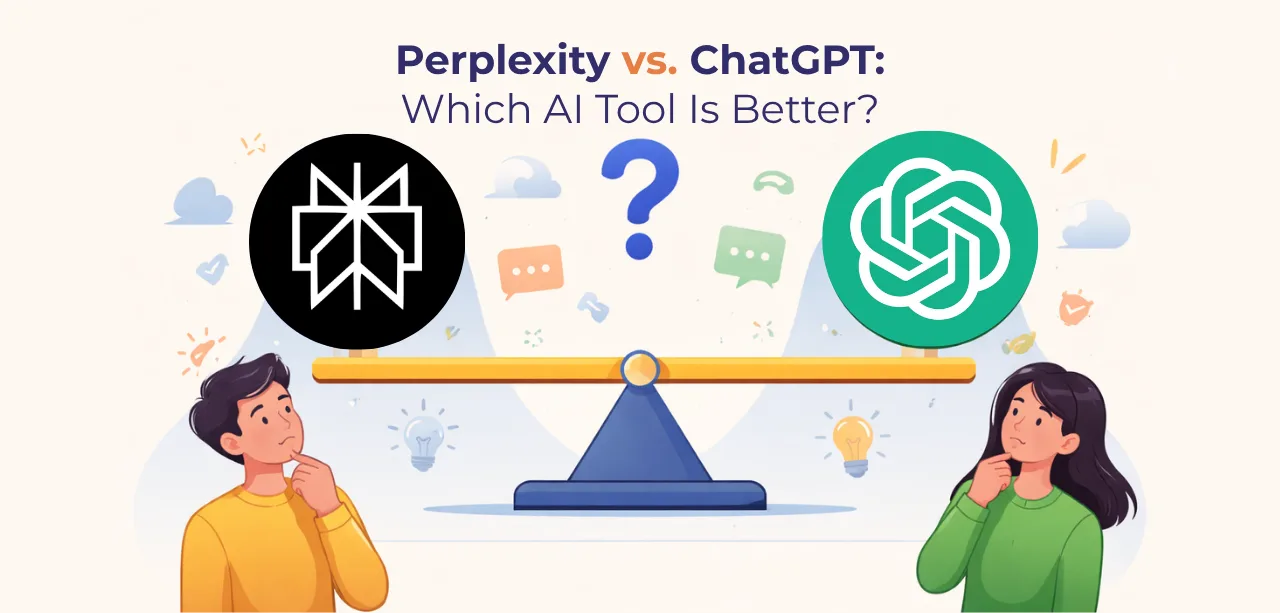
Among the most talked-about AI tools are Perplexity and ChatGPT. Although both are powered by advanced artificial intelligence, they are built with different purposes in mind. One is designed to help users discover reliable information, while the other focuses on helping users complete tasks and produce meaningful output.
Understanding how these tools differ will help you use them more strategically rather than simply choosing one at random.
Understanding Perplexity: A Research-Focused AI Tool
Perplexity is essentially an intelligent research assistant that combines search engine capabilities with AI summarization. Its goal is to deliver accurate answers supported by credible sources, making it easier for users to trust the information they receive.
Instead of generating long creative responses, Perplexity prioritizes clarity and verification. It pulls data from multiple sources and presents concise summaries along with references, helping users confirm facts quickly.
Typical uses of Perplexity include:
- Conducting quick online research
- Verifying statistics or claims
- Tracking industry trends
- Studying new topics
- Gathering background information
For people who depend on dependable data, Perplexity can significantly reduce the time spent searching and validating information.
Understanding ChatGPT: A Productivity and Creation Tool
ChatGPT works differently. Rather than acting primarily as a search tool, it functions as a digital assistant that helps users complete tasks, solve problems, and generate content. Its strength lies in versatility — it can handle many types of work within a single conversation.
From writing articles to brainstorming ideas or explaining complex concepts, ChatGPT is designed to help users turn thoughts into finished results.
Common uses of ChatGPT include:
- Writing blogs and marketing content
- Generating creative ideas
- Drafting emails and reports
- Explaining technical topics
- Automating repetitive tasks
Because of its flexibility, ChatGPT is widely used across industries such as marketing, education, customer service, and software development.
The Core Difference Between Perplexity and ChatGPT
At a basic level, the difference between these tools comes down to their primary purpose.
Perplexity helps you find information.
ChatGPT helps you use information.
Both are valuable, but they serve different stages of a workflow. One focuses on discovery, while the other focuses on execution.
This distinction is important because it determines which tool will save you more time in a given situation.
Side-by-Side Comparison
Main Function
Perplexity: Information search and research
ChatGPT: Content creation and productivity assistance
Information Updates
Perplexity: Uses live web data
ChatGPT: Uses trained knowledge with optional browsing
Source Transparency
Perplexity: Displays references automatically
ChatGPT: References depend on prompts
Content Generation Ability
Perplexity: Basic
ChatGPT: Advanced
Technical Support
Perplexity: Limited
ChatGPT: Strong
Ease of Use
Perplexity: Similar to a search engine
ChatGPT: Conversational interface
These differences explain why many professionals prefer using both tools together rather than replacing one with the other.
Performance in Real-World Tasks
Research and Information Collection
Perplexity performs especially well when users need fast, dependable answers. It simplifies research by gathering information from multiple sources and presenting it in a clear format.
This makes it useful for:
- Business research
- Academic assignments
- Market analysis
- Competitive research
- News monitoring
Instead of opening dozens of browser tabs, users can quickly review summarized information in one place.
Content Creation and Task Execution
ChatGPT excels when the goal is to produce content or complete work efficiently. It can write structured text, refine ideas, and assist with planning.
This capability makes it valuable for:
- Blogging and article writing
- Social media marketing
- Customer communication
- Documentation
- Workflow organization
Its ability to adapt to different tasks is one of the main reasons it has become widely adopted in professional environments.
Integration and Business Use Cases
Organizations increasingly rely on AI tools that can connect with their existing workflows. ChatGPT offers broader integration possibilities, allowing companies to embed AI into daily operations and automate routine tasks.
Examples of business applications include:
- Customer service automation
- Marketing content generation
- Internal documentation support
- Data analysis assistance
- Training and onboarding systems
Perplexity also supports integrations, but its primary value remains centered on research and information retrieval.
Flexibility and Customization
Flexibility is a major factor when choosing an AI tool for long-term use. ChatGPT allows users to tailor workflows based on specific needs, making it suitable for both individuals and businesses.
For example, users can create systems for:
- Writing assistance
- Lead generation
- Knowledge management
- Project planning
- Content strategy development
Perplexity, on the other hand, is designed for simplicity. Users can begin researching immediately without setting up complex configurations.
Pricing and Value for Money
Both platforms provide free versions, allowing users to explore their features before upgrading. This accessibility has contributed to their rapid adoption worldwide.
Paid plans typically offer enhanced performance and additional features.
Perplexity’s premium version usually includes:
- Faster responses
- Access to advanced models
- File upload capabilities
- Increased usage limits
ChatGPT’s premium plans often provide:
- More powerful AI models
- Improved analysis tools
- Automation features
- Custom workflow options
- Team collaboration tools
For individuals, either option can deliver good value. For businesses, ChatGPT often provides greater long-term benefits due to its broader functionality.
Situations Where Perplexity Is the Better Choice
Perplexity is most useful when accuracy and verification are the top priorities.
You should consider using it when you need to:
- Research a topic quickly
- Confirm facts or statistics
- Monitor industry changes
- Gather reliable data
- Explore unfamiliar subjects
In these scenarios, its focus on trustworthy information becomes a major advantage.
Situations Where ChatGPT Is the Better Choice
ChatGPT is the stronger option when productivity and output matter most.
You should consider using it when you need to:
- Create written content
- Generate ideas
- Solve problems
- Automate tasks
- Summarize information
- Improve efficiency
Its ability to handle complex tasks makes it especially valuable in fast-paced work environments.
Advantages and Limitations
Perplexity Advantages
- Provides up-to-date information
- Includes source references
- Simple and fast to use
- Reliable for research tasks
Perplexity Limitations
- Limited creative capabilities
- Not built for automation
- Fewer customization options
- Narrower range of features
ChatGPT Advantages
- Powerful content generation
- Wide range of applications
- Strong technical support
- Highly flexible
- Suitable for complex workflows
ChatGPT Limitations
- Important details may require verification
- Citations are not always automatic
- Results depend on clear instructions
- Free usage limits may apply
Final Thoughts: Which AI Tool Wins?
Choosing between Perplexity and ChatGPT is not about finding a single winner. Instead, it is about selecting the right tool for the task at hand.
If your main goal is to gather reliable information quickly, Perplexity is likely the better choice.
If your goal is to create content, complete tasks, or improve productivity, ChatGPT will usually deliver stronger results.