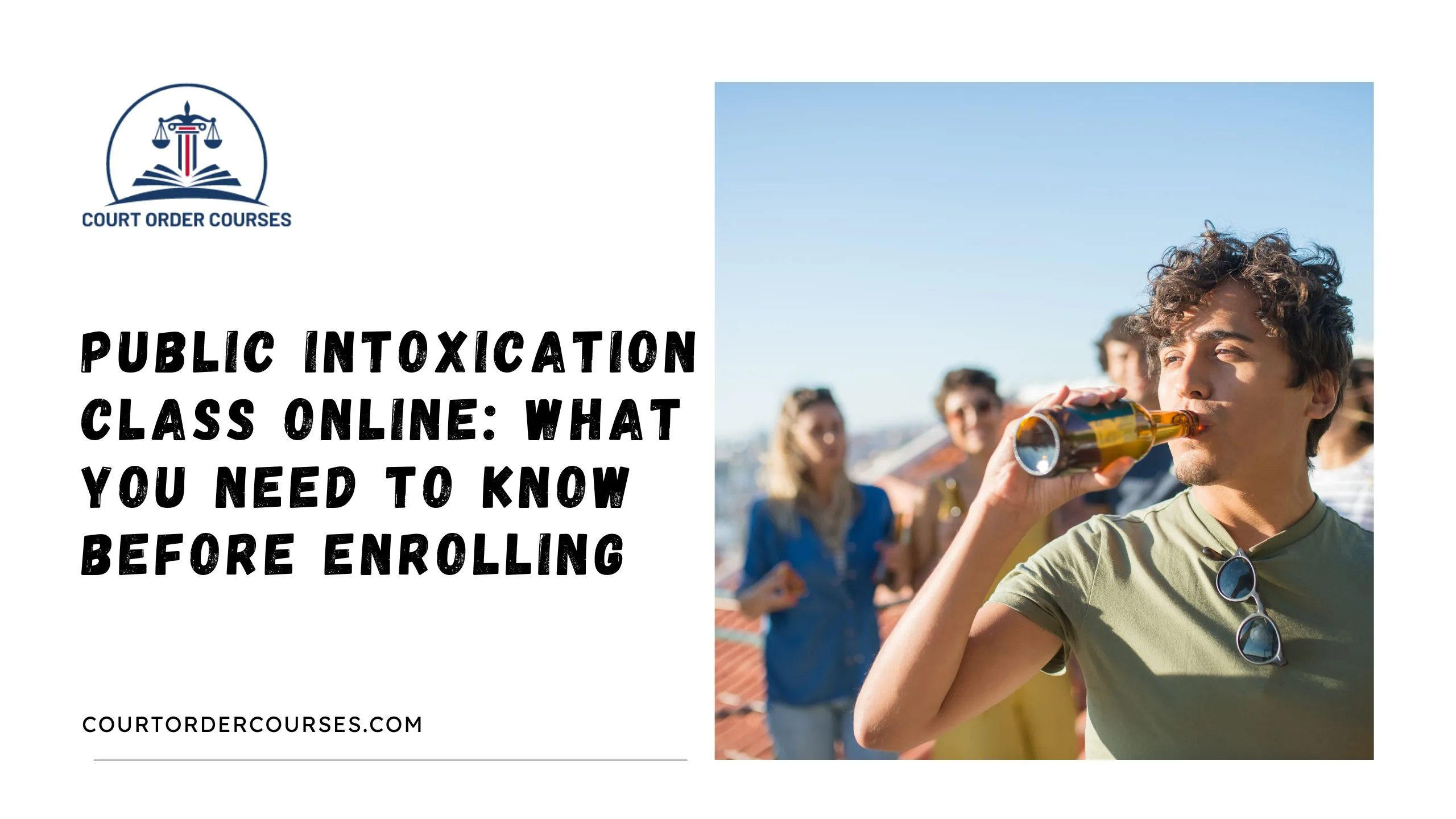
A Public Intoxication Class is an educational program that can help participants understand alcohol-related risks, responsible decision-making, and the consequences of intoxication in public. If a court or another authority requires this type of education, verify the required course length, provider, completion requirements, and acceptance before enrolling.
What Is a Public Intoxication Class?
A Public Intoxication Class is an educational course designed for people who need to learn about the risks and consequences associated with alcohol-related behavior in public settings.
Depending on the program and the requirements involved, the course may discuss alcohol use, impairment, decision-making, personal responsibility, behavioral consequences, and ways to avoid repeating situations that can result in legal or personal problems.
For someone who has been directed to complete alcohol-related education, the goal is generally not simply to finish a certain number of hours. The educational component is intended to help participants understand the choices that contributed to the situation and recognize ways to make safer decisions in the future.
An online course can also provide a convenient alternative to attending scheduled classroom sessions.
Why Might Someone Be Required to Take a Public Intoxication Class?
A person may be directed to complete an educational program after a public intoxication-related incident or as part of a court, probation, diversion, or other requirement.
The exact requirement can vary considerably. One person may be required to complete a specific alcohol education program, while another may receive instructions for a particular number of educational hours or a particular type of provider.
This is why it is important to read the paperwork carefully.
A course that sounds appropriate may not necessarily satisfy every court or jurisdiction. Before enrolling, identify exactly what the responsible authority has requested.
What Does Public Intoxication Education Usually Cover?
A comprehensive course can address several areas related to alcohol use and responsible decision-making.
How Does Alcohol Affect Judgment?
Alcohol can affect a person's ability to make decisions and respond appropriately to situations.
An educational course may explain how intoxication can influence judgment, coordination, reaction time, perception, and behavior.
Understanding these effects can help participants recognize why seemingly simple decisions can become more difficult when someone has consumed alcohol.
Why Is Decision-Making Important?
Decision-making is an important part of alcohol education because many alcohol-related incidents involve choices made before or during intoxication.
Participants may examine how decisions about drinking, transportation, social environments, and personal limits can affect what happens afterward.
The purpose is to encourage participants to think ahead rather than making decisions only after a problem has already developed.
What Are the Consequences of Public Intoxication?
The consequences of a public intoxication incident can extend beyond the immediate event.
Depending on the circumstances and jurisdiction, a person may face legal consequences, financial costs, probation conditions, educational requirements, or other obligations.
An educational program can help participants understand that alcohol-related behavior may affect employment, relationships, finances, transportation, and future opportunities.
Is a Public Intoxication Class the Same as Alcohol Treatment?
No. Education and treatment serve different purposes.
An educational course is generally intended to provide information and encourage better decision-making. Alcohol treatment, on the other hand, can involve individualized assessment, counseling, therapy, recovery planning, or other professional services.
Someone who has been ordered to complete an educational class should follow the specific requirement.
If a court or professional has also recommended treatment or counseling, completing an educational course should not be viewed as a replacement for those services.
Can You Take a Public Intoxication Class Online?
Yes, online options are available for people who need alcohol-related education.
An online format can allow participants to complete coursework from a computer or other compatible device without attending a traditional classroom.
This can be useful for people balancing work, school, family responsibilities, or transportation challenges.
However, convenience should not be the only consideration. If the course is being completed for a legal requirement, acceptance is especially important.
How Does an Online Public Intoxication Class Work?
The process is generally straightforward, but participants should confirm their requirements before registering.
How Do You Start the Process?
Step 1: Read your paperwork carefully.
Start with the court order, probation paperwork, attorney's instructions, diversion agreement, or other document that explains the educational requirement.
Look for information about:
- Course type
- Required hours
- Completion deadline
- Approved providers
- Certificate requirements
- Where proof of completion must be submitted
How Do You Select the Appropriate Course?
Step 2: Match the course to your requirement.
Do not select a course solely because it contains the words "alcohol" or "intoxication."
Compare the actual requirement with the course description.
If your paperwork requires a specific program, duration, or approved provider, those details should guide your choice.
How Do You Complete the Course?
Step 3: Work through the required lessons.
Online courses typically organize information into lessons or modules.
Read the material carefully and complete any required quizzes, exercises, or assessments.
What Happens After the Course?
Step 4: Complete all required coursework and assessments.
Finishing only some of the material may not satisfy the requirement.
Make sure every required lesson and assessment has been completed before expecting documentation.
How Do You Prove Completion?
Step 5: Obtain and save your certificate.
If the program provides a certificate of completion, keep a copy for your records.
You may need to provide it to a court, probation officer, attorney, school, employer, or another authority.
How Long Does a Public Intoxication Class Take?
There is no single universal length for every public intoxication education program.
The required duration depends on the authority that assigned the course and the specific circumstances.
Some educational programs offer multiple course lengths so participants can select an option that corresponds to their requirement.
The important point is to follow the number of hours specified in your paperwork.
Taking a shorter class simply because it is more convenient can create problems if the authority required additional educational hours.
What Should You Check Before Enrolling?
Choosing the right course requires a little preparation.
Does the Course Match the Exact Requirement?
Start by checking the wording of your order or referral.
If the requirement says "alcohol education," "public intoxication education," or another specific phrase, determine whether the course addresses that requirement.
Do not assume that all alcohol-related courses are interchangeable.
Is the Course Online and Self-Paced?
If flexibility matters to you, check whether you can complete the course online and whether lessons can be completed according to your schedule.
A self-paced course may be more convenient than a classroom program with fixed meeting times.
Does the Course Have the Required Number of Hours?
This is one of the most important things to verify.
A course should match the educational duration required by the authority.
If the requirement is unclear, ask the appropriate official or your attorney before enrolling.
Will You Receive Proof of Completion?
Ask what documentation is provided after successful completion.
A certificate or other completion record may be necessary to demonstrate that you satisfied the educational requirement.
Why Is Online Learning Convenient?
Traditional classroom courses can require participants to travel to a specific location at a specific time.
Online education can remove some of those scheduling challenges.
Participants can often study from home, during breaks, or at other convenient times.
This can be particularly useful when a deadline is approaching and attending multiple classroom sessions would interfere with existing responsibilities.
However, convenience should always come after compliance. The first question should be whether the course meets the requirement.
Can a Public Intoxication Class Help Prevent Future Problems?
Education can help participants understand the relationship between alcohol consumption, decisions, and consequences.
A course may encourage people to consider questions such as:
- What situations tend to lead to poor decisions?
- How does alcohol affect judgment?
- What alternatives are available when someone should not drive?
- How can someone recognize when drinking is becoming risky?
- What choices could prevent another alcohol-related incident?
Thinking through these questions can make the educational experience more practical.
The goal is to turn information into better decisions outside the course.
What Role Does Personal Responsibility Play?
Personal responsibility is an important concept in alcohol education.
Rather than focusing only on the legal consequences of an incident, participants can examine the decisions that occurred before the incident.
For example, someone might consider where they were drinking, how much they consumed, who they were with, how they planned to get home, and what warning signs they ignored.
The purpose is not to judge participants. It is to encourage awareness and better planning.
How Can Someone Avoid Another Public Intoxication Incident?
There is no single strategy that works for everyone, but planning ahead can reduce risky situations.
What Should You Plan Before Drinking?
Consider transportation before consuming alcohol.
If driving is not appropriate, arrange another option in advance rather than waiting until after drinking.
Possible alternatives may include a designated driver, taxi or rideshare service, public transportation, or staying somewhere safe.
Why Is It Important to Recognize Personal Limits?
People can respond differently to alcohol.
Factors such as body size, food consumption, medications, drinking speed, tolerance, and other circumstances can influence impairment.
Because of these differences, relying on a particular number of drinks as a guarantee of safety can be misleading.
The safest approach is to avoid driving or other dangerous activities when impaired.
What Should You Do If a Situation Becomes Unsafe?
Leaving a risky environment early can sometimes prevent a situation from escalating.
If someone recognizes that alcohol is affecting their judgment or behavior, seeking a safe environment and arranging appropriate transportation can be important steps.
What Are Common Mistakes People Make When Choosing a Course?
Several mistakes can make completing a court-related education requirement more difficult.
Why Should You Avoid Choosing Only by Price?
The cheapest course is not necessarily the right course.
A low-cost program does not help if it fails to meet the authority's requirements.
Always consider course duration, provider information, completion documentation, and acceptance.
Why Should You Avoid Waiting Until the Deadline?
Starting early gives you time to address unexpected issues.
If a course takes longer than expected or documentation needs to be corrected, waiting until the final day can create unnecessary stress.
Why Should You Keep Your Certificate?
Even after submitting proof of completion, retain your own copy.
Having documentation available can make it easier to demonstrate that you completed the requirement if questions arise later.
Can a Public Intoxication Class Replace Every Alcohol-Related Requirement?
No. Different requirements can involve different educational programs.
One person may need a public intoxication-related course, while another may need a broader alcohol awareness program, substance education, counseling, treatment, or another specialized requirement.
The exact wording of your paperwork matters.
If you have questions about what the court intended, contact your attorney, probation officer, or the authority that issued the requirement.
What If Your Court Order Does Not Clearly Name a Provider?
If the provider is not clearly identified, do not guess.
You can ask the responsible authority whether an online course is acceptable and whether a particular provider or course duration is required.
This small step can prevent the inconvenience of completing a course that later turns out not to satisfy the requirement.
Where Can You Find an Online Public Intoxication Course?
If you are specifically looking for an online educational option, Court Order Courses provides a Public Intoxication Class designed for people seeking online court-related education.
Before enrolling, review the course information and compare it with your specific requirement.
If your court or supervising authority has additional instructions, those instructions should take priority when determining whether the course is appropriate.
What Should You Do After Completing the Class?
Completing the course is only one part of satisfying a legal or administrative requirement.
After finishing:
- Confirm that all required lessons are complete.
- Complete any required final assessment.
- Obtain your certificate or completion documentation.
- Save a copy for your personal records.
- Submit the documentation according to your instructions.
- Confirm that the responsible authority received it if necessary.
- Keep the records until your case or requirement is fully resolved.
Following these steps can help reduce uncertainty about whether your completion has been properly documented.
How Can You Make the Most of the Course?
A court-ordered class does not have to be treated as something to finish as quickly as possible.
Pay attention to the material and think about how it applies to real situations.
The most useful lessons may be those that help you recognize risky patterns before they become another problem.
For example, understanding how alcohol affects judgment can encourage better decisions about transportation. Learning about behavioral triggers can help someone recognize situations that increase risk. Considering financial and legal consequences can provide additional motivation to make different choices.
What Should You Remember About Public Intoxication Education?
The most important point is that requirements vary.
A Public Intoxication Class can provide useful education about alcohol, impairment, decision-making, responsibility, and the consequences of alcohol-related behavior.
Online learning can make the process more convenient, particularly for people who need to complete coursework around work, school, or family responsibilities.
But convenience should never replace verification.
Before enrolling, determine exactly what your court or other authority requires. Check the course type, required hours, completion process, deadline, provider expectations, and certificate requirements.
Once those details are confirmed, completing the appropriate online course can be a straightforward way to satisfy the educational portion of your requirement.
Frequently Asked Questions About Public Intoxication Classes
Is a Public Intoxication Class available online?
Yes. Online options are available for alcohol-related education.
Is a Public Intoxication Class court ordered?
Sometimes. Requirements depend on the court and individual case.
How long is a Public Intoxication Class?
It varies. Follow the course length specified by your authority.
Do online classes provide certificates?
Yes. Many online programs provide completion documentation.
Can I take the class from home?
Yes. Online courses can generally be completed remotely.
Should I verify acceptance before enrolling?
Yes. Confirm that the course satisfies your specific requirement.
Is education the same as alcohol treatment?
No. Education and professional treatment serve different purposes.