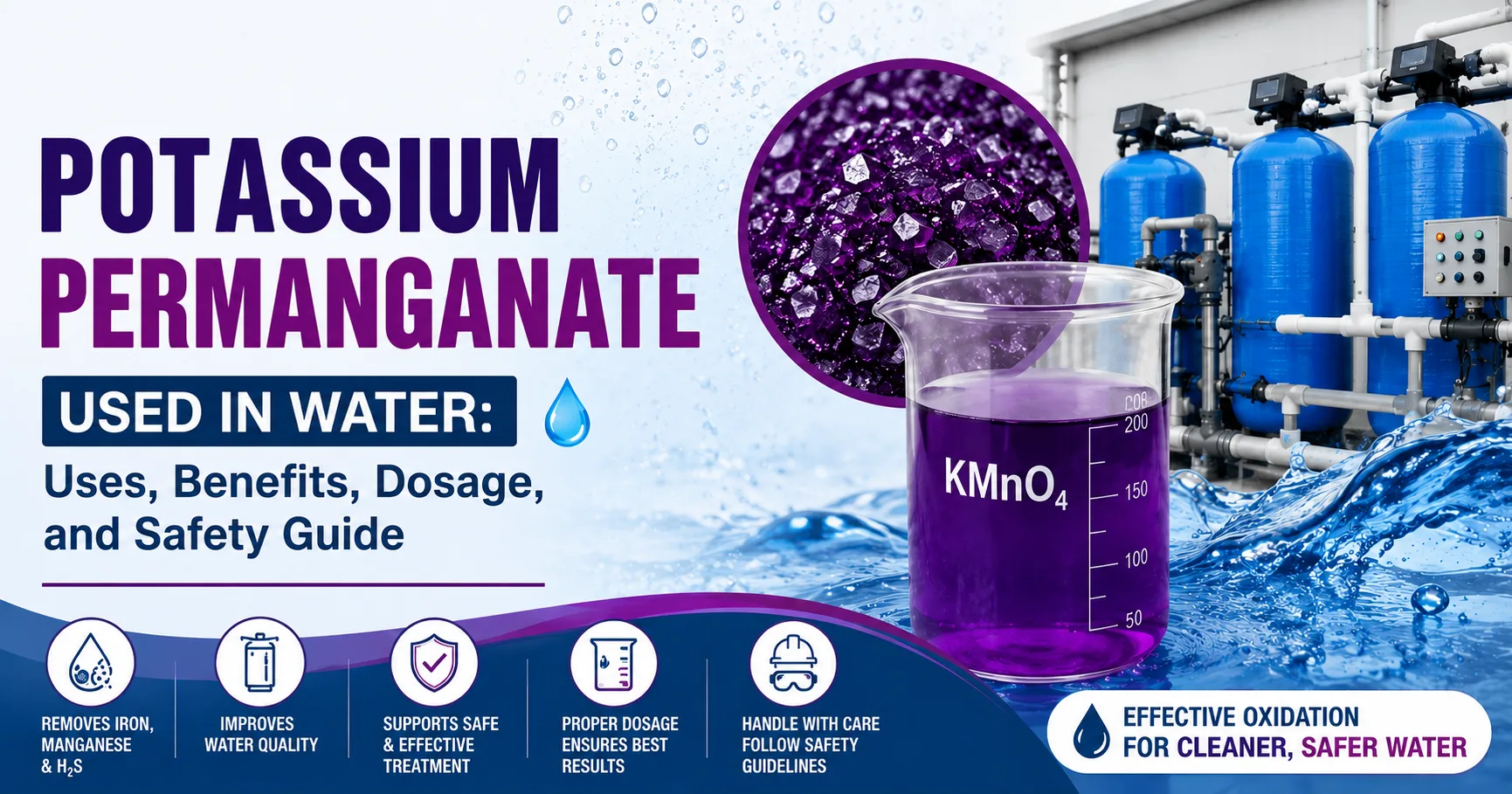
Potassium Permanganate Used in Water is an important treatment approach for managing several common water-quality problems, particularly iron, manganese, hydrogen sulfide, and unpleasant odors. This purple-colored chemical is a strong oxidizing agent that reacts with certain dissolved substances and converts them into forms that can be removed through filtration. It is used in groundwater treatment, well-water systems, municipal facilities, and some industrial water-treatment applications.
However, potassium permanganate needs to be handled carefully. The right concentration, contact time, filtration method, and dosing system all affect treatment performance.
What Is Potassium Permanganate?
Potassium permanganate is an inorganic compound with the chemical formula KMnO₄. It is usually supplied as dark purple to nearly black crystals or granules and dissolves in water to form a purple solution. Potassium Permanganate Used in Water is particularly valuable for its strong oxidizing properties. When it comes into contact with substances such as dissolved iron, manganese, and hydrogen sulfide, it promotes chemical reactions that transform them into less soluble forms. These oxidized materials can then be captured by an appropriate filtration medium. However, the chemical itself is not a universal disinfectant or a simple substitute for every water-treatment process. Its application should match the specific water-quality problem being treated.
How Is Potassium Permanganate Used in Water Treatment?
The basic principle is oxidation followed by filtration.
For example, groundwater may contain dissolved iron in a form that passes easily through ordinary filters. When potassium permanganate is introduced at a controlled dose, the iron is oxidized into an insoluble form. The resulting particles can then be trapped by a filter.
A similar process occurs with manganese, although manganese oxidation can require carefully controlled conditions.
A typical treatment system may include:
- Chemical dosing – A controlled quantity of potassium permanganate is added to the incoming water.
- Mixing or contact – The chemical is allowed to react with the target contaminants.
- Oxidation – Dissolved substances are converted into forms that can be filtered.
- Filtration – The oxidized particles are removed from the water.
- Backwashing – The filter is periodically cleaned to remove accumulated solids.
The actual design depends on the raw-water chemistry and treatment objectives.
Major Uses of Potassium Permanganate in Water
1. Iron Removal
One of the most common applications is controlling dissolved iron in groundwater and well water.
Excess iron can cause reddish-brown staining on plumbing fixtures, laundry, and bathroom surfaces. It may also affect the taste and appearance of water.
Potassium permanganate oxidizes dissolved iron, helping convert it into a particulate form that can be captured by filtration.
2. Manganese Removal
Manganese can occur naturally in groundwater and may cause dark staining, unpleasant taste, or other water-quality concerns when present at elevated levels.
Potassium permanganate can oxidize manganese and assist its removal through filtration. The effectiveness depends on pH, temperature, manganese concentration, contact time, and the filtration system.
3. Hydrogen Sulfide and Odor Control
Hydrogen sulfide is associated with the familiar rotten-egg smell sometimes found in groundwater.
Controlled potassium permanganate treatment can oxidize hydrogen sulfide and help reduce associated odors. This can be particularly useful in well-water treatment systems where hydrogen sulfide occurs alongside iron or manganese.
4. Water Conditioning
Potassium permanganate may be used as part of a broader water-conditioning process where oxidation is required before filtration.
It is often combined with specialized filter media designed to support oxidation and capture the resulting particles.
5. Industrial Water Treatment
Certain industrial water-treatment systems use potassium permanganate when oxidation of specific contaminants is required.
The application can vary significantly from one facility to another. Industrial treatment normally involves water analysis, process design, controlled dosing, and monitoring rather than simply adding a fixed amount of chemical.
Benefits of Using Potassium Permanganate in Water Treatment
When correctly applied, potassium permanganate offers several practical benefits.
Effective oxidation:
It can oxidize dissolved iron, manganese, and hydrogen sulfide, making them easier to remove through filtration.
Useful for groundwater:
It is particularly relevant to well-water treatment where naturally occurring iron and manganese are common concerns.
Supports filtration:
The oxidation step converts dissolved contaminants into forms that filtration equipment can capture.
Can address multiple problems:
A properly designed system may use one oxidation process to address iron, manganese, and hydrogen sulfide together.
Controlled chemical dosing:
Dosing equipment allows operators to adjust chemical addition according to water conditions and treatment requirements.
Potassium Permanganate Dosage in Water Treatment
There is no single dosage that works for every water source.
The required quantity depends on the concentration of contaminants and the overall chemistry of the water. Iron, manganese, and hydrogen sulfide each have different oxidation requirements.
As a general chemical-treatment principle, dosing should be based on water analysis and treatment calculations, rather than guesswork.
An excessive dose can leave residual permanganate in the treated water, while insufficient dosing may result in incomplete oxidation.
For this reason, treatment operators typically consider factors such as:
- Iron concentration
- Manganese concentration
- Hydrogen sulfide level
- Water pH
- Water temperature
- Flow rate
- Contact time
- Filter-media characteristics
- Desired treated-water quality
A pilot test or professional water analysis can help determine an appropriate operating range.
Why pH Matters
pH has a major influence on oxidation and filtration performance.
Iron is generally easier to oxidize than manganese under many water-treatment conditions. Manganese removal can become more challenging when the water chemistry is not suitable.
If the pH is too low or other water conditions are unfavorable, oxidation may be incomplete. In some systems, pH adjustment may therefore be required before or during treatment.
This is one reason why simply increasing the chemical dose is not always the right solution.
Safety Precautions When Using Potassium Permanganate
Potassium permanganate is a strong oxidizing chemical and should be treated with care.
Store It Properly
Keep the chemical in a cool, dry, well-ventilated storage area. The container should remain tightly closed and protected from contamination.
Because potassium permanganate is an oxidizer, it should be kept away from combustible materials and incompatible substances.
Use Appropriate Protective Equipment
Operators handling concentrated potassium permanganate should use suitable protective equipment, including chemical-resistant gloves and eye protection. Additional protection may be necessary depending on the handling method and workplace risk assessment.
Avoid Direct Contact
The concentrated chemical and strong solutions can irritate or damage skin and eyes. Purple staining can also occur after contact with the chemical.
If contact occurs, follow the applicable safety data sheet and workplace emergency procedures.
Do Not Guess the Dose
Adding more chemical does not necessarily mean better treatment. Overdosing can create residual permanganate and may interfere with water quality.
Use calibrated dosing equipment and monitor the treatment process.
Can Potassium Permanganate Make Water Safe to Drink?
Potassium permanganate can play an important role in treating certain water-quality problems, but it should not automatically be considered a complete drinking-water treatment solution.
Water intended for consumption may require several treatment stages depending on its source and contaminants. Filtration, disinfection, pH control, and other processes may be necessary.
Before using potassium permanganate in a drinking-water system, the raw water should be tested and the complete treatment process should be properly designed.
Common Mistakes to Avoid
Using a fixed dose without testing the water: Water chemistry varies considerably between sources.
Ignoring pH: Oxidation and filtration performance can depend strongly on pH.
Skipping filtration: Oxidizing iron and manganese is only part of the process. The resulting solids generally need to be removed.
Overdosing: Excess chemical can cause unwanted residuals and staining.
Poor chemical storage: Potassium permanganate should be stored away from incompatible and combustible materials.
Neglecting maintenance: Filters and dosing equipment need regular inspection and maintenance for consistent performance.
Final Thoughts
Potassium permanganate can be a valuable oxidation chemical for water treatment, especially when dissolved iron, manganese, or hydrogen sulfide is present. Its effectiveness depends on correct dosing, suitable water chemistry, adequate contact time, and efficient filtration.
For reliable results, water should be tested before selecting a treatment method, and the dosing system should be designed around actual contaminant levels rather than assumptions. Safe storage and careful handling are equally important because potassium permanganate is a strong oxidizer.
For businesses looking for consistent-quality treatment chemicals, working with an experienced potassium permanganate manufacturer in india can help ensure suitable product quality, technical consistency, and reliable supply for water-treatment applications.