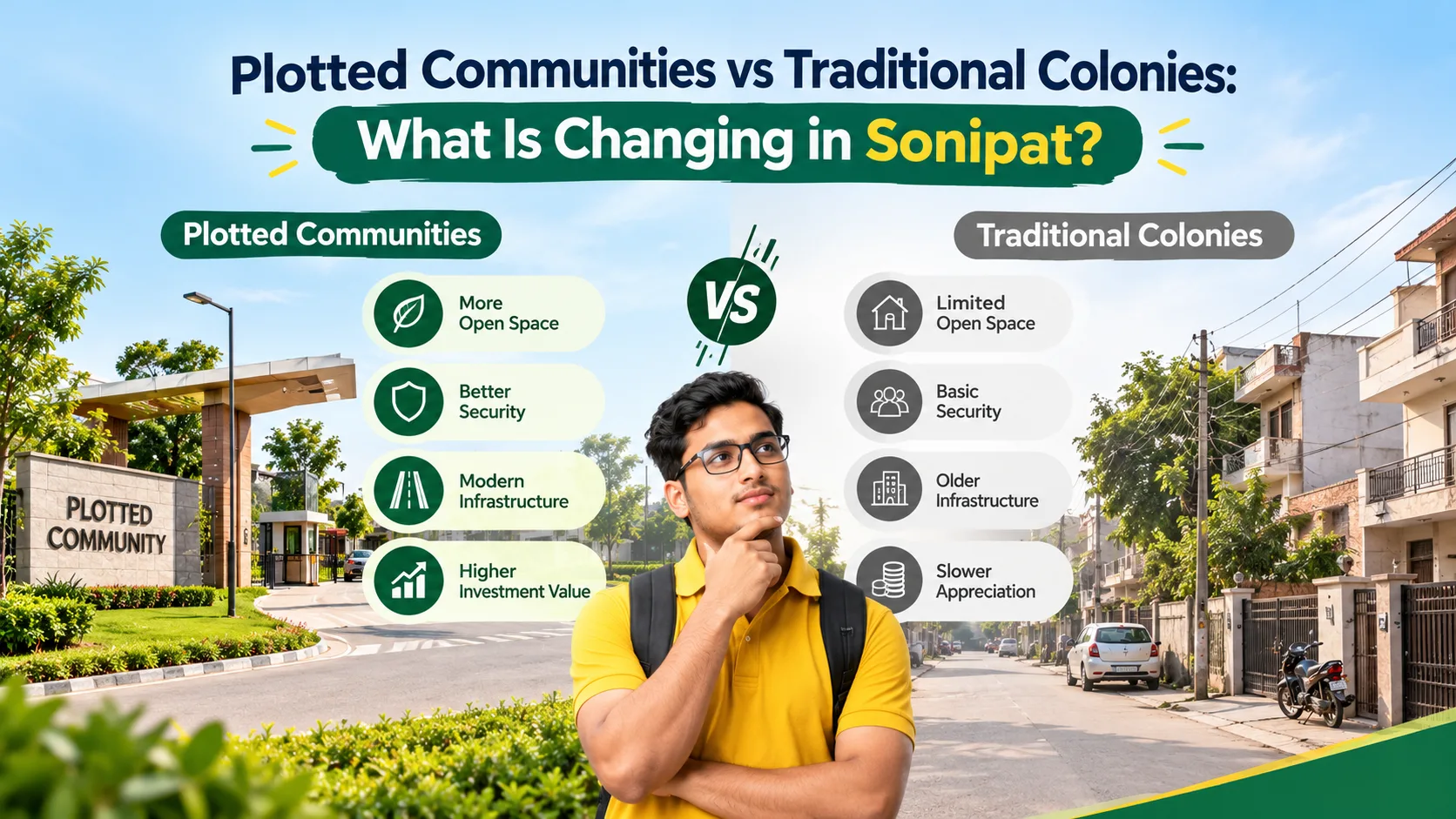
Sonipat's residential market has historically been built around traditional colonies — organically developed neighborhoods with individually built houses, informal planning, and infrastructure added incrementally over time. In recent years, plotted communities in Sonipat have emerged as a distinct alternative: pre-planned layouts with defined infrastructure, common amenities, and a managed environment from the outset. Neither format is universally superior — the right choice depends on what a buyer values. This article compares both across ten factors relevant to anyone evaluating Residential Plots in Sonipat.
1. Planning
Traditional colonies typically grow organically, with plots developed and built upon over years or decades, often without a unified master plan. Roads, plot sizes, and infrastructure evolve reactively based on demand. Plotted communities, by contrast, are designed against a sanctioned master layout from the start — road hierarchy, plot distribution, and common areas are planned before the first plot is sold. This gives plotted communities more predictable, uniform development, while traditional colonies offer more organic, sometimes unpredictable, growth patterns.
2. Infrastructure
In traditional colonies, infrastructure — roads, drainage, electricity, water lines — is often added or upgraded incrementally, sometimes lagging behind population growth in the area. Plotted communities generally install core infrastructure as part of the initial development, meaning roads, drainage, and utility connections are in place before residents move in. That said, infrastructure quality within plotted communities varies significantly by developer, so this advantage isn't automatic — it depends on execution.
3. Security
Traditional colonies rely on ad hoc security arrangements — individual home security, occasional local patrolling, or none at all. Plotted communities that are gated typically offer boundary walls, controlled entry points, and centralized security management. This is a meaningful differentiator for buyers prioritizing controlled access, though it's worth noting not every plotted development is fully gated — verify this specifically rather than assuming.
4. Open Spaces
Traditional colonies often have limited dedicated open space, since land use developed incrementally without reserved green areas. Plotted communities frequently reserve a defined percentage of land for parks and open areas as part of the sanctioned layout. For buyers who value planned green space and walkable common areas, this is often a clearer advantage in plotted developments — though actual allocation should be checked against the approved plan, not assumed from marketing material.
5. Community Environment
Traditional colonies often have an established social fabric — long-term residents, mixed generations, and an organic sense of neighborhood built over years. Plotted communities are newer environments where the community culture is still forming, often among buyers with broadly similar life stages or expectations. Some buyers prefer the settled feel of an established colony; others prefer the more homogenous, newly forming environment of a plotted community.
6. Customization
Buyers in traditional colonies generally have more flexibility in house design, since there's less centralized architectural control. Plotted communities may include design guidelines or architectural norms to maintain visual consistency across the development, which can mean less individual design freedom but a more uniform streetscape. Buyers who prioritize personal design control should factor this in before choosing a plotted community with strict guidelines.
7. Maintenance
Maintenance in traditional colonies is typically the responsibility of individual homeowners and, where they exist, informal local associations — coverage and consistency vary widely. Plotted communities more often have a defined maintenance structure, whether through a resident welfare association or builder-managed services, covering common areas, security, and shared infrastructure. This generally means more consistent upkeep in plotted communities, but it also comes with ongoing maintenance charges that traditional colony residents may not pay.
8. Amenities
Traditional colonies rarely include built-in common amenities beyond what individual residents arrange themselves. Plotted communities are more likely to include shared amenities — parks, walking paths, community spaces — as part of the original design. The range and quality of amenities varies substantially between plotted projects, so this should be evaluated project by project rather than assumed as a category-wide standard.
9. Accessibility
Accessibility depends heavily on specific location rather than format. Traditional colonies are often located in more established, centrally connected parts of the city, while plotted communities are frequently developed in newer or peripheral areas as land availability allows. Buyers should evaluate proximity to workplaces, schools, and transport connectivity for each specific location rather than assuming one format is inherently better connected.
10. Buyer Considerations
The right format depends on what you're optimizing for. Buyers prioritizing structured infrastructure, security, and defined common areas often lean toward plotted communities. Buyers who value an established neighborhood, greater design flexibility, and potentially lower ongoing maintenance costs may prefer traditional colonies. Neither is a universally better investment or lifestyle choice — the fit depends on individual priorities, budget, and long-term plans.
Comparison Table
FactorTraditional ColoniesPlotted CommunitiesPlanningOrganic, evolves over timePre-planned master layoutInfrastructureAdded incrementallyTypically installed upfrontSecurityAd hoc, individualOften centralized (if gated)Open SpacesLimited, unplannedOften reserved by designCommunity EnvironmentEstablished, mixed generationsNewer, still formingCustomizationHigher design flexibilityMay follow design guidelinesMaintenanceIndividual responsibilityStructured (RWA/builder-managed)AmenitiesRarely built-inOften included, varies by projectAccessibilityDepends on specific locationDepends on specific locationBuyer FitFlexibility, established feelStructure, security, planningFAQs
1. Are plotted communities always more expensive than traditional colonies?
Not necessarily — pricing depends on location, developer, infrastructure quality, and market conditions, and varies too much to generalize across either category.
2. Is a plotted community always gated?
No. "Plotted community" refers to a pre-planned layout, while gating (boundary walls, controlled entry) is a separate feature some — but not all — plotted developments include. Verify this specifically for any project you're considering.
3. Which option offers better long-term value?
Long-term value depends on location, infrastructure execution, and market trends specific to the project and area — not on the format alone. Both traditional colonies and plotted communities have examples of strong and weak long-term performance.
4. Can I get more design freedom in a plotted community?
It depends on the specific project's guidelines. Some plotted communities allow significant design flexibility within the plot, while others impose architectural norms for visual consistency — check the specific project's building guidelines before assuming either way.