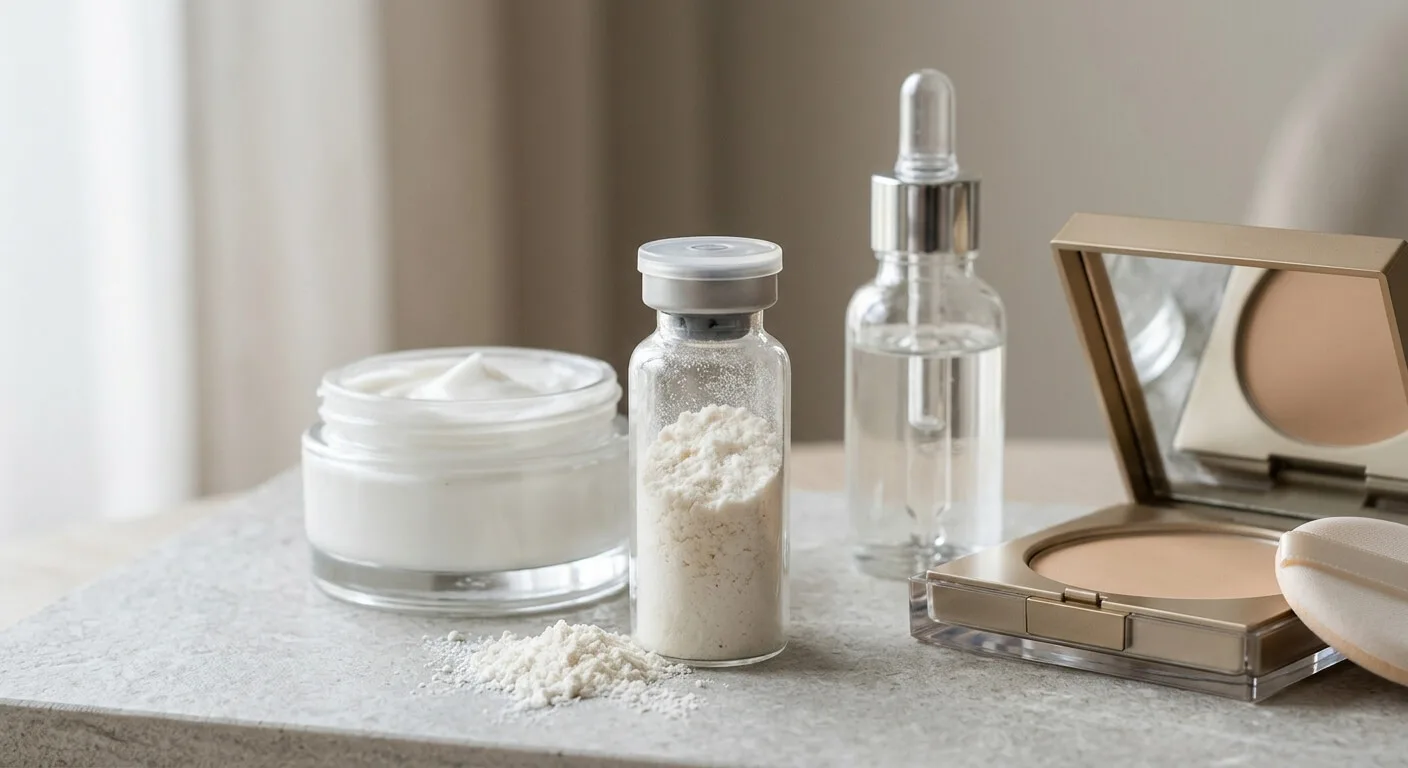
Many people first became familiar with PLLA through medical aesthetics. However, from a materials application perspective, the value of PLLA Polymer is not limited to aesthetic medicine. In recent years, research into biodegradable polyester microspheres has also begun to expand into leave-on skincare, color cosmetics, and functional materials.
Unlike conventional skincare ingredients such as niacinamide and retinol, PLLA Microspheres are better understood as functional particulate materials. Their primary role is to influence the sensory properties, spreadability, and formulation structure of a product.
1.Can PLLA Microspheres Be Used in Skincare Products?
Yes. PLLA Microspheres can be developed as functional particulate materials, although they are currently better understood from the perspective of materials applications rather than as active cosmetic ingredients.
In leave-on skincare and color cosmetics, PLLA Microspheres can contribute to sensory design by leveraging their particle size, sphericity, and physical properties.
For example, in creams, serums, foundations, and other products, microsphere materials can influence friction during application, spreadability, smoothness, and overall skin feel.
Therefore, one important application of PLLA in skincare and cosmetics is sensory enhancement.
2.Why Can PLLA Microspheres Improve Skin Feel?
The sensory properties of microspheres are not determined simply by the fact that they are made of “PLLA.” Instead, they are largely determined by their particle structure and physical characteristics.
When evaluating microspheres for sensory enhancement, several factors typically need to be considered, including:
Particle size distribution, morphology, sphericity, hardness, compressive strength, and oil absorption capacity.
Highly spherical particles are more likely to produce a rolling, ball-bearing-like sensation during application, while appropriate particle size and hardness can help balance a fine, silky feel with the risk of noticeable particles on the skin.
Therefore, when PLLA Microspheres are incorporated into skincare or cosmetic formulations, the key development task is to identify the appropriate combination of:
Particle size + morphology + hardness + concentration.
This is also one of the major differences between microsphere materials and conventional powder ingredients.
3.Why Are the Requirements for PLLA Higher in Leave-On Products?
Products such as facial scrubs are rinse-off products and typically have a relatively short contact time with the skin. In contrast, creams, serums, and color cosmetics are leave-on products and need to withstand longer storage periods and extended use after application.
Therefore, when PLLA Microspheres are incorporated into leave-on formulations, particular attention needs to be paid to:
- Long-term hydrolytic stability during storage;
- Whether the particle size and morphology change over time;
- Dispersion and suspension stability in emulsions and gels;
- Compatibility with oils, ethanol, polyols, and other formulation components.
Polyester materials generally have a certain degree of hydrophobicity and may tend to aggregate in water-based formulations. Therefore, formulation approaches such as viscosity modification, surfactant systems, or other dispersion strategies may be required to maintain a stable dispersion.
This means that when PLLA Polymer moves from a materials platform into cosmetic formulations, the real technical challenges often arise during the formulation adaptation stage.
4.Can PLLA Microspheres Be Used for Active Ingredient Delivery in the Future?
This is a highly promising area for biodegradable polyester microspheres, but it is important to distinguish between established applications and future research directions.
From a materials technology perspective, PLGA microspheres have already been extensively investigated for encapsulating active ingredients such as retinol, peptides, and growth factors, with the potential to achieve controlled release through material degradation.
PLLA offers similar technical possibilities for the development of functional microspheres. However, at present, it is more appropriate to regard these applications as areas of research and development, rather than as mature and widely established cosmetic applications.
In other words, the potential development pathway for PLLA Microspheres may gradually evolve from:
Sensory particles → Functional microspheres → Active ingredient delivery carriers
Throughout this process, factors such as material degradation rate, encapsulation efficiency, active ingredient stability, and release behavior will require further validation.
5. What Capabilities Are Needed to Bring PLLA Microspheres from the Laboratory to Commercial Products?
Industrialization is not simply a matter of “grinding a polymer into small particles.”
The process begins with a stable polymer material, with key parameters such as molecular weight, purity, and batch-to-batch consistency under control. Microspheres are then produced through processes such as emulsification and solvent evaporation, with particle size and morphology carefully controlled. Finally, the material must be incorporated into specific formulations to evaluate suspension, dispersion, stability, and sensory performance.
Therefore, a complete industrial chain includes:
Polymer synthesis → Material modification → Microsphere fabrication → Quality control → Formulation adaptation
For brands and formulation companies, greater stability and consistency of upstream materials provide better control over downstream product development.
This is where eSUNMed's business capabilities align with the upstream part of this value chain. eSUNMed has its headquarters and manufacturing base in Shenzhen, as well as an R&D and testing center in Wuhan, focusing on the synthesis, modification, characterization, and application research of biomedical polymer materials.
Currently, eSUNMed can stably supply medical-grade PCL, PLLA, and PDLA homopolymers, as well as PDLLA, PLGA, and PLCL copolymers, and also provides customized polymer services. In addition, the company offers absorbable medical polymers, injectable microspheres for medical applications, implant-grade 3D printing filaments, and biomedical 3D printing services.
From the perspective of the materials value chain, companies like eSUNMed do not directly define the cosmetic efficacy of a particular product. Rather, they provide downstream applications with a more stable foundation of high-performance polymer materials and microsphere technologies.
6. What Is the Future of PLLA in Skincare and Color Cosmetics?
At present, the potential value of PLLA in cosmetics can be considered at three levels.
First, as a particulate material.
It can be explored for use in scrubs and other rinse-off products.
Second, as a sensory-enhancing material.
The particle size, morphology, and physical properties of PLLA Microspheres can be engineered to improve the application experience of leave-on skincare and color cosmetics.
Third, as a functional material.
Further research may explore active ingredient encapsulation, controlled release, and more sophisticated microsphere systems.
At the same time, surface modification, polymer blending, precise particle size control, and more efficient microsphere fabrication processes may become important areas of future research and development.
Therefore, the incorporation of PLLA into cosmetics is not simply a case of “bringing a medical aesthetic material into skincare.”
Rather, it represents a process in which materials technology continues to extend into consumer products—from biodegradable particles to sensory design, formulation design, and functional material design.
For the cosmetics industry, the question worth watching in the future may not simply be “Can PLLA be used?”, but rather:
Can PLLA Polymer and PLLA Microspheres be made sufficiently stable and uniform to deliver measurable, verifiable value in specific cosmetic products?