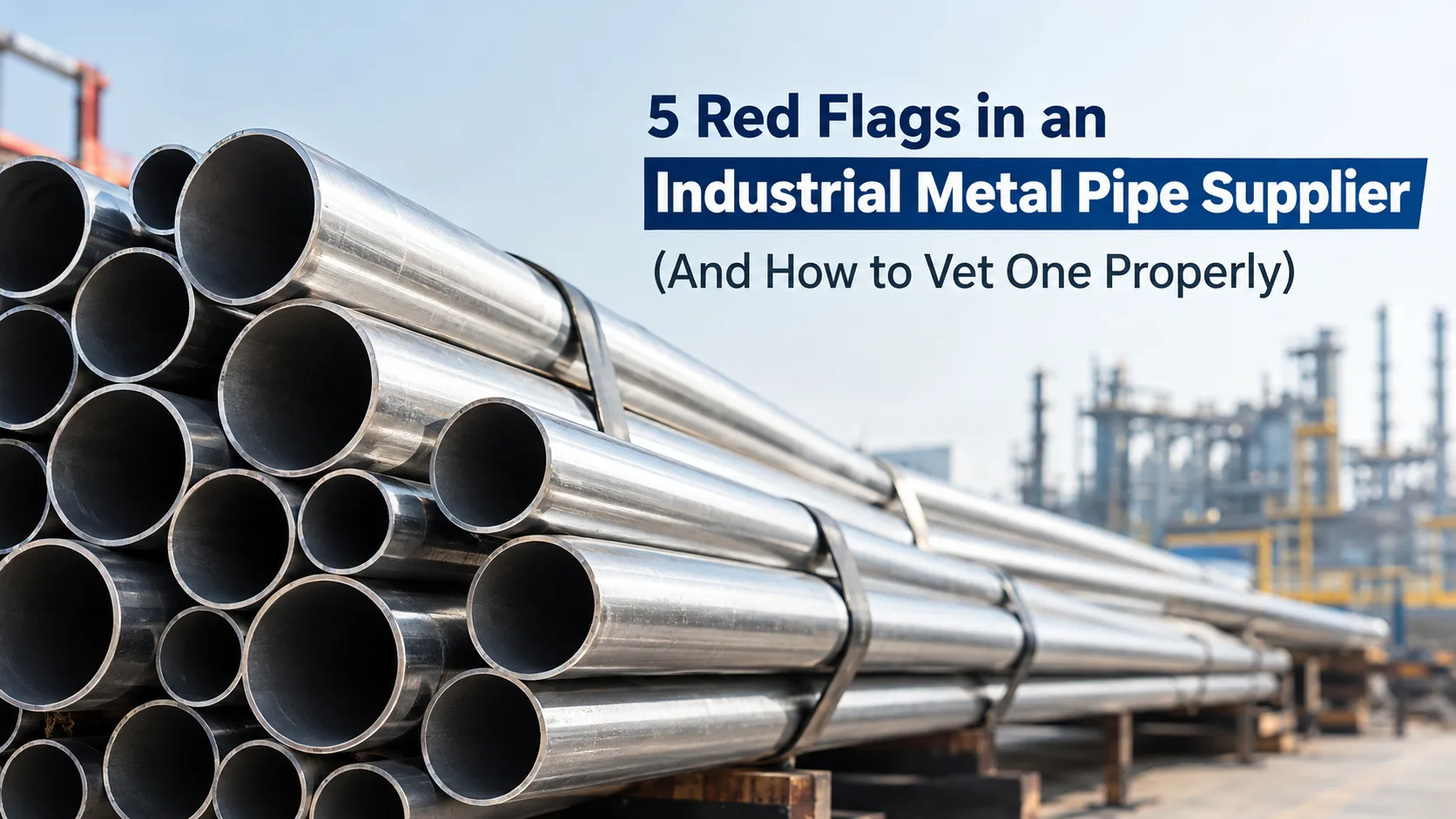
Industrial piping systems are the backbone of many sectors, from oil and gas and chemical processing to pharmaceuticals, construction, water treatment, and manufacturing. Choosing the right pipes and tubes is therefore not simply about selecting a diameter. Material grade, wall thickness, manufacturing method, dimensions, pressure requirements, corrosion resistance, temperature, and application all influence the final selection.
Sagar Steel Corporation supplies a wide range of industrial pipes and tubes in different materials, grades, forms, sizes, thicknesses, and lengths. Its range includes stainless steel, carbon steel, alloy steel, duplex and super duplex steel, Hastelloy, cupro-nickel and specialty alloy products. The company lists products manufactured according to standards such as ASTM, ASME, DIN, NFA, and JIS.
What Are Pipes and Tubes?
Pipes and tubes are hollow cylindrical products used for transporting liquids and gases, supporting structures, manufacturing equipment, and creating industrial systems. Although the terms are often used interchangeably, there are important dimensional and application differences.
Pipes are generally identified by nominal pipe size and are widely selected for fluid and gas transportation, pressure applications, plumbing, and industrial process lines. Tubes are commonly specified by outside diameter and are frequently used where dimensional accuracy, tighter tolerances, structural strength, or specialized fabrication is required.
Pipes vs Tubes: Key Differences
FeaturePipesTubesCommon measurementNominal Pipe Size / ODOutside DiameterPrimary purposeFluid and gas transportationStructural, mechanical and fluid applicationsDimensional focusFlow and pressure requirementsAccurate OD and wall thicknessTypical industriesOil & gas, chemical, plumbingEngineering, machinery, fabricationConnectionsWelding, threading, flangesWelding, brazing, compression and other fittingsCommon formsSeamless, weldedRound, square, rectangular, coiledPipes and Tubes Size Chart
A Pipes and tube size chart is important when selecting the correct product because the same nominal size can have different outside diameters and wall thicknesses depending on the schedule.
Sagar Steel Corporation lists pipe sizes from 1/8” NB to 24” NB, with outside-diameter options from 1/4” OD to 24” OD, while tube sizes are listed from 1/2” OD to 8” OD. Thicknesses can range from 4.0 mm to 100 mm, depending on the product and specification.
Nominal SizeApprox. ODExample Schedule Options1/2”21.34 mm5S, 10S, 40S, 80S3/4”26.67 mm5S, 10S, 40S, 80S1”33.40 mm5S, 10S, 40S, 80S1 1/4”42.16 mm5S, 10S, 40S, 80S2”60.33 mmSelected according to specification4”114.30 mmSelected according to specification6”168.28 mmSelected according to specification8”219.08 mmSelected according to specificationFinal dimensions should always be confirmed against the applicable standard, grade, and schedule before ordering.
Understanding Pipes and Tubes Weight
Pipes and tubes Weight is an important consideration for procurement, transportation, fabrication, and project costing. Weight depends primarily on the material density, outside diameter, wall thickness, and length.
For example, increasing wall thickness increases the amount of material used and therefore increases the weight per metre. Similarly, a larger outside diameter generally results in a higher weight when other dimensions remain comparable.
Buyers should therefore provide the supplier with the required material grade, OD or nominal size, wall thickness/schedule, and length when requesting a weight calculation or quotation.
Alloy 20 Pipes for Corrosive Industrial Environments
Alloy 20 pipes are specialty alloy piping products selected for applications where corrosion resistance is a major requirement. Alloy 20 is known for its resistance to sulfuric acid and chloride stress corrosion cracking, along with good mechanical properties and fabricability. Sagar Steel Corporation lists Alloy 20 as part of its product range.
Common Alloy 20 Pipe Applications
- Chemical processing plants
- Pharmaceutical processing
- Oil and gas applications
- Fluid piping systems
- Textile machinery
- Water and waste projects
- Medical gas pipeline systems
- Specialized industrial equipment
The correct Alloy 20 grade and dimensions should be selected according to the chemical environment, temperature, pressure, and applicable design standard.
Corten Steel Pipe for Durable Applications
Corten Steel pipe is another specialty option used where weather resistance and long-term outdoor performance are important. Corten steel develops a protective weathered surface under suitable atmospheric conditions, making it particularly interesting for structural, architectural, and outdoor applications.
Sagar Steel Corporation lists Corten Steel Pipes and highlights applications including textile machinery and oil and gas industries.
Corten Steel Pipe vs Alloy 20 Pipes
RequirementCorten Steel PipeAlloy 20 PipesMain advantageAtmospheric weather resistanceHigh corrosion resistanceTypical environmentOutdoor/structural environmentsAggressive chemical environmentsKey considerationExposure and structural requirementsChemical compatibilityAppearanceDevelops weathered surfaceMetallic alloy appearanceSuitable applicationsStructural and industrial projectsChemical and process industriesSelection priorityAtmospheric durabilityCorrosion resistanceMajor Uses and Applications of Pipes and Tubes
The versatility of industrial piping makes these products essential across multiple sectors.
Oil and Gas: Pipes are used for transporting hydrocarbons, gases, process fluids, and other materials through industrial systems.
Chemical Processing: Corrosion-resistant grades are selected for handling aggressive chemicals and demanding process conditions.
Pharmaceutical Industry: Precisely manufactured tubes and pipes can be used in processing, fluid transfer, and specialized pipeline systems.
Construction and Infrastructure: Structural tubes, hollow sections, and pipes are used for frameworks, supports, fabrication, and infrastructure projects.
Water and Wastewater: Piping systems are used for water transportation, treatment facilities, drainage, and waste-management projects.
Textile Machinery: Specialty pipes and tubes can be incorporated into machinery, fluid systems, and manufacturing equipment.
Engineering and Fabrication: Round, square, rectangular, coiled, hydraulic, and other forms provide flexibility for customized industrial requirements. Sagar Steel Corporation lists round, square, rectangular, coiled, U-shaped, pancake-coil, and hydraulic tube forms.
How to Choose the Right Pipes and Tubes Supplier
Selecting a Pipes and tubes Supplier should involve more than comparing basic prices. Buyers should consider material quality, available grades, dimensions, manufacturing standards, inspection requirements, delivery capabilities, packaging, and customization.
A reliable Pipe and tubes Supplier in India should be able to understand the technical requirements of the project and recommend suitable material and dimensions. Sagar Steel Corporation maintains stocks of standard sizes, materials, and types and supplies products for domestic and international requirements.
Why Choose a Pipes and Tubes Manufacturer in India?
Working with an experienced Pipe and tubes Manufacturer in India can simplify procurement by providing access to multiple material grades and dimensions from a single source. Sagar Steel Corporation states that it has operated in the steel market since 2003 and offers pipes and tubes in different forms, sizes, thicknesses, lengths, and grades.
For buyers, the most effective way to request a quotation is to specify the material or grade, pipe/tube size, OD, wall thickness or schedule, length, quantity, applicable standard, end finish, and intended application.
Frequently Asked Questions About Pipes and Tubes
What is the difference between pipes and tubes?
Pipes are commonly selected for fluid and gas transportation and are often specified by nominal pipe size, while tubes are commonly specified by outside diameter and are widely used for structural, mechanical, and specialized applications.
What sizes of pipes and tubes are available?
The listed range includes pipes from 1/8” NB to 24” NB and tubes from 1/2” OD to 8” OD, with thicknesses ranging from 4.0 mm to 100 mm depending on the product and specification.
What affects pipes and tubes weight?
Material density, outside diameter, wall thickness, schedule, and length all influence the final weight of a pipe or tube.
What are Alloy 20 pipes used for?
Alloy 20 pipes are commonly considered for corrosion-intensive applications, including chemical processing, pharmaceutical processing, fluid piping, oil and gas, textile machinery, and water or waste projects.
Where are Corten Steel pipes used?
Corten Steel pipes can be considered for applications where atmospheric weather resistance and durable performance are required, including selected structural and industrial applications.
Conclusion
Choosing industrial pipes and tubes requires a balance between material performance, dimensions, weight, operating conditions, applicable standards, and application requirements. From standard industrial piping to specialized Corten Steel pipe and Alloy 20 pipes, selecting the correct material can significantly influence reliability and service life.
For businesses sourcing industrial products, Sagar Steel Corporation provides a broad range of pipes and tubes in different grades, sizes, forms, thicknesses, and lengths. By sharing complete technical requirements with the supplier, buyers can obtain a more accurate product recommendation and quotation for their specific project.