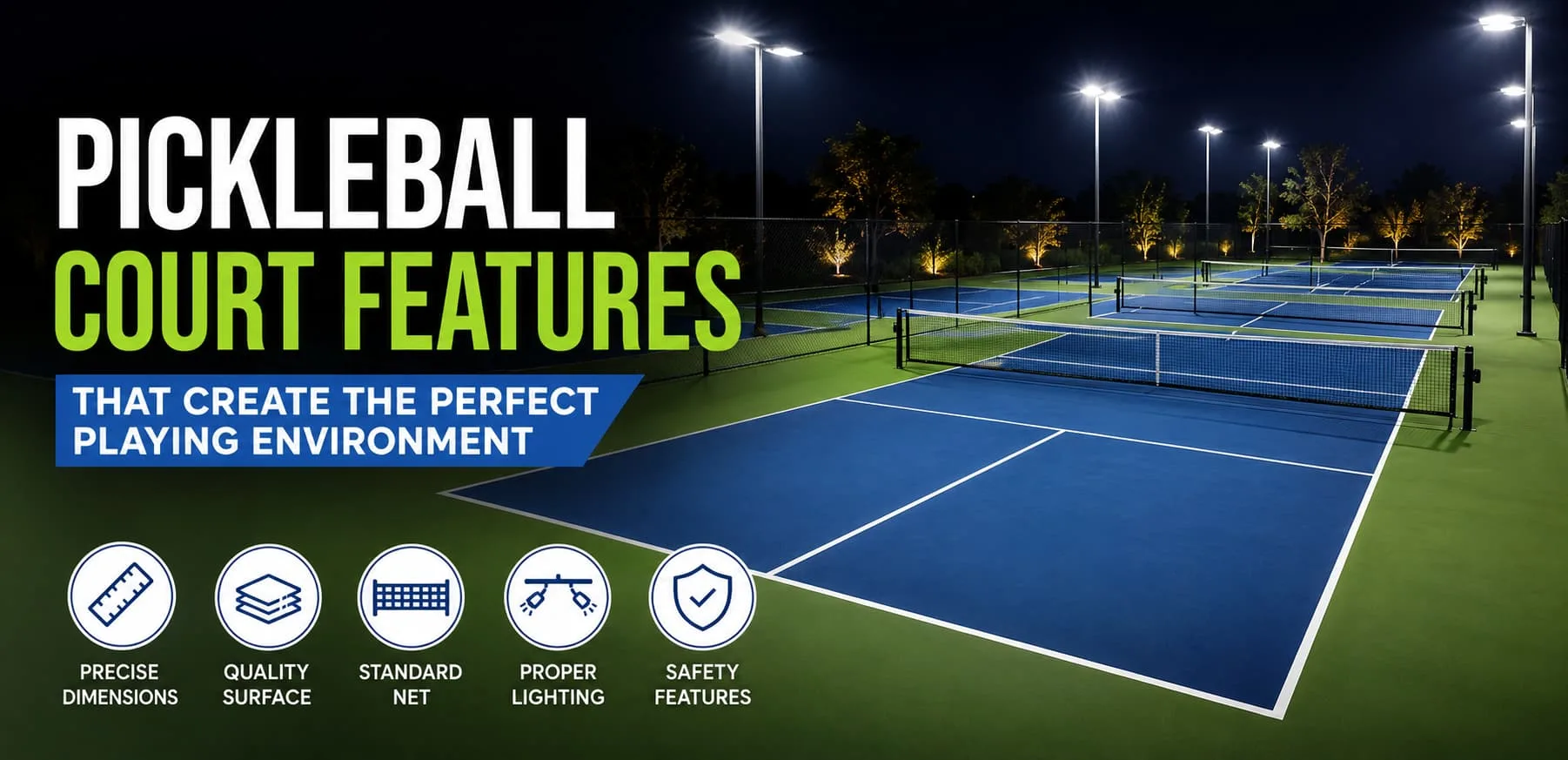
A great game of pickleball does not just happen because two good players showed up. It happens because the pickleball court they are playing on was built right. The surface, the net, the lighting, the fencing, the lines — every single detail shapes how the game feels and how well you play.
Whether you are planning to build your own backyard pickleball court, investing in a commercial facility, or simply curious about what makes a court genuinely good — this guide covers every feature that creates the perfect playing environment. And by the end, you will know exactly what to look for and what to demand.
Pickleball Court Design and Layout — Start With the Foundation
Everything starts with the pickleball court layout and pickleball court design. Get this wrong and no amount of quality material or premium lighting will fix it.
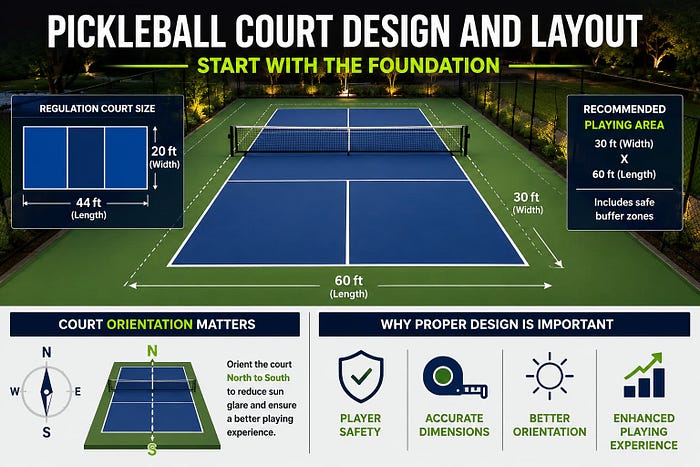
A regulation pickleball court measures 20 feet wide by 44 feet long — that is the standard pickleball court size for both singles and doubles play. The total recommended playing area including safe buffer zones is 30 feet wide by 60 feet long. This extra space around the court is not optional — it is what keeps players safe when they sprint for wide balls.
Understanding pickleball court dimensions and pickleball court measurements before construction begins saves you from expensive mistakes later. A court that is even slightly off will feel wrong the moment you start playing on it.
One thing most people miss during pickleball court design is orientation. Pickleball court orientation should always be north to south for outdoor courts. This prevents players from looking directly into the sun during morning or late afternoon play — a simple detail that makes a massive difference to the playing experience.
Pickleball Court Surface — The Feature That Affects Everything
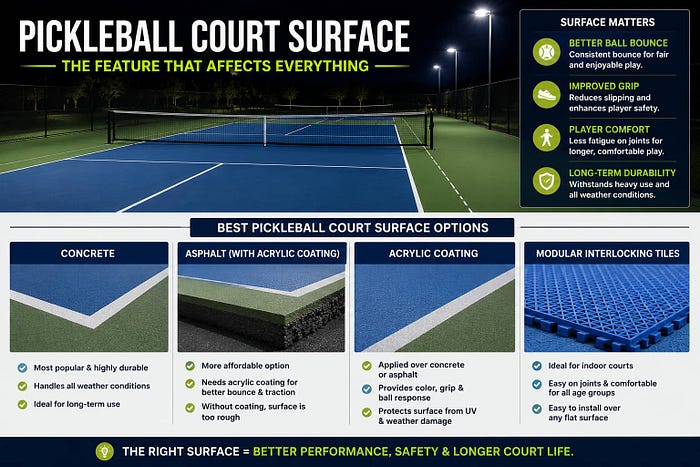
If there is one feature that impacts your game more than anything else, it is the pickleball court surface. The surface determines ball bounce, player grip, comfort, and long-term durability of the court.
What is the best pickleball court surface?
Concrete is the most popular choice and for good reason. A concrete pickleball court is highly durable, handles all weather conditions well, and holds up under heavy use for years. It is the go-to base for most serious facilities across India.
Asphalt is a more affordable alternative but requires an acrylic coating on top to give proper ball bounce and traction. Without the coating, asphalt alone is too rough and unpredictable.
Acrylic coating is what goes on top of concrete or asphalt to create the actual playing surface. This is what gives the court its color, its grip level, and its ball response. Premium acrylic coatings also protect the base from weather damage and UV exposure — very important for outdoor pickleball courts in India.
Modular interlocking tiles are another option used in indoor pickleball courts. They can be installed over any flat surface and are easier on joints — a good choice for older players or high-usage indoor facilities.
The pickleball court material you choose for the surface directly affects how long your court lasts and how much maintenance it needs. Always invest in the right surface from the beginning — cutting corners here costs more in the long run.
Pickleball Court Color, Paint, and Markings
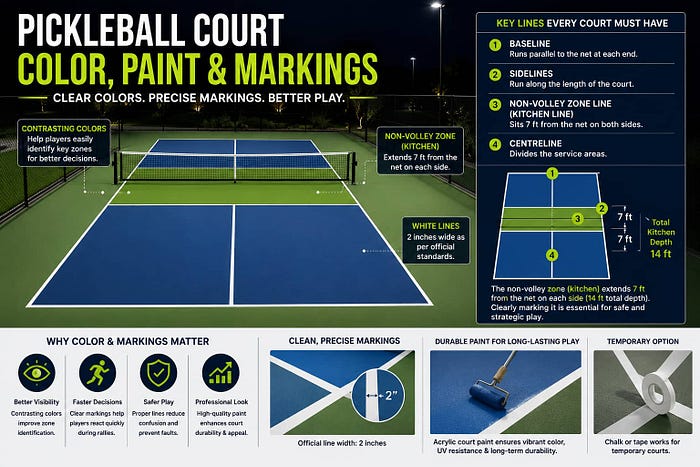
This is one of the most underrated features of a great pickleball court. The right pickleball court color and pickleball court paint do not just make the court look good — they make it easier and safer to play on.
The playing area is typically painted in one color and the kitchen zone in a contrasting color. This contrast helps players instantly identify the pickleball non volley zone — also called the kitchen — during fast-paced rallies. When the colors are clearly different, players make better decisions faster.
Pickleball court markings and pickleball court lines must be white and 2 inches wide according to official standards. The pickleball court line width matters because lines that are too narrow or faded create confusion during competitive play.
Key lines every court must have:
- Baseline — runs parallel to the net at each end
- Sidelines — run along the length of the court
- Non-volley zone line — also called the pickleball kitchen line, sits 7 feet from the net on both sides
- Centreline — divides the service areas
The pickleball non volley zone extends 7 feet from the net on each side — making the total kitchen depth 14 feet across both sides. This zone is where most of the strategic action in pickleball happens, so having it clearly marked is non-negotiable.
For temporary courts, chalk or tape works fine for pickleball court markings. For permanent courts, acrylic pickleball court paint that matches the surface coating gives the best durability and visibility.
Pickleball Court Net — The Heart of the Game
No pickleball court is complete without the right net. And there is more to a pickleball court net than most people think.
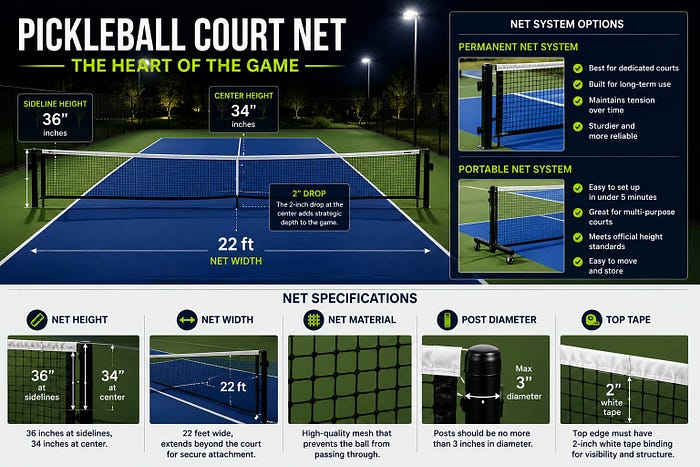
Pickleball net height is 36 inches at the sidelines and 34 inches at the center. That 2-inch drop at the center is intentional — it creates different shot angles and adds strategic depth to the game. Pickleball net size spans 22 feet wide, extending slightly beyond the 20-foot court width to attach securely to the posts.
Permanent pickleball net systems are the best choice for dedicated courts. They are built for sustained use, maintain proper tension over time, and are far sturdier than portable options. If your court serves multiple purposes or needs to be moved, a portable pickleball net is a practical alternative — modern portable nets are easy to set up in under 5 minutes and still meet official height standards.
The net material should be mesh that does not allow the ball to pass through. Posts should be no more than 3 inches in diameter and placed exactly 22 feet apart. The top edge of the net must have a 2-inch white tape binding for visibility and structure.
Pickleball Court Lighting — Play Beyond Sunset
Good pickleball court lighting is not a luxury. For any court that expects evening use — which is most courts in India given the heat during the day — it is absolutely essential.
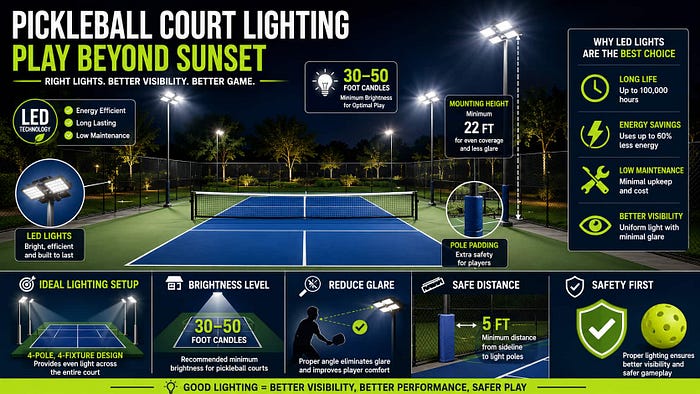
The right pickleball court lights setup uses LED lights for two key reasons. First, LED lights for pickleball court setups last up to 100,000 hours compared to 12,000 hours for older HID lamps. Second, LEDs cost significantly less to run and require almost no maintenance. For a single pickleball court, a four-pole four-fixture LED design gives even coverage across the entire playing surface.
Pickleball court lighting requirements call for a minimum brightness of 30 to 50 foot candles across the court. Light fixtures should be mounted at least 22 feet high and angled properly to eliminate shadows and reduce glare. Glare is a serious issue — if a player looks up to track a lob and gets blinded by a light, it becomes both a performance and safety problem.
A minimum distance of 5 feet from the sideline to light poles is recommended. If poles are inside the fence line, padding should be added to protect players from impact during play.
Pickleball Court Fencing — Safety, Containment, and Focus
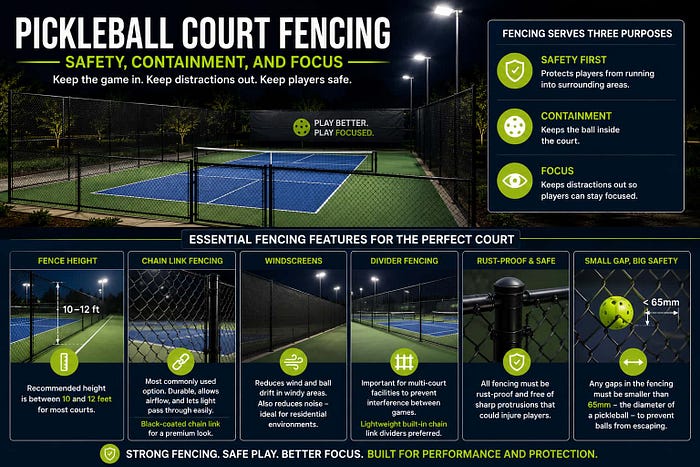
Pickleball court fencing serves three purposes — keeping the ball inside the court, keeping distractions out, and protecting players from running into surrounding areas.
The recommended pickleball court fence height is between 10 and 12 feet for most courts. Chain link fencing is the most commonly used option because it is durable, allows airflow, and lets light pass through easily. For a more premium appearance, black-coated chain link is the preferred choice at professional facilities.
In windy areas — which matters for outdoor pickleball courts across many Indian cities — windscreens can be attached to the fencing to reduce ball drift during play. Windscreens also reduce noise, which is useful in residential areas.
For facilities with multiple courts, divider fencing between courts is important to prevent interference between games. A lightweight built-in chain link divider is the preferred option for its durability and clean look.
All fencing must be rust-proof and free of sharp protrusions that could injure players. Any gaps in the fencing must be smaller than 65mm — the diameter of a pickleball — to prevent balls from escaping the court area.
Pickleball Court Base, Drainage, and Slope
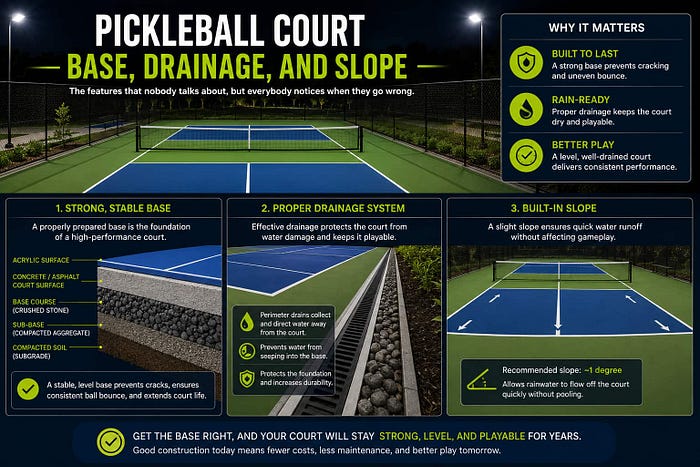
The features that nobody talks about but everybody notices when they go wrong.
The pickleball court base is the foundation everything else sits on. It needs to be stable, level, and properly prepared before any surface material is applied. A poorly prepared base leads to cracking, uneven bounce, and expensive repairs down the line.
Pickleball court drainage is equally important — especially for outdoor pickleball courts in India where monsoon rain is a reality. A pickleball court slope of approximately 1 degree is built into proper court construction to allow rainwater to run off the surface quickly without pooling. Perimeter drainage systems further protect the base from water damage over time.
Getting the pickleball court base and drainage right during pickleball court construction prevents the most common and costly problems courts face after a few years of use.
Pickleball Court Flooring for Indoor Courts
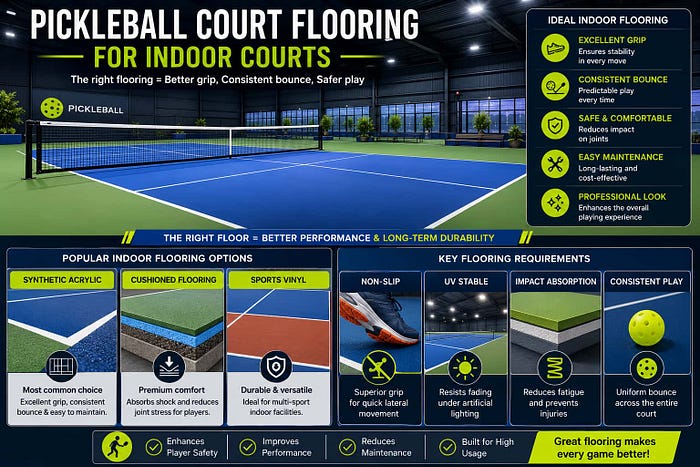
For indoor pickleball courts, the flooring choice is one of the most important decisions you will make. Unlike outdoor courts where concrete and acrylic dominate, indoor courts have more options.
Synthetic acrylic flooring is the most common choice — it offers excellent grip, consistent ball bounce, and is easy to maintain. Cushioned synthetic systems are a premium option that absorb shock and reduce joint stress — ideal for older players or high-frequency use facilities.
Good pickleball court flooring for indoor use should be non-slip, UV stable under artificial lighting, and capable of handling the lateral movement that pickleball demands. Poor flooring in an indoor court is a safety risk, not just a performance issue.
Pickleball Court Resurfacing and Maintenance
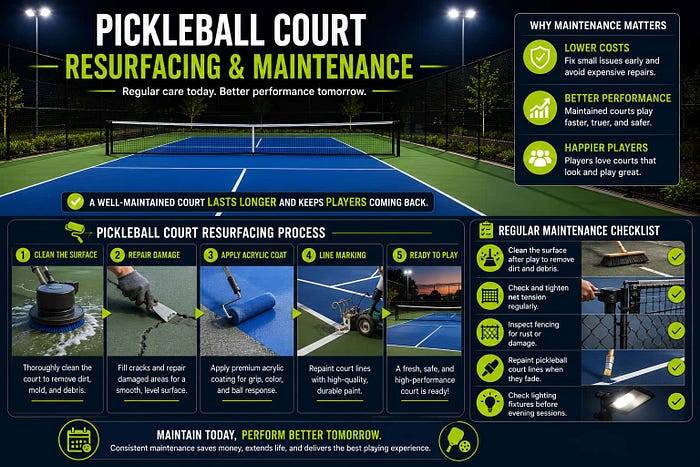
Even the best pickleball court surface needs care over time. Pickleball court maintenance done regularly is far cheaper than letting small problems become big ones.
Surface cracks should be filled as soon as they appear. The acrylic coating on the surface typically lasts 5 to 8 years before it needs refreshing. Pickleball court resurfacing involves cleaning the existing surface, repairing any damage, and applying a fresh acrylic coat to restore grip, color, and ball response.
Regular pickleball court maintenance also includes:
- Cleaning the surface after play to remove dirt and debris
- Checking and tightening net tension regularly
- Inspecting fencing for rust or damage
- Repainting pickleball court lines when they fade
- Checking lighting fixtures before evening sessions
A well-maintained court lasts significantly longer and keeps players coming back. Neglected courts lose players fast.
Pickleball Court Construction Cost in India
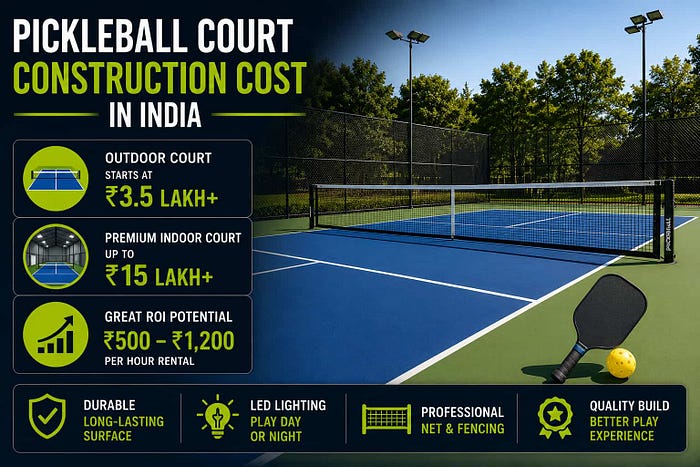
So how much does all of this cost to build?
Pickleball court construction in India typically ranges from ₹3.5 lakh for a basic outdoor pickleball court with a concrete pickleball court base and acrylic coating, up to ₹15 lakh for a premium indoor pickleball court with cushioned flooring, full pickleball court lighting, fencing, and professional pickleball court installation.
What is the cheapest way to build a pickleball court? Start with an outdoor concrete base, basic acrylic surface, a portable pickleball net, and simple chain link pickleball court fencing. This keeps costs at the lower end while still giving you a proper playing surface.
How much investment is needed for pickleball commercially? Factor in pickleball court installation, lighting, fencing, net systems, and surface — a well-equipped commercial court can be set up for ₹8 to ₹15 lakh per court. With court rentals averaging ₹500 to ₹1,200 per hour across Indian cities, the return on investment is strong.
How much will it cost to build a pickleball court in India for a backyard setup? A simple backyard pickleball court with concrete base, acrylic surface, and a portable net can be done for ₹3.5 to ₹5 lakh depending on your location and finishing choices.
Final Word
A perfect pickleball court is not just about size and lines. It is about every feature working together — the right pickleball court surface, proper pickleball court lighting, solid pickleball court fencing, correct pickleball net height, clear pickleball court markings, good pickleball court drainage, and smart pickleball court design from the ground up.
Whether you are building from scratch, planning a backyard pickleball court, or looking to improve an existing facility — now you know exactly what a perfect playing environment looks like.
And if you want to experience what a properly built, professionally maintained pickleball court actually feels like before you build your own — 3rd Shot by Strokess in Vadodara is the place to visit. It is Vadodara‘s premier pickleball court where every feature on this list has been done right.