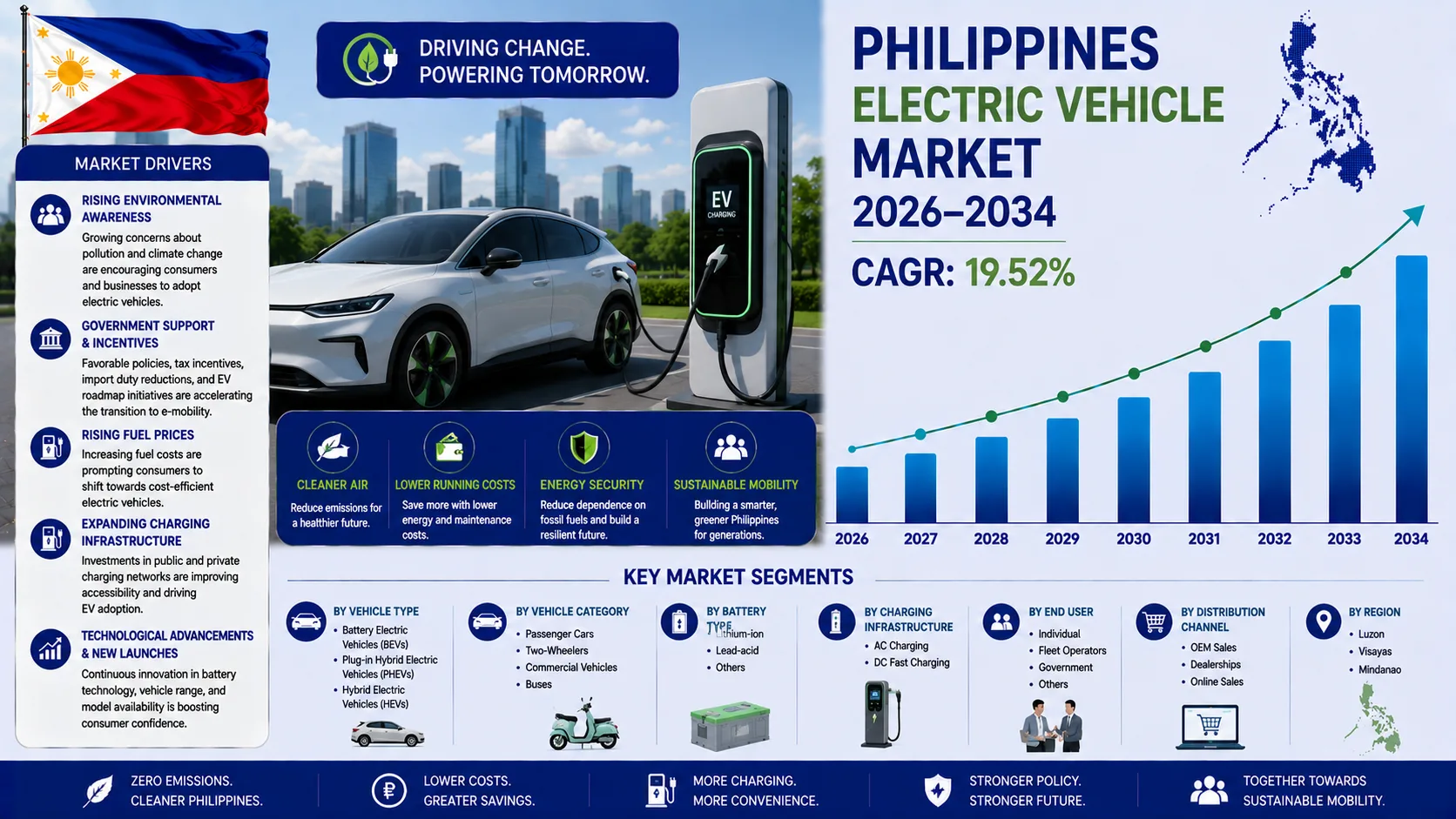
The Philippines electric vehicle market size reached USD 4.1 Billion in 2025 and is projected to reach USD 21.2 Billion by 2034, exhibiting a CAGR of 19.52% during 2026-2034. The market is gaining momentum, supported by growing environmental awareness, improving charging infrastructure, and evolving regulatory frameworks. Consumers are increasingly attracted to low-emission mobility options, while investment in clean transportation continues to rise across urban and regional areas. In May 2024, government authorities confirmed the extension of a zero-tariff policy on EVs, e-motorcycles, e-bicycles, hybrid units, and associated parts until 2028.
Request a Sample Report for In-Depth Market Insights: https://www.imarcgroup.com/philippines-electric-vehicle-market/requestsample
Philippines Electric Vehicle Market Summary
- The Philippines electric vehicle market encompasses battery electric vehicles (BEVs), fuel cell electric vehicles (FCEVs), plug-in hybrid electric vehicles (PHEVs), and hybrid electric vehicles (HEVs), serving passenger and commercial vehicle applications.
- These vehicles are valued for their role in providing low-emission mobility solutions, reducing greenhouse gas emissions, and supporting sustainable transportation.
- The ecosystem includes EV manufacturers (VinFast, Wardwizard), component suppliers, charging infrastructure providers, government agencies (Department of Energy), and consumers.
- Major segments identified in the market include component (battery cells and packs, on-board charger, fuel stack), charging type (slow charging, fast charging), propulsion type (BEV, FCEV, PHEV, HEV), vehicle type (passenger vehicles, commercial vehicles), and region (Luzon, Visayas, Mindanao).
- The market is benefiting from a comprehensive incentive framework and wider adoption driven by infrastructure and registrations.
- In March 2025, VinFast partnered with Motech in the Philippines to enhance after-sales service for electric vehicle owners.
PORTER'S FIVE FORCES ANALYSIS
- Competitive Rivalry: Moderate, with established automotive brands, emerging EV manufacturers (VinFast), and new entrants competing on technology, pricing, and model range. Business implication: Companies must differentiate through technology, after-sales service, and partnerships.
- Supplier Power (Battery and Components): Moderate. Suppliers of battery cells and EV components have some leverage, but the presence of multiple global suppliers and government incentives for local assembly moderates this power. Business implication: Manufacturers should maintain diverse supplier relationships and invest in local assembly.
- Buyer Power (Consumers): Moderate. Consumers have growing choice among EV models and brands, but limited charging infrastructure and model availability in some segments give manufacturers some leverage. Business implication: Brands must focus on affordability, range, and after-sales support.
- Threat of Substitutes: Moderate. Conventional internal combustion engine vehicles and public transport compete, but government incentives and environmental benefits support EV adoption. Business implication: The industry should emphasize total cost of ownership and environmental benefits.
- Threat of New Entrants: Moderate. Higher barriers for established manufacturers (scale, technology, regulatory compliance), but lower barriers for new EV brands and partnerships. Business implication: Established players should build defensible positions through technology, brand, and after-sales network.
MARKET GROWTH DRIVERS
Comprehensive Incentive Framework for Electric Vehicle Adoption
The Philippine government has instituted a robust framework of fiscal and regulatory incentives designed to accelerate the adoption and integration of electric vehicles (EVs). These include an expanded tariff exemption program under Executive Order No. 12, now applying to a broader range of electric and hybrid vehicles and their components. In May 2024, government authorities confirmed the extension of a zero-tariff policy on EVs and associated parts until 2028, enhancing affordability and market accessibility, reflecting a deliberate effort to promote sustainable urban mobility.
Wider Adoption Driven by Infrastructure and Registrations
Electric vehicle adoption in the Philippines continues to accelerate, supported by coordinated developments in infrastructure, policy implementation, and consumer awareness. The expansion of public charging stations, guided by the Department of Energy's long-term targets, is ensuring greater accessibility across key regions. In February 2025, the Electric Vehicle Association of the Philippines confirmed that newly registered electric vehicles had already surpassed 10,000 units within the first half of the previous year, exceeding the total for the entire previous year.
Improved Policy Alignment and Public Participation
Government and private sector coordination continues to drive the pace of electric vehicle deployment in the Philippines. National initiatives and multi-stakeholder partnerships have helped to promote awareness, enhance access, and define long-term vision for sustainable mobility. Government departments and industry associations are proactively engaged through forums like the Philippine Electric Vehicle Summit, which enhances information sharing and policy discussion. Programs like the Electric Vehicle Incentive Strategy (EVIS) are being designed to offer holistic support.
PHILIPPINES ELECTRIC VEHICLE MARKET SEGMENTATION
Component Insights:
- Battery Cells and Packs
- On-Board Charger
- Fuel Stack
Charging Type Insights:
- Slow Charging
- Fast Charging
Propulsion Type Insights:
- Battery Electric Vehicle (BEV)
- Fuel Cell Electric Vehicle (FCEV)
- Plug-In Hybrid Electric Vehicle (PHEV)
- Hybrid Electric Vehicle (HEV)
Vehicle Type Insights:
- Passenger Vehicles
- Commercial Vehicles
- Others
Regional Insights:
- Luzon
- Visayas
- Mindanao
COMPETITIVE LANDSCAPE
The Philippines electric vehicle market features a competitive landscape of established automotive brands, emerging EV manufacturers, and new entrants competing on technology, pricing, and model range. Competition is intensifying as companies invest in technology, after-sales service, and partnerships. Differentiation occurs through technology, after-sales support, and strategic partnerships.
Key players mentioned in the report context include:
- VinFast (partnered with Motech for after-sales service)
- Wardwizard Innovations & Mobility (partnered for public transportation)
- (Complete list provided in the full report)
REGIONAL ANALYSIS
- Luzon: The largest market, driven by the concentration of economic activity, population density, and improving charging infrastructure in Metro Manila and surrounding regions. Luzon leads in EV adoption, registrations, and infrastructure deployment.
- Visayas: A growing market with expansion driven by increasing urbanization, tourism-related transportation needs, and growing awareness of sustainable mobility options. Charging infrastructure development is gradually expanding.
- Mindanao: An emerging market with growth potential, supported by improving infrastructure, increasing investment in clean transportation, and growing consumer interest in low-emission vehicles.
RECENT INDUSTRY DEVELOPMENTS
August 2026: Electric-vehicle adoption accelerated sharply despite a slowdown in the overall Philippine automotive market. During the first half of 2026, total vehicle sales declined 11.4% year-on-year to 204,557 units, while electrified-vehicle (xEV) sales jumped 132.7% to 31,381 units, giving xEVs a 15.34% share of total sales.
August 2026: Battery-electric vehicles continued gaining traction. H1 2026 BEV sales reached 8,702 units, representing 27.73% of total xEV sales. VinFast led the BEV segment with 3,142 units, followed by Tesla with 2,374 and Omoda & Jaecoo with 1,484 units.
August 2026: Plug-in and conventional hybrid vehicles also recorded strong growth. PHEV sales reached 5,531 units in H1 2026, while HEV sales totaled 17,148 units. Overall xEV sales in June alone reached 6,995 units, including 3,193 BEVs, 1,681 PHEVs and 2,121 HEVs.
August 2026: Government policy received a major boost with Executive Order No. 121, which established the Electric Vehicle Incentive Strategy (EVIS) Program. The program provides up to PHP 60 billion in fiscal support for qualified local EV and component manufacturers, including fixed investment support of up to 40% of capital expenditure for BEVs and 30% for HEVs.
August 2026: The EVIS framework is designed to strengthen domestic manufacturing rather than relying solely on imported vehicles. Qualified manufacturers must make at least PHP 5 billion in capital investment and introduce enrolled models within three years. Production-volume incentives can reach 12% of the ex-factory price, capped at PHP 200,000 per complete vehicle.
August 2026: EV momentum remained strong in July, even as conventional vehicle sales softened. CAMPI-TMA vehicle sales declined 3% year-on-year to 37,319 units, but xEV sales surged 162% year-on-year, demonstrating that electrified vehicles continued to outperform the broader automotive market.
August 2026: Charging infrastructure and fleet electrification are becoming increasingly important alongside vehicle sales. The DOE is working with other government agencies to streamline EV-charging-station permitting and establish requirements for dedicated EV parking and charging infrastructure. The government is also encouraging local government units to transition their vehicle fleets toward EVs under the EVIDA framework.
Key Aspects Required for the Philippines Electric Vehicle Market
- Market Performance: USD 4.1 Billion in 2025, with a projected trajectory to USD 21.2 Billion by 2034.
- Market Outlook: A 19.52% CAGR through 2034 indicates explosive growth across components, charging types, and vehicle types, driven by government incentives, infrastructure development, and consumer adoption.
- Growth Drivers: Comprehensive incentive framework for EV adoption; wider adoption driven by infrastructure and registrations; improved policy alignment and public participation; growing environmental awareness; and investment in clean transportation.
- Competitive Landscape: A competitive market with established brands, emerging EV manufacturers, and new entrants. Differentiation occurs through technology, after-sales support, and partnerships.
- Value Chain Analysis: From component manufacturing and vehicle assembly through distribution, charging infrastructure, and after-sales service to end-use by consumers, with government policy and infrastructure investment shaping market dynamics.
- Industry Trends: Comprehensive incentive framework for EV adoption; wider adoption driven by infrastructure and registrations; improved policy alignment and public participation; strategic partnerships for after-sales service; and Public Utility Vehicle Modernization Program integration.
- Strategic Recommendations: Invest in EV model development and localization; expand charging infrastructure networks; develop strategic after-sales service partnerships; target public utility vehicle modernization opportunities; and leverage government incentives and tariff exemptions.
Note: If you need any specific information that is not currently covered within the scope of the report, we will provide the same as a part of customization.
Speak to an analyst: https://www.imarcgroup.com/request?type=report&id=42252&flag=C
Report Format, Delivery, and Customization Details
- Report Format Mode: PDF and Excel (Editable version in PPT/Word format available on special request)
- Report Delivery Mode: Online Delivery, Physical Delivery
- Report Delivery Time: report delivered over email within 24 to 48 hours. If requested by the client, a physical copy will be delivered within three to ten days.
- Report Confirmation Mode: Yes, via email
- Report Customization Mode: Yes, via Email / Call
- Report Table of Content: Yes
- Report List of Figures: Yes
- Report Methodology Mode: Yes
- Request For Sample Report: Yes
About Us
IMARC Group is a global management consulting firm that helps the world's most ambitious changemakers to create a lasting impact. The company provides a comprehensive suite of market entry and expansion services. IMARC offerings include thorough market assessment, feasibility studies, company incorporation assistance, factory setup support, regulatory approvals and licensing navigation, branding, marketing and sales strategies, competitive landscape and benchmarking analyses, pricing and cost research, and procurement research.
Contact Us
IMARC Group
134 N 4th St, Brooklyn, NY 11249, USA
Email: [email protected]
Tel No: (D) +91 120 433 0800
United States: +1-201-971-6302