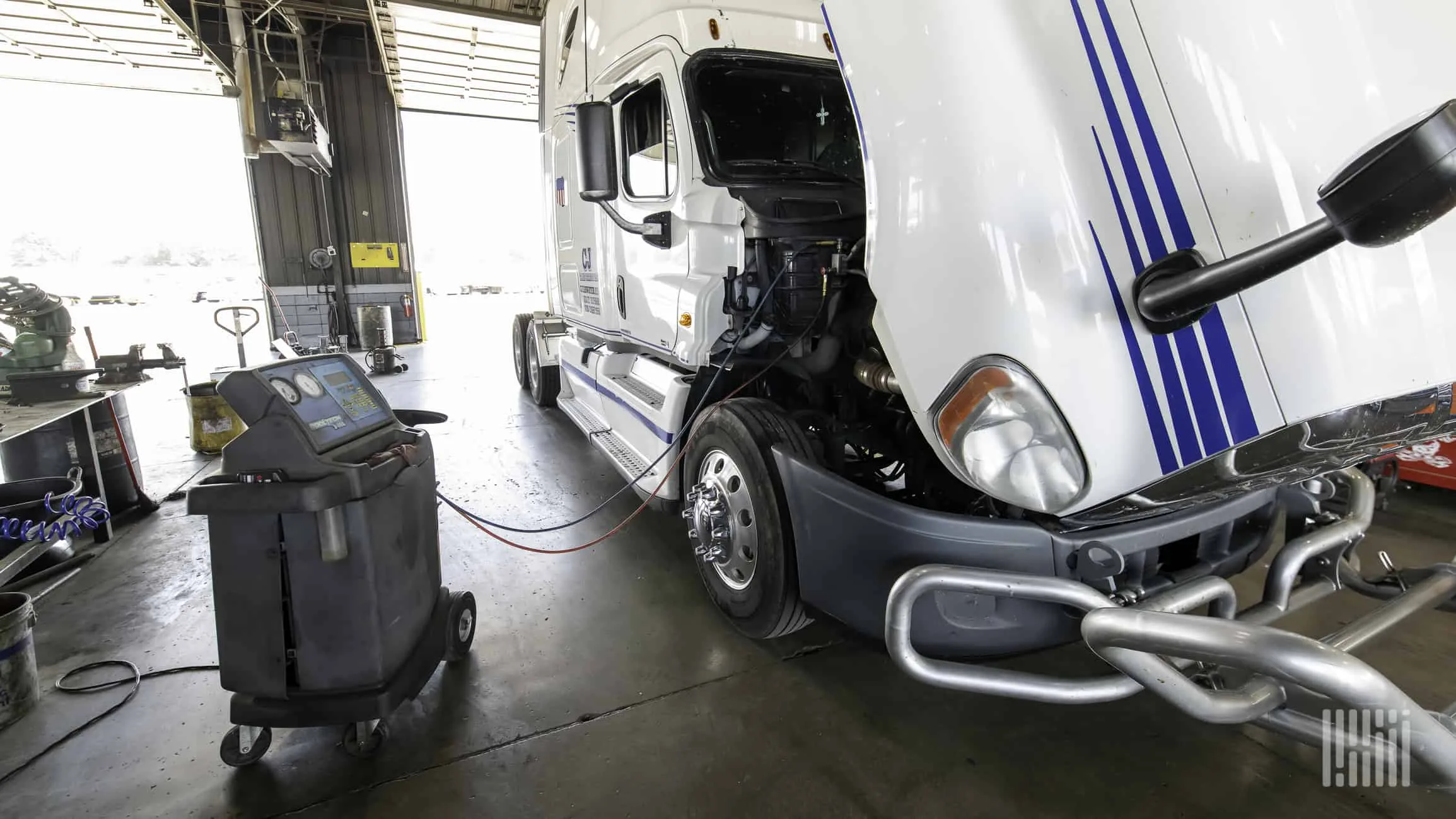
The diagnostic laptop connects. The engine control module responds. The technician can see the system information, but the repair requires a manufacturer-restricted programming function that the available software cannot perform.
At this point, the issue is no longer simply identifying a mechanical problem. It is determining who has the authorization, equipment, and technical access needed to finish the job.
For commercial truck owners, the choice between diesel diagnostic tools vs. dealer service can influence repair costs, workshop scheduling, warranty claims, and equipment availability.
A dealership is not automatically necessary for every electronic problem. Likewise, an independent repair facility cannot be expected to perform every factory-controlled procedure.
The deciding factor is whether the repair provider has the technical capability and authorization required for the specific vehicle and service.
Key Takeaways
- Dealer-level diagnostic equipment is not the same as unrestricted manufacturer programming access.
- Dealerships are often the appropriate route for manufacturer-paid warranty work, recalls, and restricted factory procedures.
- Qualified independent diesel shops can perform many commercial truck diagnostics and repairs.
- The right provider depends on the required service, software access, warranty status, and repair capabilities.
What Can Modern Diesel Diagnostic Tools Actually Do?
Modern commercial trucks depend on electronic control modules that manage engine operation, fuel injection, emissions systems, and other vehicle functions.
Professional diesel diagnostic tools communicate with supported vehicle modules to retrieve fault information, monitor operating parameters, and perform available service tests.
Depending on the software, vehicle platform, and access permissions, technicians may be able to perform:
- Electronic control module communication.
- Live operating-data monitoring.
- Component activation and functional testing.
- Aftertreatment system evaluations.
- Supported calibrations and service procedures.
However, diagnostic capability varies considerably.
A multifunction scanner might provide broad coverage across several truck manufacturers while offering limited programming functions. Manufacturer-specific software may support more specialized operations, subject to subscription and authorization requirements.
Dealer-level diagnostics describes a category of advanced diagnostic capability. It does not necessarily mean a shop has every function available to an authorized dealership.
The Diesel Scanner Trap: Advanced Tools, Limited Access
The difference between diagnostic equipment often comes down to software coverage, communication protocols, and manufacturer permissions.
Heavy-duty vehicles commonly use diagnostic communication systems such as SAE J1939, while older equipment may use different protocols.
A tool must support the relevant vehicle systems before it can retrieve useful information.
Commercial platforms involving Cummins, Detroit Diesel, Caterpillar, Volvo, and International equipment may also require different software environments.
A qualified provider offering commercial truck diagnostics should understand which tools are compatible with the vehicle and which procedures require additional access.
Technology alone is not sufficient. Technicians must interpret the information correctly and understand the mechanical systems being evaluated.
Management author Peter Drucker famously observed:
"The most important thing in communication is hearing what isn't said." — Peter Drucker
The same principle applies to diagnostic work: information that does not appear directly on a screen may still matter. Physical inspections, operating conditions, and mechanical testing can reveal concerns electronic systems cannot establish independently.
When Is Dealership Service the Right Choice?
A dealership becomes particularly relevant when the required work involves manufacturer-administered programs or restricted technical procedures.
Commercial truck owners should consider dealership truck service when dealing with:
- Applicable manufacturer warranty claims.
- Open safety recalls.
- Manufacturer-directed service campaigns.
- Restricted programming or security authorization.
- Repairs requiring factory support unavailable to the selected independent facility.
These circumstances do not mean independent shops lack technical ability. They concern access, authorization, and who is responsible for completing or paying for the work.
A dealership may also have direct access to manufacturer technical assistance for unusual problems involving newly introduced vehicle systems.
Can Advanced Diagnostic Tools Bypass Factory Restrictions?
Some electronic repairs involve changing more than a mechanical component.
Replacing an engine control module, for example, may require compatible software, vehicle-specific configuration, programming, and verification.
Certain ECM programming services depend on manufacturer credentials, software licenses, approved procedures, or secure system access.
An independent facility with the appropriate tools and authorizations may be capable of performing some of these operations.
Others may remain restricted to authorized channels.
Before arranging diesel engine diagnostics, owners should determine whether the job requires diagnostic evaluation, programming, or both.
Confusing these services can lead to unnecessary transfers between repair providers.
The Dealership Question Gets Serious With Recalls
Safety recalls create an important distinction between ordinary repairs and manufacturer-directed corrective work.
According to the National Highway Traffic Safety Administration (NHTSA), more than 29.3 million vehicles were recalled in the United States during 2024. The national figure includes vehicle categories beyond commercial trucks, but it demonstrates why checking recall status matters.
An applicable safety recall generally requires owners to arrange the prescribed remedy through the manufacturer-authorized repair network at no charge.
Fleet managers and owner-operators should check the vehicle identification number for outstanding recalls before authorizing potentially related repairs elsewhere.
A vehicle's age or current operating condition does not establish whether a recall applies.
Dealer vs. Independent Diesel Shop: Who Can Fix It?
Choosing between an independent diesel repair shop and an authorized dealership depends on the truck's diagnostic requirements, manufacturer warranty status, and the technical access needed to complete the repair. Both can handle commercial truck repairs, but their equipment capabilities and authorization levels may differ.
Independent Diesel Shop vs. Authorized Dealership
1. Diesel Engine Diagnostics
- Independent Diesel Shop: Can evaluate engine faults using compatible professional diagnostic equipment.
- Authorized Dealership: Uses manufacturer-supported diagnostic systems and procedures.
2. Dealer-Level Diagnostic Tools
- Independent Diesel Shop: May offer advanced testing, depending on software licenses and vehicle compatibility.
- Authorized Dealership: Typically has manufacturer-specific diagnostic access.
3. ECM Programming and Calibration
- Independent Diesel Shop: Can perform supported programming with the required software and authorization.
- Authorized Dealership: Often handles restricted factory programming and configuration.
4. Diesel Performance Problems
- Independent Diesel Shop: Can investigate power loss, drivability issues, and engine performance concerns.
- Authorized Dealership: Can diagnose performance issues using manufacturer-specific procedures.
5. Manufacturer Warranty Repairs
- Independent Diesel Shop: May diagnose problems, but manufacturer-paid repairs can require authorization.
- Authorized Dealership: Commonly handles warranty claims and approved repairs.
6. Safety Recalls and Factory Updates
- Independent Diesel Shop: May identify applicable recalls or service campaigns.
- Authorized Dealership: Normally performs authorized recall remedies and factory-directed updates.
7. Commercial Truck and Trailer Repairs
- Independent Diesel Shop: Can handle mechanical, electrical, and trailer repairs within its capabilities.
- Authorized Dealership: Can service supported trucks and systems; trailer repair capabilities vary.
A dealership is often appropriate when repairs involve manufacturer warranty coverage, safety recalls, or restricted factory programming. For other diagnostic and mechanical problems, an independent diesel specialist with compatible tools and relevant technical experience may be a suitable choice.
The deciding factor is whether the provider can complete the required work, including any programming, calibration, and post-repair verification, without unnecessary service transfers.
Does Using an Independent Shop Put Your Warranty at Risk?
Not automatically. However, commercial truck warranties require careful review because manufacturer coverage, engine warranties, extended protection plans, and commercial service agreements may have different conditions.
Owners should check the actual contract before authorizing repairs involving covered components.
The Federal Trade Commission explains that certain consumer warranties cannot be invalidated solely because an independent provider performed service. However, the Magnuson-Moss Warranty Act does not generally cover products sold for commercial purposes, so its consumer protections should not be assumed to apply to every heavy-duty fleet vehicle.
For heavy-duty diesel repair, the safer approach is to confirm claim eligibility, authorization requirements, and documentation obligations with the warranty administrator.
If manufacturer payment is involved, dealership coordination may be necessary even when an independent technician can identify the problem.
A Kansas City Repair Decision That Changes Midway
Consider a hypothetical owner-operator whose truck develops an intermittent communication problem after a replacement electronic control module is installed.
The independent shop has equipment capable of reading the truck's module information and checking the relevant communication network.
During the repair, the technician determines that completing the installation requires a manufacturer-authorized software configuration.
The shop can perform the available diagnostic work but cannot complete that restricted step with its current authorization.
Rather than attempting unsupported programming, the owner arranges the required factory procedure through an authorized service channel.
This is an example of diesel truck diagnostics reaching a legitimate equipment-access limit, not evidence that the original technician lacked mechanical expertise.
Do This, Not That When Choosing Diagnostic Service
Do This
- Confirm whether the repair requires restricted manufacturer programming.
- Check manufacturer warranty and recall eligibility.
- Verify software compatibility with the truck's actual platform.
- Ask whether programming access is available for the required procedure.
- Confirm whether the shop can complete and validate the repair.
Not That
- Assume every scanner supports every factory function.
- Pay for work before reviewing possible coverage.
- Choose a provider solely because it advertises advanced tools.
- Assume dealer-level diagnostic capability includes all authorizations.
- Arrange additional work without understanding service limitations.
These distinctions help owners choose the provider appropriate to the repair rather than treating every electronic problem as a dealership-only issue.
When Does an Independent Diesel Specialist Make Sense?
An independent facility can be an appropriate choice for commercial diesel repair when it has the equipment, technician experience, and technical access necessary for the work.
That may include drivability evaluations, electrical troubleshooting, engine repairs, diesel performance assessments, and mechanical concerns unrelated to factory-administered campaigns.
For mixed fleets, access to technicians familiar with different diesel platforms can be particularly useful.
The decision should not be based on assumptions that all independent shops offer lower prices or that all dealerships deliver faster repairs.
Instead, owners should evaluate the specific repair requirements, available appointments, warranty arrangements, and whether additional service transfers are likely.
Conclusion: Choose the Service That Can Finish the Job
Choosing between diesel diagnostic tools vs. dealer service should not become an automatic decision based on the sign outside a repair facility.
Independent specialists can perform many advanced diesel diagnostic and mechanical procedures. Dealerships remain important when manufacturer authorization, covered repairs, recalls, or restricted factory functions determine how the job must be completed.
For drivers, owner-operators, and fleets across Independence and the Kansas City area, TBC truck trailer repair and Diesel Performance offers dealer-level diesel diagnostics, commercial truck and trailer repairs, and performance-related service options for a range of heavy-duty vehicle platforms.
Frequently Asked Questions
1. Can Independent Shops Perform Dealer-Level Diesel Diagnostics?
Yes. Qualified independent shops can use advanced manufacturer-compatible equipment for many electronic tests. Actual functions depend on software, subscriptions, vehicle compatibility, and access permissions.
2. What Is the Difference Between Diagnostics and ECM Programming?
Diagnostics involves investigating system behavior and faults. ECM programming involves installing or changing software or configuration information in a control module.
3. When Should a Commercial Truck Go to a Dealership?
A dealership is often appropriate for manufacturer warranty claims, open safety recalls, restricted programming, and factory service procedures unavailable through the selected independent provider.
4. Are Dealership Diagnostic Services Always More Expensive?
Not necessarily. Pricing depends on labor, testing requirements, repair procedures, and coverage arrangements. Manufacturer-paid work may change the owner's actual expense.
5. Can an Independent Diesel Shop Diagnose Engine Performance Problems?
Yes, provided the shop has suitable equipment and experience with the engine platform. Some subsequent repairs may still require manufacturer-specific access.