
Market Overview
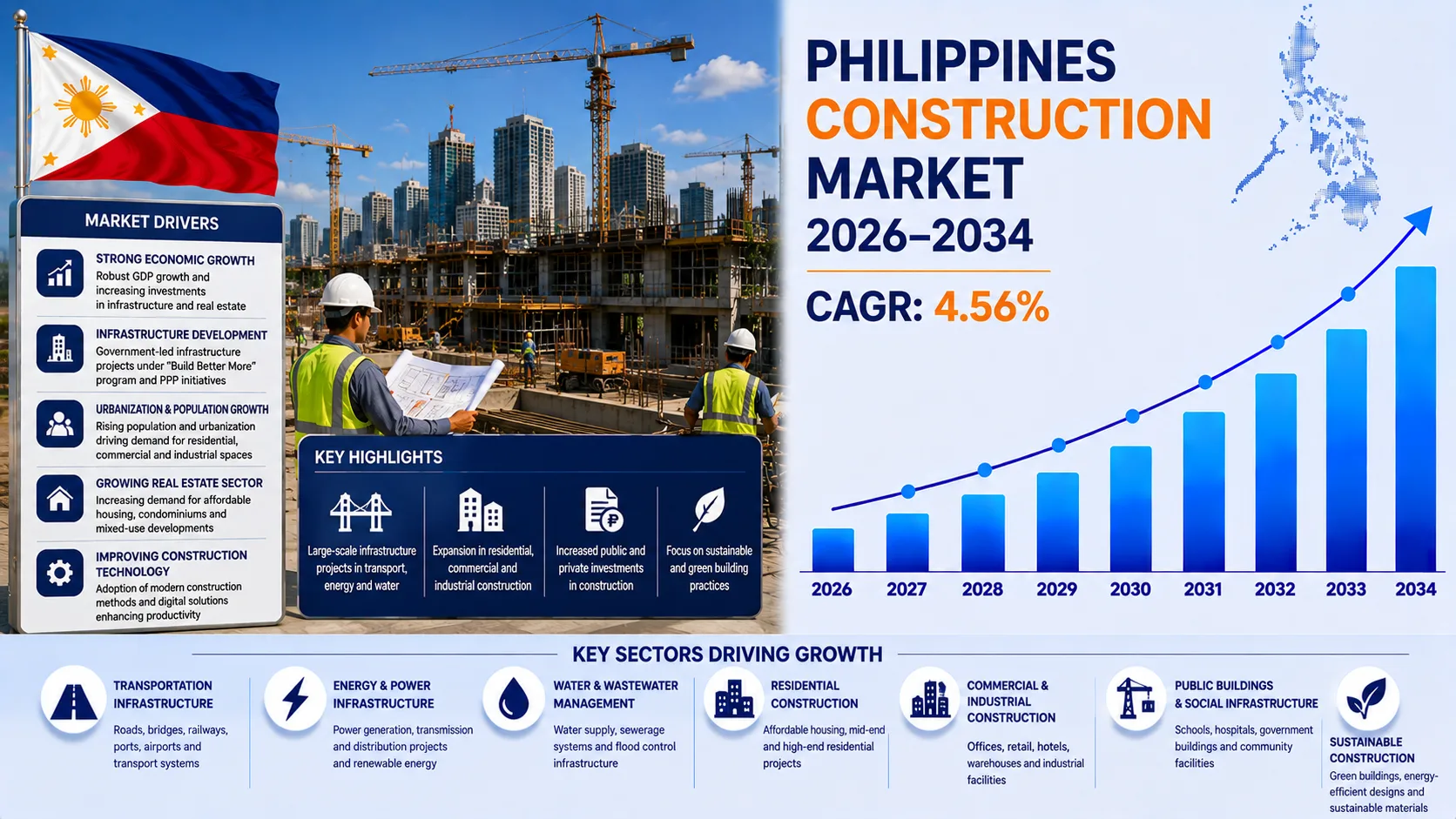
The Philippines construction market is experiencing steady growth, driven by rising infrastructure investments, rapid urbanization, government-backed projects, growing foreign direct investments, increasing demand for residential and commercial spaces, expansion of transport networks, and technological advancements in construction methods. The market size reached USD 41.3 Billion in 2025 and is projected to reach USD 61.7 Billion by 2034, growing at a compound annual growth rate (CAGR) of 4.56% from 2026 to 2034.
The market is strategically important to the Philippines' economy as it supports infrastructure modernization, creates employment opportunities, enables economic growth, facilitates foreign investment, and provides housing for a growing urban population.
Request a Sample Report for In-Depth Market Insights: https://www.imarcgroup.com/philippines-construction-market/requestsample
Philippines Construction Market Summary
- The Philippines construction market encompasses a system where residential, commercial, industrial, infrastructure (transportation), and energy and utilities construction projects are planned, financed, and executed across the archipelago.
- These construction services are valued for their role in improving connectivity, providing housing, supporting industrial development, enabling energy generation, and facilitating economic growth.
- The ecosystem includes government agencies (DPWH, PPP Center, DTI-CIAP), construction companies, contractors and developers, material suppliers, foreign investors, industry associations (PCA, SCLP), and consumers across Luzon, Visayas, and Mindanao.
- Major segments identified in the market include sector (residential construction, commercial construction, industrial construction, infrastructure/transportation construction, and energy and utilities construction), and region (Luzon, Visayas, Mindanao).
- The market is benefiting from government infrastructure initiatives (Build Better More program), emphasis on sustainable and green building practices, urban housing boom, industrial and economic zone expansion, foreign direct investments (FDIs), and public-private partnerships (PPPs).
- The Philippine Public-Private Partnership (PPP) Center announced the roll-out of 173 infrastructure projects worth about USD 56 Billion, with transportation, health, and information technology as the main sectors, consisting of 95 solicited projects (USD 21 Billion) and 78 unsolicited projects (USD 37 Billion).
PORTER'S FIVE FORCES ANALYSIS—PHILIPPINES CONSTRUCTION MARKET
Bargaining Power of Suppliers — Moderate
- Construction suppliers include raw material providers (cement, steel, aggregates), equipment manufacturers, and subcontractors. Elevated construction costs are primarily influenced by increasing prices of raw materials, fuel, and labor. Volatility of global commodity markets and dependence on imported materials like steel and cement put additional strain on project budgets.
- The government's commitment to infrastructure generation ensures uninterrupted flow of projects, giving material suppliers consistent demand.
- However, construction firms are increasingly adopting cost-effective strategies such as prefabrication and bulk procurement, which can reduce dependency on individual suppliers.
Bargaining Power of Buyers — Moderate
- Buyers include government agencies, private developers, real estate firms, and individual homeowners. Government-led projects and PPPs give public entities significant bargaining power due to project scale.
- Foreign direct investments bring capital and expertise, giving international investors leverage in negotiating terms with local construction firms.
- Rising demand for both affordable housing and high-rise condominiums creates competition among developers, which can give buyers (homeowners and tenants) more options and negotiating power.
Threat of New Entrants — Moderate
- The construction market has moderate barriers to entry. New entrants can enter through specialized niches (green building, modular construction, infrastructure PPPs) or through partnerships with established firms.
- Technological integration (BIM, automation, prefabrication) allows new entrants with advanced capabilities to compete effectively.
- However, established construction companies have existing relationships with government agencies, material suppliers, and financial institutions, as well as track records that are essential for large-scale project bidding.
Threat of Substitutes — Low
- Construction has no direct substitute for building physical infrastructure, housing, and industrial facilities.
- Alternative construction methods (modular, prefabricated) complement rather than substitute traditional construction, as both are construction approaches.
- The growing emphasis on sustainable and green building practices is creating new construction categories (eco-friendly materials, smart building systems) rather than substituting construction.
Competitive Rivalry — Moderate to High
- The Philippines construction market features competition among local contractors, foreign construction firms, and specialized developers. The continuous expansion of industrial and economic zones guarantees steady demand for construction labor, materials, and services.
- PPPs provide a continuous stream of projects, granting opportunities for both local and foreign contractors, intensifying competition for government infrastructure contracts.
- Competition is also driven by technological adoption (BIM, automation) and sustainability credentials (green building certifications, eco-friendly materials).
MARKET GROWTH DRIVERS
Government Infrastructure Initiatives
The market is driven by large-scale infrastructure programs aimed at improving connectivity and economic growth. The government-funded projects focus on transportation, water resources, energy, and digital infrastructure. The increased construction of road networks, rail systems, and airports facilitates the Philippines construction market growth. The construction of bypass roads enhances logistics efficiency, fostering industrial and commercial development.
Public-private partnerships (PPPs) stimulate foreign investments in infrastructure development with modernized facilities and services. Smart city projects utilize digital solutions for effective urban planning and management. The government's commitment to infrastructure generation ensures that there will be an uninterrupted flow of projects into the construction sector.
According to an industry report, the Philippine Public-Private Partnership (PPP) Center announced the roll-out of 173 infrastructure projects worth about USD 56 Billion, with transportation, health, and information technology as the main sectors. This initiative consists of 95 solicited projects with a value of USD 21 Billion and 78 unsolicited projects with a value of USD 37 Billion.
Emphasis on Sustainable and Green Building Practices
The increasing environmental awareness and evolving industry standards are positively influencing the Philippines construction market outlook. Green building practices reduce energy consumption, waste, and consumption of resources. Developers have started using eco-friendly building materials—recycled concrete, bamboo, and low-carbon cement—to minimize environmental impact.
Smart building systems are being adopted widely, which include features such as light automation, ventilation control, and water management, thereby ensuring maximum energy use. Additionally, there is an increasing number of certification programs to ensure compliance with green building standards. On November 28, 2024, the DTI-CIAP, in collaboration with the Philippine Constructors Association (PCA), convened the 5th Philippine Construction Congress to promote sustainable and innovative building practices.
Urban Housing Boom
The rapid urbanization taking place in the Philippines is propelling a huge growth in residential development particularly in urban areas. Growing population density and a growing middle class are fueling the demand for both budget-friendly housing and high-rise condominiums. Many families are seeking modern housing close to central business areas, schools, and shopping centers leading to an increase in vertical housing projects.
Developer-backed affordable housing programs and government subsidies are targeting the needs of low to mid-income households. This expansion in housing enhances living conditions and greatly increases Philippines construction market demand as it necessitates substantial quantities of materials, skilled labor, and cutting-edge construction techniques.
Industrial and Economic Zone Expansion
The growth of industrial and economic zones of the Philippines is creating huge impetus for the construction industry. The establishment of manufacturing centers, logistics centers, and export processing zones requires massive construction of factories and warehouses as well as associated infrastructures. These developments enhance the industrial backbone of the nation and enhance trade competitiveness.
As the need for state-of-the-art facilities increases, construction firms play a critical role in meeting the requirements of domestic as well as foreign investors. The continuous expansion of these areas guarantees a steady demand for construction labor, materials, and services.
Foreign Direct Investments (FDIs)
Foreign direct investments are crucial for the growth of the construction industry in the Philippines, providing essential capital and expertise for large-scale initiatives. Global investors are directing funds into real estate, commercial developments, and infrastructure projects, creating new opportunities for construction firms.
According to the Philippines construction market analysis, FDIs also promote the implementation of global best practices, advanced technologies, and sustainable construction methods elevating industry standards. Furthermore, foreign investments frequently lead to partnerships with local companies contributing to job creation and enhancing market competitiveness.
PHILIPPINES CONSTRUCTION MARKET SEGMENTATION
- Sector Insights:
- Residential Construction
- Commercial Construction
- Industrial Construction
- Infrastructure (Transportation) Construction
- Energy and Utilities Construction
- Regional Insights:
- Luzon
- Visayas
- Mindanao
COMPETITIVE LANDSCAPE
The Philippines construction market features competition among local contractors, foreign construction firms, and specialized developers. Leading players differentiate through project scale, technological capabilities (BIM, automation), sustainability credentials, PPP experience, and government relationships. The continuous expansion of industrial and economic zones guarantees steady demand for construction labor, materials, and services.
Key players mentioned in the report include various construction companies, contractors, and developers. Notable industry developments include:
- July 2024: The Philippine Domestic Construction Board (PDCB) conducted a 16-hour training course titled "Training Course on Understanding Construction Contracts," aimed at enhancing the expertise of academic professionals in the construction sector, reflecting PDCB's commitment to advancing construction education.
- October 17, 2024: President Ferdinand Marcos Jr. led the groundbreaking ceremony of the MTerra Solar Project, recognized as the world's largest integrated solar and battery storage facility, signifying a significant milestone in renewable energy development.
- November 28, 2024: The DTI-CIAP, in collaboration with the Philippine Constructors Association (PCA), convened the 5th Philippine Construction Congress to promote sustainable and innovative building practices, bringing together industry leaders, stakeholders, and experts.
- MoU Signing: The Society of Construction Law Philippines (SCLP) and the DTI-CIAP signed a MoU to create standardized contract templates and start awareness campaigns and training initiatives on construction rules and standard contract conditions.
REGIONAL ANALYSIS
- Luzon: As the region containing Metro Manila and other major urban centers, Luzon represents the largest construction market in the Philippines. The region benefits from concentration of government infrastructure projects, PPP initiatives, industrial and economic zones, and residential and commercial developments. Major transportation megaprojects (railways, expressways, airports) are concentrated in Luzon.
- Visayas: The Visayas region is experiencing growing construction activity driven by infrastructure development, tourism-related projects (hotels, resorts, airports), and residential and commercial expansion. Major cities like Cebu serve as construction hubs. Port and seaport improvements support inter-island connectivity and economic activity.
- Mindanao: Mindanao represents an emerging construction market with significant growth potential driven by infrastructure development, industrial zone expansion, renewable energy projects (MTerra Solar Project), and rural development initiatives. The region's improving security environment and government focus on balanced regional development support construction activity.
RECENT INDUSTRY DEVELOPMENTS
May 2026: A condo-hotel under construction in Angeles City, Pampanga collapsed, prompting authorities to investigate potential safety and regulatory violations after reports indicated the project was approved as a 9-story building while a 10th-floor swimming pool was allegedly under construction.
May 2026: The Philippine government ended rescue operations following the Angeles City building collapse. The incident resulted in at least four fatalities and 16 missing workers, intensifying scrutiny of construction safety standards and project compliance.
May 2026: Several of the country's largest construction firms expressed interest in participating in upcoming government infrastructure projects, highlighting continued private-sector confidence in the Philippines' infrastructure development pipeline.
May 2026: Arthaland Corp. announced plans to continue launching new projects despite rising construction and operating costs, supported by strategic procurement measures that helped stabilize material expenses.
February 2026: The Department of Public Works and Highways (DPWH) reaffirmed support for major infrastructure projects under the 2026 budget, including the Panglao–Tagbilaran Offshore Bridge Connector, Fourth Cebu–Mactan Bridge, and Consolacion–Liloan Bypass Road Project, reinforcing long-term construction activity in the country.
Note: If you need any specific information that is not currently covered within the scope of the report, we will provide the same as a part of customization.
Speak to an analyst: https://www.imarcgroup.com/request?type=report&id=28749&flag=C
About Us
IMARC Group is a global management consulting firm that helps the world's most ambitious changemakers to create a lasting impact. The company provides a comprehensive suite of market entry and expansion services. IMARC offerings include thorough market assessment, feasibility studies, company incorporation assistance, factory setup support, regulatory approvals and licensing navigation, branding, marketing and sales strategies, competitive landscape and benchmarking analyses, pricing and cost research, and procurement research.
Contact Us
IMARC Group
134 N 4th St., Brooklyn, NY 11249, USA
Email: [email protected]
Tel. No.: (D) +91 120 433 0800
United States: +1-201-971-6302