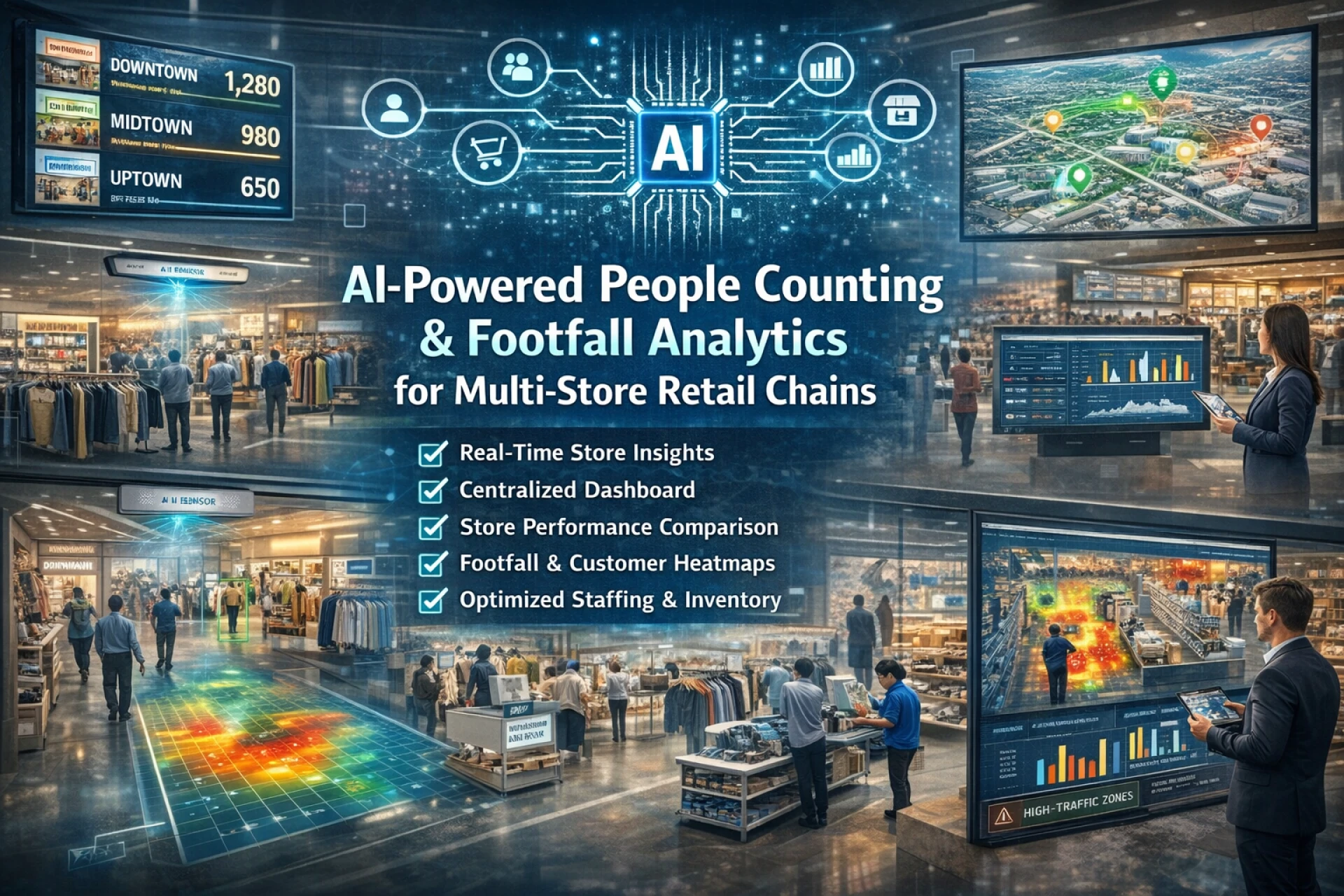
The retail industry is witnessing a data-driven revolution, and multi-store retail chains are at the forefront of this transformation. With increasing competition, evolving customer expectations, and the need for efficient resource allocation, retail brands must rely on accurate insights rather than assumptions. This is where people counting software becomes invaluable. It empowers retail enterprises with real-time footfall analytics, centralized intelligence, and store comparison capabilities that enhance performance and profitability across all branches.
People counting has evolved from simple entry counting sensors to sophisticated AI-driven systems capable of analyzing customer behavior, store efficiency, and engagement patterns. For retail chains with multiple locations, this intelligence helps standardize operations, boost conversions, and understand which stores are performing—and why.
1. What Is People Counting Software?
People counting software uses AI, sensors, and video analytics to track how many people enter, exit, and move inside a retail store. It gathers real-time and historical data to help businesses understand:
- Daily footfall volumes
- Peak and non-peak hours
- Store occupancy
- Customer flow pathways
- Zone-wise heatmaps
- Staff planning requirements
- Conversion rates
The accuracy of AI-powered people counting offers a clear understanding of store performance, especially when comparing multiple locations.
2. Why Multi-Store Retail Chains Need People Counting Software
Retail chains face unique challenges compared to single-store businesses. Customer demographics vary by location, operational workflows differ, and store efficiency depends on numerous factors.
People counting software provides multi-store chains with:
✔ Store-wise visibility
Retailers can instantly see which stores attract more footfall and which struggle.
✔ Performance transparency
Executives can evaluate store productivity with numbers, not assumptions.
✔ Data-driven operational planning
Insights help optimize staffing, inventory, and marketing activities.
✔ Improved customer experience
Better crowd management and seamless service enhance customer satisfaction.
✔ Accurate conversion rate measurement
Retailers can calculate the exact percentage of visitors who buy, helping them understand true store potential.
For multi-store operations, footfall data is essential—not optional.
3. Centralized Intelligence: The Future of Multi-Store Retail Management
One of the major advantages of people counting software is the ability to consolidate all data across stores into a single centralized dashboard.
A. Unified Footfall Analytics for All Stores
Retail leaders can view:
- Store-wise footfall
- Daily, weekly, and monthly comparisons
- Traffic fluctuations across cities
- Store performance patterns
- Real-time occupancy
This real-time visibility helps identify trends across regions and outline corrective actions instantly.
B. Real-Time Monitoring Across Branches
Executives no longer need manual reports. Live dashboards allow them to view:
- Which stores are overcrowded
- Which stores need more staff
- Underperforming locations
- Sudden drops or spikes in traffic
This real-time intelligence enhances decision-making speed and accuracy.
C. Identifying High & Low Performers
Footfall-based benchmarking highlights:
- High-traffic, high-revenue stores
- Low-traffic but high-conversion stores
- Stores that attract visitors but fail to convert
- Outliers needing immediate attention
This helps brands replicate successful strategies across underperforming locations.
4. Store Comparison Made Easy
Comparing performance across dozens or hundreds of retail stores can be complex. People counting software simplifies this dramatically.
A. Performance Benchmarking
Retail chains can analyze:
- Total visitors
- Revenue-to-footfall ratio
- Customer engagement duration
- Hourly visitor patterns
- Layout and navigation effectiveness
Benchmarking exposes gaps and strengths across stores.
B. Accurate Conversion Insights
Retailers can calculate:
Conversion Rate = (Total Sales ÷ Total Visitors) × 100
This reveals whether:
- Staff performance is weak
- Product display needs improvement
- Offers are not attracting customers
- Store layout requires optimization
Conversion insights drive revenue-focused decisions.
C. Heatmaps for Layout Optimization
AI-generated heatmaps show:
- Hotspots where customers spend more time
- Cold zones receiving less attention
- Best positions for promotion displays
- Areas causing customer confusion
Brands can test layouts across stores and standardize the most effective one.
D. Right Staffing at Each Store
People counting identifies store-specific peak hours. Retail chains can:
- Deploy staff at the right time
- Reduce labor costs
- Speed up checkout operations
- Improve customer satisfaction
Knowing when visitors arrive is as important as knowing how many arrive.
5. Better Marketing & Inventory Decisions
People counting software enables multi-store chains to:
A. Run Hyperlocal Campaigns
Each store has unique customer behavior. Footfall data helps tailor promotions to match local demand.
B. Track Impact of Campaigns
Retailers can see whether footfall increases after:
- Sales promotions
- Digital signage ads
- Seasonal offers
- Local offline campaigns
C. Make Accurate Inventory Plans
High-footfall stores may need more stock, while low-footfall stores can reduce ordering to prevent wastage.
6. Enhancing Customer Experience Across Locations
Customer experience can make or break retail success. People counting improves:
- Queue management
- Store navigation
- Checkout speed
- Space planning
- Safety compliance
- Staff availability during busy hours
Consistent experience across branches strengthens brand trust.
How Nextbrain Empowers Multi-Store Retail Chains With AI-Powered People Counting
Nextbrain is a leading AI development company specializing in enterprise-grade people counting software designed specifically for multi-store retail chains.
Key features of Nextbrain’s people counting solution:
✔ AI-driven video analytics with high accuracy
✔ Centralized dashboard for all store locations
✔ Real-time occupancy tracking
✔ Store-to-store performance comparison
✔ Heatmaps & customer pathway analysis
✔ Predictive analytics for staffing & inventory
✔ Automated reports for decision-making
✔ Seamless integration with retail POS & ERP systems
Nextbrain’s solution helps retail chains unlock hidden opportunities, reduce operational inefficiencies, and drive higher profitability backed by real data.
Retail brands seeking a scalable, accurate, and customized people counting platform greatly benefit from Nextbrain’s expertise.
Conclusion
People counting software is transforming the way multi-store retail chains operate. With centralized intelligence, store comparison insights, real-time monitoring, and AI-driven analytics, retail leaders can make smarter decisions, improve operations, boost conversions, and enhance customer satisfaction. As retail continues to evolve, brands that adopt people counting early will gain a competitive edge.
To unlock advanced footfall analytics and multi-store retail intelligence, contact Nextbrain today.
FAQs
1. Why is people counting important for multi-store retail chains?
It helps retailers track footfall, understand customer behavior, compare store performance, and optimize operations across multiple locations.
2. Can people counting software improve conversions?
Yes. By analyzing visitor data, retailers can enhance layout, staffing, and promotions—leading to higher conversions.
3. What makes AI-powered people counting more accurate?
AI reduces errors caused by overlapping crowds, varied lighting, and multiple entrances, offering accuracy levels of 95%+.
4. How does people counting help in staff planning?
It identifies hourly footfall patterns so management can allocate staff efficiently and minimize labor costs.
5. Why choose Nextbrain for people counting solutions?
Nextbrain offers intelligent AI-powered people counting software with centralized dashboards, heatmaps, store comparison tools, and enterprise-grade accuracy for multi-store retail chains.