Market Overview:
According to IMARC Group's latest research publication, "Packaged Food Market: Global Industry Trends, Share, Size, Growth, Opportunity and Forecast 2026-2034", The global packaged food market size was valued at USD 2,793.0 Billion in 2025. Looking forward, IMARC Group estimates the market to reach USD 4,968.6 Billion by 2034, exhibiting a CAGR of 6.41% from 2026-2034.
This detailed analysis primarily encompasses industry size, business trends, market share, key growth factors, and regional forecasts. The report offers a comprehensive overview and integrates research findings, market assessments, and data from different sources. It also includes pivotal market dynamics like drivers and challenges, while also highlighting growth opportunities, financial insights, technological improvements, emerging trends, and innovations. Besides this, the report provides regional market evaluation, along with a competitive landscape analysis.
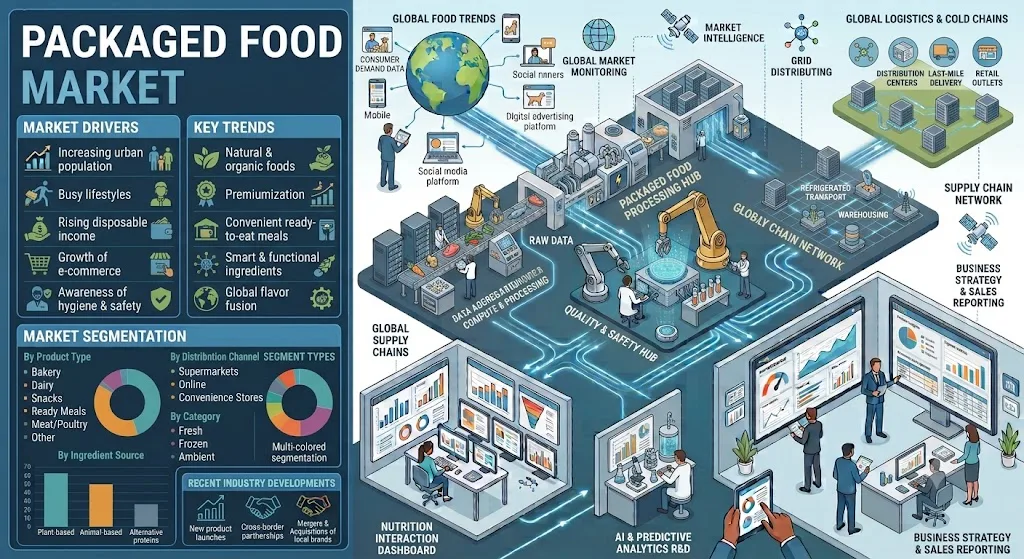
How AI is Reshaping the Future of the Packaged Food Market
- Asia Pacific currently dominates the packaged food market, holding a market share of 34% in 2025, driven by rapid urbanization, expanding middle-class populations, rising disposable incomes, and evolving dietary preferences that favor convenient and ready-to-eat packaged food options.
- Dairy products hold a 24% share among all product types, led by innovations such as probiotic-enriched yogurt, lactose-free dairy products, high-protein dairy drinks, and functional dairy snacks that have expanded consumer reach far beyond traditional dairy users.
- Supermarkets and hypermarkets lead the distribution channel segment with a 45% market share, offering consumers a one-stop shopping experience, competitive pricing, and an expanding range of private-label packaged food brands.
- Average weekly grocery spending per US household reached USD 170 as of February 2025, reflecting sustained and growing consumer expenditure on packaged food products across all major categories.
- In August 2025, General Mills Inc. announced a USD 54 million investment in a new innovation hub near its Minnesota headquarters, adding a 35,000-square-foot wing to accelerate new packaged food product development.
Download a sample PDF of this report: https://www.imarcgroup.com/packaged-food-market/requestsample
Key Trends in the Packaged Food Market
- Rising Demand for Clean-Label Products: Consumers worldwide are increasingly rejecting products containing artificial preservatives, sweeteners, and additives in favor of packaged foods with transparent, minimal, and natural ingredients. Manufacturers are responding by reformulating products with plant-based ingredients, organic sourcing, and natural preservatives. In Europe, the Packaging and Packaging Waste Regulation enacted in February 2025 requires plastic packaging to contain a minimum of 65% recycled content, compelling manufacturers to innovate in sustainable packaging while maintaining product quality and shelf life.
- Expansion of E-Commerce Retail Channels: The proliferation of digital retail platforms is fundamentally changing how consumers worldwide purchase packaged food products. The growing use of smartphones, advancements in logistics infrastructure, and the expansion of same-day and next-day delivery options have made online grocery shopping a mainstream channel. Leading e-commerce platforms are expanding their packaged food product lines through data-driven recommendation algorithms, while direct-to-consumer platforms and social commerce are helping new packaged food brands reach consumers without traditional middlemen.
- Growing Health and Functional Food Demand: Consumers are increasingly seeking packaged foods that deliver functional benefits beyond basic nutrition, including added probiotics, prebiotics, high protein, dietary fiber, and essential vitamins. This is driving manufacturers to develop fortified and nutrient-dense packaged food products targeting specific health needs such as digestive wellness, immune health, and weight management. The growing adoption of GLP-1 weight management medications has further fueled demand for portion-controlled, high-protein, and calorie-managed packaged food products across all major retail categories.
We explore the factors driving the growth of the market, including technological advancements, consumer behaviors, and regulatory changes, along with emerging
Growth Factors in the Packaged Food Market
- Urbanization and Dual-Income Household Growth: The increasing rate of urbanization and the rise of dual-income households have created a substantial and sustained increase in demand for convenient, ready-to-eat, and shelf-stable packaged food products globally. As working populations expand across emerging economies, the preference for packaged foods that reduce meal preparation time and offer consistent quality continues to intensify, particularly in Asia Pacific where urban migration is accelerating.
- Organized Retail Expansion in Emerging Markets: The development of organized retail formats such as supermarkets, hypermarkets, and online grocery platforms has significantly improved the visibility and accessibility of packaged food products in both developed and developing countries. In Asia Pacific, government efforts to promote food safety standards, nutritional labeling requirements, and local food processing industry development are encouraging both local and international packaged food companies to scale up their regional presence.
- Technological Advancements in Food Processing and Packaging: Advancements in food processing, preservation, and packaging technology have significantly increased the shelf life of packaged food products while retaining their nutritional content. Technologies such as aseptic packaging and ultra-high temperature processing have made dairy and other perishable packaged food categories accessible through organized retailing and online purchasing, opening new commercial opportunities for manufacturers across global markets.
- Private-Label Brand Proliferation: The expansion of private-label brands across major retail chains is intensifying price competition while broadening consumer choice within the packaged food category. Particularly in Europe and North America, discount retail formats are driving the growth of private-label packaged food products that offer value-oriented alternatives without compromising on quality, reshaping competitive dynamics across bakery, dairy, and ready-meal categories.
- Rising Tourism and Hospitality Sector Demand: Growing tourism and hospitality sector activity across the Middle East and Africa is driving demand for a variety of shelf-stable and ready-to-eat packaged food products. Expanding cold chain infrastructure, the growth of organized retail, and an increasing youth population in the region are further accelerating the adoption of packaged food across both urban and rural markets.
Leading Companies Operating in the Global Packaged Food Industry:
- Aidells Sausage Company (Tyson Foods, Inc.)
- Conagra, Inc.
- Danone S.A.
- General Mills Inc.
- Hormel Foods Corporation
- Kellanova
- Maple Leaf
- Nestle S.A.
- Smithfield Foods, Inc.
- Unilever
- WH Group Limited
Packaged Food Market Report Segmentation:
Breakup By Product Type:
- Bakery Products
- Dairy Products
- Beverages
- Breakfast Products
- Meals
- Others
Dairy products account for the largest share with 24% of the market, driven by innovations in probiotic-enriched, lactose-free, and high-protein dairy formats along with advancements in packaging technologies that have extended shelf life and improved accessibility through both organized retail and online channels.
Breakup By Distribution Channel:
- Supermarket/Hypermarket
- Specialty Stores
- Convenience Stores
- Online Retail Stores
- Others
Supermarkets and hypermarkets dominate the market with a 45% share due to their ability to provide consumers with a wide product selection, competitive pricing, loyalty programs, and a convenient one-stop shopping experience, with omnichannel features like click-and-collect services further strengthening their position.
Breakup By Region:
- North America (United States, Canada)
- Asia Pacific (China, Japan, India, South Korea, Australia, Indonesia, Others)
- Europe (Germany, France, United Kingdom, Italy, Spain, Russia, Others)
- Latin America (Brazil, Mexico, Others)
- Middle East and Africa
Asia Pacific holds the leading position in the global packaged food market with a 34% market share, driven by a massive consumer base, rapid urbanization, rising disposable incomes, and the strong expansion of organized retail and e-commerce infrastructure across major economies including China, India, Japan, South Korea, and Indonesia.
Recent News and Developments in the Packaged Food Market
- May 2025: Danone S.A. launched Oikos Protein Shakes in the United States, marking the brand's first entry into the USD 7 billion shelf-stable protein shake market. Each ready-to-drink bottle contains 30 grams of complete protein and 5 grams of prebiotic fiber, targeting health-conscious consumers and those on weight management journeys seeking convenient, nutrient-dense packaged food options.
- August 2025: General Mills Inc. announced a USD 54 million investment in a new innovation hub near its Minnesota headquarters. The expansion added a 35,000-square-foot wing to the James Ford Bell Technical Center, increasing pilot plant space by more than 20% and providing state-of-the-art facilities to accelerate new packaged food product development.
- February 2026: The European Union's Packaging and Packaging Waste Regulation came into full effect, imposing stringent recyclability mandates requiring plastic packaging used in packaged food products to contain a minimum of 65% recycled content, compelling manufacturers across the region to accelerate sustainable packaging innovation while maintaining product quality and shelf life standards.
Note: If you require specific details, data, or insights that are not currently included in the scope of this report, we are happy to accommodate your request. As part of our customization service, we will gather and provide the additional information you need, tailored to your specific requirements. Please let us know your exact needs, and we will ensure the report is updated accordingly to meet your expectations.
About Us:
IMARC Group is a global management consulting firm that helps the world's most ambitious changemakers to create a lasting impact. The company provides a comprehensive suite of market entry and expansion services. IMARC offerings include thorough market assessment, feasibility studies, company incorporation assistance, factory setup support, regulatory approvals and licensing navigation, branding, marketing and sales strategies, competitive landscape and benchmarking analyses, pricing and cost research, and procurement research.
Contact Us:
IMARC Group
134 N 4th St. Brooklyn, NY 11249, USA
Email: [email protected]
Tel No: (D) +91 120 433 0800
United States: +1-201-971-6302