Every June, homeowners across the South ask whether their crawl space vents should be open or closed. In hot, humid weather, neither choice will keep a crawl space dry.
That surprises people, because most of us were taught the opposite.
"If you were like me, you were taught that good ventilation is sufficient to keep a crawl space dry and mold free," says Barry Westbrook, who founded DocAir, a Leading Crawlspace Encapsulation Company in Nashville. "This is only true if the outside air is drier than the air already in the crawl space."
In a Tennessee July, it almost never is.
Why the Vents Are There
Building codes have traditionally required crawl space vents, Westbrook notes. The idea was to let moisture rising from the ground escape from under the house.
In dry weather, with modest moisture, that works.
The trouble starts when the air coming in through the vents is wetter than the air it is supposed to replace.
What Summer Air Does Under the Floor
Hot summer air carries a lot of water vapor. When it drifts into a crawl space, it cools down to match the cooler space.
If crawl space surfaces are colder than the dew point of that incoming air, the vapor turns into liquid water. In the worst cases, Westbrook says, a crawl space turns into a sauna, with water dripping from pipes, insulation, and even the floor joists.
"Since the outside air is the source of the moisture, it makes no sense to bring in more air to dry things out," he says.
The research agrees. Advanced Energy's crawl space research found that in warm seasons, outside air carries more water vapor than crawl space air, so ventilation adds moisture instead of removing it.
In its North Carolina field study, humidity in vented crawl spaces tracked the outdoor humidity.
Westbrook takes the same view. As he puts it, the moisture coming in from outside is "many, many times" the amount evaporating from the ground.
Why Mold Shows Up Under Kitchens and Baths
Condensation forms on the coldest surfaces first. In a vented crawl space, those are often the floors under bathrooms and kitchens.
According to Westbrook, those floors are not insulated as well as carpeted floors, so they run cool all summer. Moisture collects there, and mold follows.
Hardwood floors above can suffer too. Wood that soaks up condensation swells until it buckles or cups.
So Should You Close Them?
Closing the vents cuts down on humid outside air. It does nothing about moisture coming up from the ground or storm water working its way in.
"So, it is really a trick question with no correct answer," Westbrook says. In hot, humid weather, neither position guarantees a dry crawl space.
For homes that stay vented, DocAir's advice for June, July, and August is to leave the vents open. That limits how much humidity can build up in the worst conditions.
One rule has no exceptions. Never close the vents if there is standing water in the crawl space, or if the ground is not covered by a continuous vapor barrier.
What Works Year Round
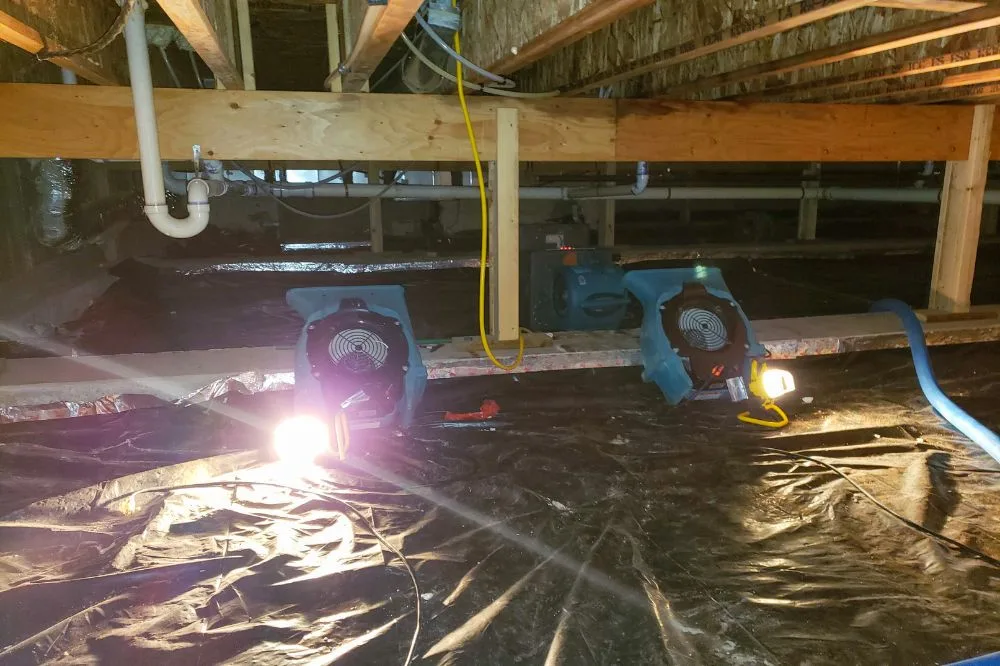
For Tennessee and other humid climates, Westbrook recommends a closed crawl space. That means a continuous liner that seals the space off from the ground and from outside air, sealed vents, and a controlled dehumidifier that keeps relative humidity below 60 percent all year.
Builders are catching on. Advanced Energy notes that most codes now allow properly detailed closed crawl spaces.
Keep the Worry in Proportion
This is where Westbrook differs from the scare-selling end of the industry. Mold on the joists of a vented crawl space is common in Middle Tennessee, and he does not treat it as a structural emergency.
"The mold is typically a surface phenomenon and does not significantly affect the structural integrity of the wood," he says.
He also does not claim every house needs encapsulation right away. There are millions of vented crawl spaces across the Southeast. In his words, the decision to close one "should be governed by the sensitivities, preferences, and budgets of the home owner."
The Short Answer
Open or closed, vents alone cannot keep a humid summer out from under your floor. Control the moisture source, and the vent question stops mattering.