
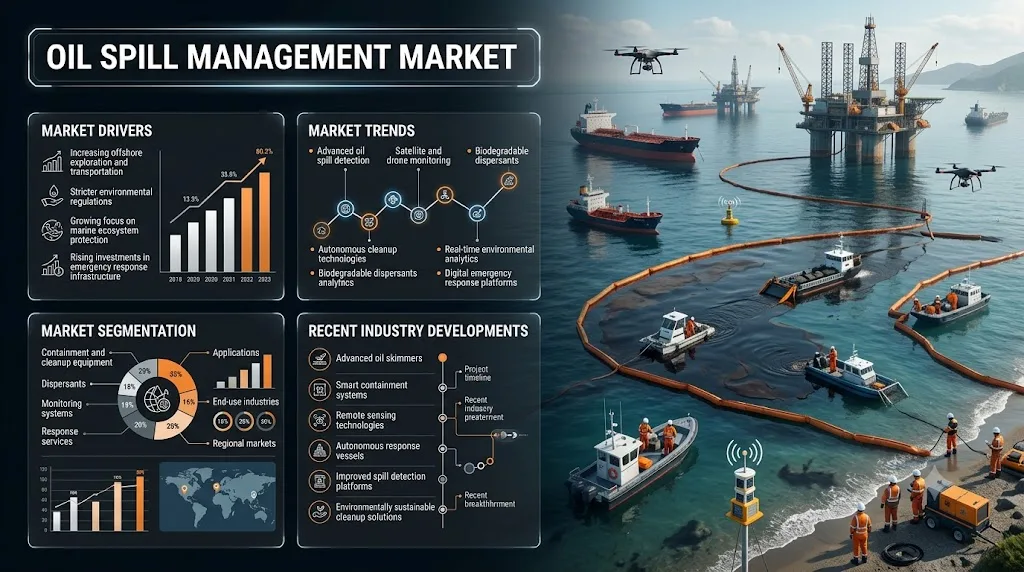
Market Overview:
According to IMARC Group's latest research publication, "Oil Spill Management Market: Global Industry Trends, Share, Size, Growth, Opportunity and Forecast 2026-2034", The global oil spill management market size reached USD 154.4 Billion in 2025. Looking forward, IMARC Group expects the market to reach USD 194.6 Billion by 2034, exhibiting a growth rate (CAGR) of 2.50% during 2026-2034.
This detailed analysis primarily encompasses industry size, business trends, market share, key growth factors, and regional forecasts. The report offers a comprehensive overview and integrates research findings, market assessments, and data from different sources. It also includes pivotal market dynamics like drivers and challenges, while also highlighting growth opportunities, financial insights, technological improvements, emerging trends, and innovations. Besides this, the report provides regional market evaluation, along with a competitive landscape analysis.
How Technology and Regulation Are Reshaping the Oil Spill Management Market
- North America leads the global market, driven by heightened regulatory enforcement and increasing frequency of offshore oil spill incidents, with the U.S. Environmental Protection Agency having finalized stronger standards under the National Contingency Plan (NCP) to enhance response efforts to oil spills and hazardous substance releases into U.S. waters and adjoining shorelines.
- Pre-oil spill management accounts for the majority of the market share in 2025, with companies investing in double hull vessels, blowout preventers, and pipeline leak detection systems to proactively mitigate risks and avoid significant legal liabilities.
- Six of the top ten global oil companies were piloting digital twin spill response systems by 2025, signaling a fundamental shift in preparedness modeling and emergency simulation practices across the industry.
- In April 2025, Miros Group launched its Oil Spill Detection (OSD) Monitoring application via Miros Cloud, enabling real-time, centralized monitoring and secure data sharing between offshore units, onshore control rooms, and remote stakeholders.
- Autonomous AI vessels for oil spill containment are gaining commercial traction, with Finnish firm OliOil.iO deploying such systems in 2026, and 12 similar autonomous vessels reported to be in development globally as of mid-2026.
Download a sample PDF of this report: https://www.imarcgroup.com/oil-spill-management-market/requestsample
Key Trends in the Oil Spill Management Market
- Increasing Impact of Climate Change on Spill Risk: Climate change is altering weather dynamics, raising the occurrence of storms and hurricanes that damage offshore platforms and coastal infrastructure. According to the European Environment Agency, global mean sea level reached its highest recorded value in 2022, amplifying the difficulty of containing oil spills as they spread across larger and more sensitive marine environments. Rising coastal erosion further complicates containment and cleanup operations for response teams.
- AI and Machine Learning Integration in Spill Detection: The integration of artificial intelligence and machine learning into oil spill monitoring systems is a defining trend shaping the market. AI-enabled platforms combining satellite imagery, drone surveillance, and predictive analytics are enabling early spill detection and automated response coordination. As of 2026, oil spill management providers have accelerated adoption of these systems, fundamentally shifting the sector toward data-driven, real-time operational models.
- Rapid Globalization and Interconnectedness of Marine Environments: Global oil trade grew by approximately 3% year-over-year, increasing maritime traffic and the associated risk of transboundary spills. Spilled oil can travel vast distances through ocean currents, affecting distant coastlines and marine species, including migratory animals. This interconnectedness is prompting governments, corporations, and environmental organizations to form international partnerships and develop comprehensive cross-border spill response frameworks.
- Rising Adoption of Bio-Remediation and Sustainable Cleanup Technologies: In 2025, advancements in bio-remediation technologies gained commercial traction, with enzyme-based and microbial treatments increasingly deployed to reduce environmental impact. Researchers at the Indian Institute of Technology Kharagpur developed a graphene-based method for oil-water separation in April 2025, offering a sustainable alternative to conventional cleanup strategies. In June 2026, researchers demonstrated that controlled fire whirls can clean up oil spills faster and more cleanly than traditional burning methods.
- Tightening Legal and Financial Liabilities Driving Market Investments: Companies involved in oil spill incidents face escalating financial penalties, lawsuits, and compensation claims from affected communities and governments. In 2025, regulatory authorities in major oil-producing regions introduced stricter compliance frameworks mandating enhanced spill preparedness and response capabilities, leading to significant capital allocation toward certified equipment and trained response personnel. The costs of cleanup and ecological remediation serve as a strong financial incentive for proactive investment in spill prevention technologies.
Our report provides a deep dive into the oil spill management market analysis, outlining the current trends, underlying market demand, and growth trajectories.
Growth Factors in the Oil Spill Management Market
- Expansion of Offshore Drilling and Maritime Trade: Increasing offshore and onshore drilling activities are directly expanding the demand for oil spill management solutions. As global maritime trade intensifies, the exposure to potential incidents at sea rises proportionally, compelling operators to invest in both preventive and reactive spill response capabilities across offshore platforms, pipelines, and shipping routes.
- Technological Advancements in Spill Detection and Containment: The development of advanced sensors, drones, and satellite imaging systems has transformed how spills are identified and addressed. In June 2025, Miros, in partnership with Belga Marine, enhanced its Oil Spill Detection system with cloud-based monitoring capabilities that became fully operational across several production assets offshore Brazil, demonstrating the practical deployment of next-generation detection infrastructure.
- Government Regulations and Environmental Mandates: Stringent environmental regulations continue to compel industry players to adopt comprehensive oil spill management systems. The U.S. Bureau of Safety and Environmental Enforcement (BSEE), which oversaw oil spill planning and preparedness for offshore oil and gas production facilities, managed an Oil Spill Preparedness Division responsible for approving spill response plans, inspecting response equipment, and auditing responder training exercises up until regulatory restructuring in July 2026.
- Investment in Research and Development of Novel Cleanup Materials: Investment in R&D for new cleanup materials and methods is contributing to market expansion. In April 2025, LSU Chemical Engineering researchers issued a patent for a technology employing lignin nanoparticles as an eco-friendly method for oil spill cleanup. The University of Texas at Austin's Cockrell School of Engineering also developed a technology using soft polymer gel and a dual-layer roller design to improve oil spill cleanup efficiency.
- Consolidation Among Regional Spill Response Providers: In 2025, consolidation activity among regional spill response providers resulted in the formation of larger, integrated service entities. This trend is strengthening competitive positioning and enabling economies of scale in equipment deployment and service delivery, improving the overall capacity of the sector to respond to large-scale and geographically complex spill incidents.
Leading Companies Operating in the Global Oil Spill Management Industry:
- ACME Environmental Inc.
- Fender and Spill Response Services L.L.C.
- Oil Pollution Environmental Control Ltd.
- Oil Spill Response Limited
- Osprey Spill Control L.L.C.
- Sorbcontrol S.L.
- Vikoma International Limited
Oil Spill Management Market Report Segmentation:
Breakup By Type:
- Pre-Oil Spill Management
- Double Hull
- Blowout Preventers
- Pipeline Leak Detection
- Others
- Post-Oil Spill Management
- Mechanical Containment Methods
- Chemical and Biological Management Methods
- Others
Pre-oil spill management accounts for the majority of the market share due to growing regulatory pressure compelling companies to adopt proactive measures, including equipment maintenance, safety protocols, and advanced contingency planning to prevent spill incidents before they occur.
Breakup By Application:
- Offshore
- Onshore
Offshore holds the largest share of the market as advanced preparedness, rapid response capabilities, and compliance with international standards are integral to offshore oil spill management, requiring specialized equipment, trained personnel, and coordination with local, national, and international response units.
Breakup By Region:
- North America (United States, Canada)
- Asia Pacific (China, Japan, India, South Korea, Australia, Indonesia, Others)
- Europe (Germany, France, United Kingdom, Italy, Spain, Russia, Others)
- Latin America (Brazil, Mexico, Others)
- Middle East and Africa
North America enjoys the leading position owing to the heightened implementation of strict regulations to manage oil spills, growing environmental awareness across public and private sectors, and collaborative frameworks between governments, industry stakeholders, and environmental organizations fostering innovation in comprehensive spill response.
Recent News and Developments in the Oil Spill Management Market
- April 2025: Miros Group launched its Oil Spill Detection (OSD) Monitoring application through Miros Cloud, providing real-time, centralized monitoring and secure data sharing among offshore units, onshore control rooms, and remote stakeholders, expanding the company's spill detection capabilities across production assets.
- June 2025: Miros, in partnership with Belga Marine, made its enhanced Oil Spill Detection monitoring system with cloud-based capabilities fully operational across several production assets offshore Brazil, marking a significant step in the practical deployment of next-generation offshore spill monitoring infrastructure.
- December 2025: Miros and Marine Tech announced a partnership to develop next-generation marine sensing systems, combining real-time ocean insight capabilities with advanced sensing technologies to strengthen early oil spill detection and marine situational awareness across offshore operations.
Note: If you require specific details, data, or insights that are not currently included in the scope of this report, we are happy to accommodate your request. As part of our customization service, we will gather and provide the additional information you need, tailored to your specific requirements. Please let us know your exact needs, and we will ensure the report is updated accordingly to meet your expectations.
About Us:
IMARC Group is a global management consulting firm that helps the world's most ambitious changemakers to create a lasting impact. The company provides a comprehensive suite of market entry and expansion services. IMARC offerings include thorough market assessment, feasibility studies, company incorporation assistance, factory setup support, regulatory approvals and licensing navigation, branding, marketing and sales strategies, competitive landscape and benchmarking analyses, pricing and cost research, and procurement research.
Contact Us:
IMARC Group
134 N 4th St. Brooklyn, NY 11249, USA
Email: [email protected]
Tel No: (D) +91 120 433 0800
United States: +1-201-971-6302