Choosing how to build and manage a software development team is no longer simply a question of hiring locally or reducing hourly rates. For many businesses, the more important question is how much control, scalability, flexibility, and long-term engineering capability they need.
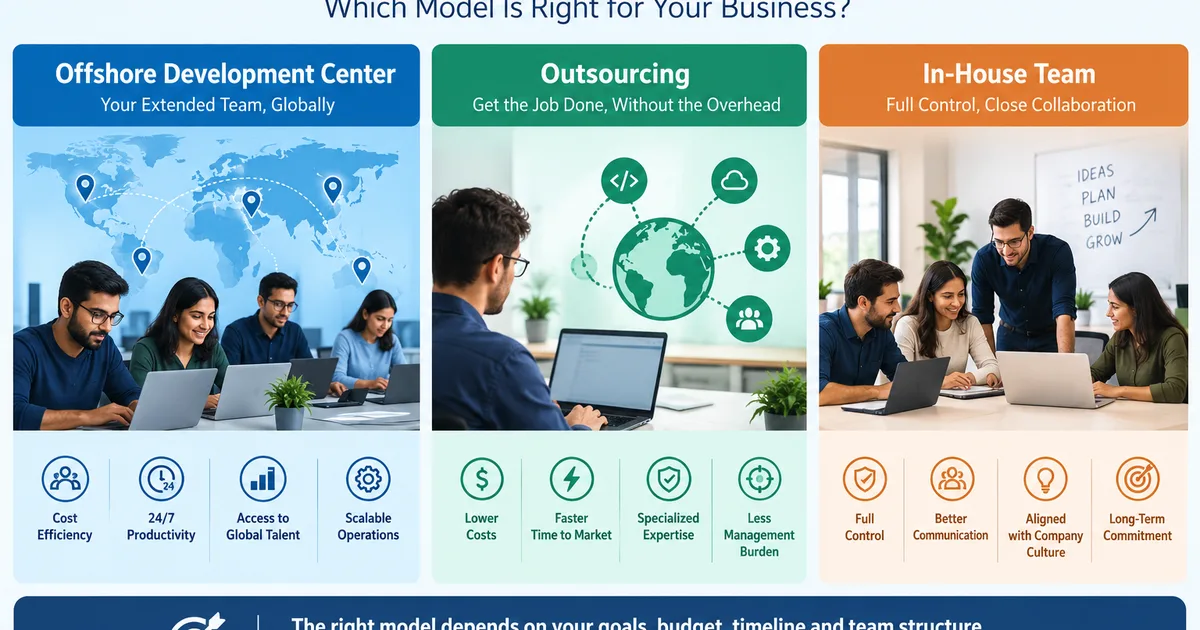
An organization can build an in-house development team, outsource an application or project to an external provider, or establish an Offshore Development Center (ODC) that operates as an extended engineering function.
All three models can work. The right choice depends on the company's goals, product lifecycle, technical requirements, management capacity, and expected growth.
What Are the Three Development Models?
Before comparing them, it helps to understand what each model actually means.
In-House Development Team
An in-house team consists of employees directly hired by the organization. The company manages recruitment, compensation, performance, infrastructure, technology decisions, and day-to-day engineering operations.
This approach provides a high degree of control and can work particularly well when software development is a core strategic capability.
However, building an in-house team can require substantial time and ongoing operational effort, particularly when specialized skills are difficult to find.
Software Development Outsourcing
With outsourcing, an external technology partner takes responsibility for defined projects, applications, features, or development activities.
The company generally defines requirements and business objectives while the provider manages some or most of the delivery process.
Outsourcing can be useful when an organization needs specialized expertise or additional delivery capacity without building a permanent internal team.
Offshore Development Center
An Offshore Development Center provides a dedicated developer team or engineering operation located in another country or region.
Unlike traditional project outsourcing, an ODC is typically designed for longer-term collaboration. The client can maintain greater involvement in team composition, development processes, priorities, and technical direction.
This makes an offshore development center vs outsourcing comparison particularly important. Both use external resources, but the operating model and level of integration can be quite different.
Comparing the Three Models
FactorIn-HouseOutsourcingOffshore Development CenterDirect controlHighModerateHighHiring responsibilityCompanyProviderShared/provider-managedScalabilityModerateHighHighLong-term team continuityHighDepends on providerHighProject flexibilityModerateHighHighManagement effortHighLowerModerateSpecialized talent accessDepends on local marketHighHighBest suited forCore capabilitiesDefined projectsLong-term engineering capacityThe table is not a universal ranking. Each model solves a different organizational problem.
When an In-House Team Makes Sense
An in-house development team is often the natural choice when engineering is closely tied to the company's competitive advantage.
It can be particularly appropriate when:
- Product knowledge is highly specialized.
- Engineers need continuous interaction with internal business teams.
- Security or regulatory requirements favor direct employment.
- The organization has strong recruiting and engineering management capabilities.
- Long-term technical ownership is strategically important.
The tradeoff is operational responsibility.
The organization must recruit engineers, retain them, provide benefits and infrastructure, manage career development, and address capacity gaps when business requireDements change.
For a growing technology organization, these responsibilities can become significant.
When Outsourcing Is the Better Option
Software development outsourcing can make sense when the company has a specific outcome to deliver but does not need to build a permanent team around it.
For example, an organization may outsource:
- A mobile application
- A website modernization project
- A cloud migration
- A business application
- A specific software module
- Testing and quality assurance
- A short-term development initiative
The model works well when scope and ownership can be clearly defined.
The potential limitation is continuity. If the business eventually needs the external team to function as an ongoing extension of internal engineering, a conventional project-based outsourcing arrangement may become less suitable.
When an Offshore Development Center Makes Sense
An Offshore Development Center becomes attractive when a company needs ongoing engineering capacity rather than one isolated project.
Consider an organization that needs developers for product engineering, application modernization, cloud development, QA, or maintenance over several years.
Instead of repeatedly hiring locally or outsourcing separate projects, the organization can establish a dedicated offshore team aligned with its technology roadmap.
The model can provide:
- Dedicated engineering capacity
- Access to broader technical talent pools
- Greater continuity than project-based outsourcing
- Flexible team expansion
- Alignment with internal development practices
- More direct involvement in technical priorities
It can therefore occupy a useful middle ground between traditional outsourcing and fully in-house hiring.
Cost Is Important—but It Should Not Be the Only Decision
One of the most common mistakes is comparing only salaries or hourly rates.
The actual cost of a development model can include:
- Recruitment
- Benefits and employment costs
- Onboarding
- Management
- Infrastructure
- Training
- Employee retention
- Vendor management
- Rework
- Delayed delivery
- Scaling costs
A lower hourly rate does not automatically mean a lower total cost.
Similarly, an offshore model should not be selected solely because engineering talent costs less in another market.
The better question is:
Which model delivers the required engineering capability with an acceptable balance of cost, control, speed, and risk?
Control vs. Flexibility
The central difference between these models often comes down to operating control.
An in-house team provides direct employment and organizational control.
Outsourcing provides flexibility by shifting part of delivery responsibility to an external provider.
An ODC can provide external delivery infrastructure while allowing the client to remain closely involved in team priorities and engineering decisions.
That distinction matters for organizations expecting requirements to evolve.
What About Security and Intellectual Property?
Security should be evaluated at the operating-model level rather than assumed from the location of a team.
Businesses considering offshore development should establish clear policies around:
- Source-code access
- Identity and access management
- Data handling
- Secure development practices
- Intellectual property ownership
- Confidentiality
- Device and infrastructure controls
- Compliance requirements
A mature development partner should be able to explain how these areas are managed.
A Practical Decision Framework
Ask five questions before selecting a model:
1. Is software development a core business capability?
If yes, maintaining significant internal ownership may be important.
2. Is the requirement project-based or ongoing?
A defined project may favor outsourcing. A continuous engineering requirement may favor an ODC or in-house model.
3. How quickly must the team scale?
If hiring locally is slow or specialized skills are difficult to find, an offshore model may provide additional flexibility.
4. How much management capacity do you have?
Building an in-house team requires substantial internal management. Outsourcing can reduce that burden.
5. What level of control is required?
The more closely engineers need to operate alongside internal teams, the more important team continuity and integration become.
The Best Model May Be a Hybrid
Businesses do not necessarily have to choose one model for everything.
A company may retain product leadership and architecture internally, use an offshore development team for engineering capacity, and outsource specialized projects when necessary.
For example:
- Product management remains internal.
- Architecture and security remain internally governed.
- An ODC provides application development capacity.
- A specialist vendor handles a short-term cloud migration.
This hybrid approach can align team structure with business priorities instead of forcing every technology requirement into one model.
Final Takeaway
There is no universal winner in the Offshore Development Center vs. Outsourcing vs. In-House debate.
An in-house team offers ownership and direct organizational integration. Outsourcing provides flexibility for defined initiatives. An ODC can provide dedicated, scalable engineering capacity while maintaining closer alignment with the client organization.
The right decision should begin with the business requirement—not the delivery model.
Companies evaluating these options should consider total cost, technical capability, scalability, security, management effort, continuity, and long-term strategy before making a decision.
A technology consulting and implementation partner can also help organizations assess their current engineering capacity, identify gaps, and determine whether hiring, outsourcing, an ODC, or a hybrid model best fits the roadmap.
Frequently Asked Questions
1. What is an Offshore Development Center?
An Offshore Development Center is a dedicated software engineering team or development operation located in another country or region. It typically works as an extension of the client's internal technology organization and supports ongoing development, maintenance, modernization, or product engineering.
2. What is the difference between an offshore development center and outsourcing?
Traditional outsourcing often focuses on delivering a defined project or service. An ODC is generally structured around longer-term, dedicated engineering capacity. The client typically has greater involvement in team composition, priorities, processes, and ongoing technical direction.
3. Is an offshore development center cheaper than an in-house team?
It can reduce some recruitment and operating costs, but cost should not be evaluated only through salary or hourly rates. Management, infrastructure, communication, security, onboarding, retention, and productivity should also be considered when comparing the total cost of each model.
4. When should a company choose an in-house development team?
An in-house team can be appropriate when software engineering is a core competitive capability, the organization requires direct control, or continuous product and business knowledge are particularly important.
5. Can a company combine outsourcing, offshore development, and in-house teams?
Yes. A hybrid model can allow an organization to retain strategic capabilities internally while using an ODC for ongoing engineering capacity and outsourcing specialized or short-term initiatives when appropriate.