
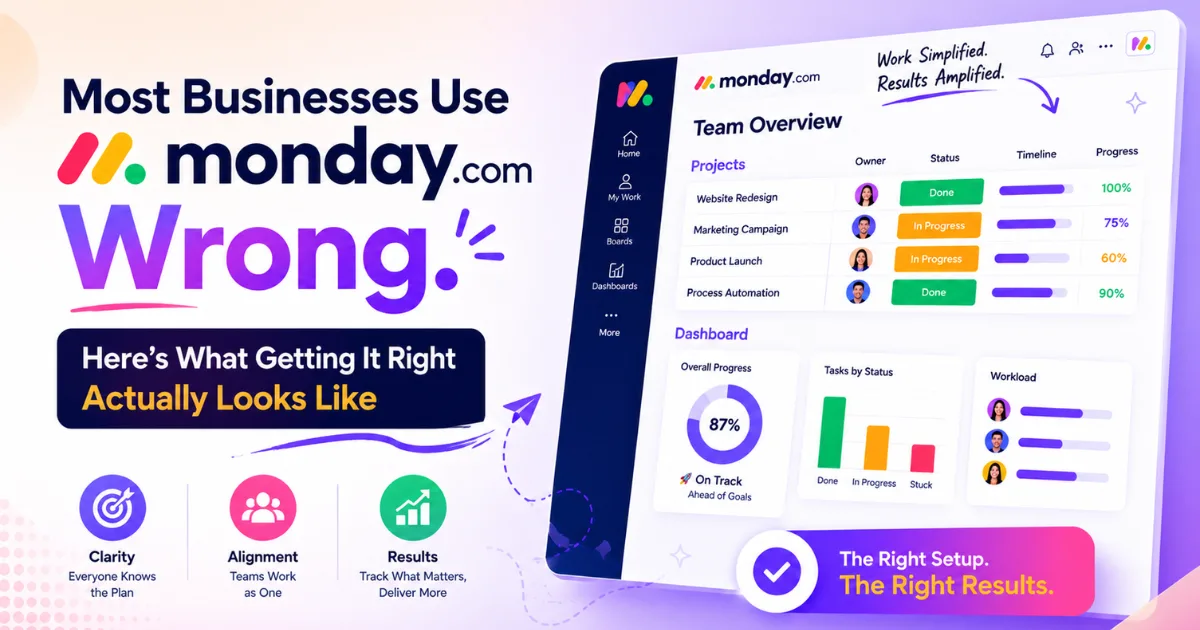
Monday.com is one of the most popular work management platforms in the world, and for good reason. It's flexible, visual, relatively intuitive, and capable of running everything from a simple project tracker to a complex, multi-team operational system. The sales pitch is compelling, and the free trial makes it easy to get started.
So most businesses do get started. They sign up, build a few boards, get some of the team on it, and call it done. And then, six months later, half the team has stopped using it, the boards are a mess of outdated information, and someone in leadership is quietly wondering whether the subscription is worth renewing.
This pattern is so common that it has become the default Monday.com experience for a huge number of businesses. And it's rarely the platform's fault. The problem, almost universally, is implementation, or more precisely, the absence of it.
Why Buying the Software is the Easy Part
There's a tendency to treat software adoption as a purchasing decision rather than an operational one. The business evaluates a few options, chooses the one that looks best in the demo, buys the licenses, and moves on to the next thing. What happens after the purchase is treated as someone else's problem, usually whoever volunteered to “set it up.”
But with a platform as flexible as Monday.com, the setup decisions made in those first few weeks determine almost everything about whether the tool delivers value. How boards are structured affects whether the information in them is actually useful. How automations are configured determines whether the platform reduces admin or adds to it. How the platform connects to other tools in the stack dictates whether data flows cleanly across the business or sits in yet another silo.
None of these decisions is obvious to someone who hasn't implemented the platform many times before. Which is exactly why proper Monday.com implementation is the step most businesses skip and the reason most of them end up underusing a tool they're paying for every month. A 2024 Gartner report on work management platform adoption found that 72% of businesses reporting low ROI from collaboration tools cited poor initial configuration and insufficient training as the primary causes, not the platforms themselves. Companies that invested in structured onboarding and implementation support reported 3.1x higher platform adoption rates at the six-month mark, the difference between a tool that transforms how a team works and one that becomes a monthly line item nobody wants to defend at budget review.
What a Proper Monday.com Implementation Actually Involves
Proper Monday.com implementation is not the same as setting up a few boards and showing the team where the buttons are. Done well, it's a structured process that begins before anyone touches the platform and ends well after the go-live date.
It starts with discovery: understanding how the business actually operates, where the friction points are, what information needs to flow between which teams, and what outcomes the platform needs to support. This sounds obvious, but most DIY implementations skip it entirely; they jump straight to building boards that reflect how people think the business works rather than how it actually does.
From there, a well-structured Monday.com implementation builds a workspace architecture that serves the business rather than constraining it. This includes decisions about board structure, item hierarchy, column types, group logic, and the naming conventions that make boards scannable and maintainable over time. It includes automation design, identifying the repetitive tasks and handoffs that can be handled without human input, and building the automations that handle them reliably. And it includes integration configuration, connecting Monday.com to the other platforms the business uses so that data moves where it needs to go without manual effort.
Finally, it includes training that's built around real workflows rather than generic platform walkthroughs and a review process that catches what isn't working before it becomes entrenched.
When to Bring in a Specialist
For small teams with straightforward needs, a self-guided implementation can work. If you're managing a handful of projects with a single team and your processes are simple, the platform's own documentation and templates are a reasonable starting point.
But for businesses with more complexity (multiple teams, cross-functional workflows, integrations with CRM or ERP systems, or a need to replace an existing operational system rather than just add a new one), the case for working with a Monday.com solutions partner becomes compelling quickly.
A solutions partner brings something that no amount of YouTube tutorials can replicate: experience implementing the platform across many different businesses and use cases. They've seen what works, what doesn't, and what decisions tend to create problems six months down the line. They can build in a day what might take an internal team weeks to figure out through trial and error. And because their reputation depends on implementations that actually stick, the best ones stay involved through the adoption curve, not just until the boards are built.
The other thing a good solutions partner brings is objectivity. When a business is implementing a new platform, there's often pressure to replicate existing processes exactly as they are, because change is uncomfortable. An experienced partner can challenge those assumptions, identifying inefficiencies in the existing process that the platform could fix if only the business were willing to rethink how things are done.
Monday.com as a CRM: More Powerful than Most People Realise
One area where Monday.com is consistently underused (even by businesses that have it running well in other parts of the organization) is sales. Most companies that need a CRM either use a dedicated sales platform or rely on spreadsheets that nobody trusts. The idea that their existing Monday.com subscription could handle this function often doesn't occur to them.
But Monday.com sales CRM solutions are a genuine option for a wide range of businesses, and in some cases, a better fit than the heavyweight alternatives. The platform's flexibility means it can be configured to match exactly how a sales team actually works, rather than requiring the team to adapt its process to fit the tool. Lead tracking, deal pipeline management, contact records, activity logging, email integration, and revenue forecasting can all be built within Monday.com, and because it sits in the same workspace as the rest of the business's operations, the handoff between sales and delivery is seamless in a way that a separate CRM can never quite replicate.
This is particularly valuable for businesses where the boundary between winning a client and delivering for them is blurry, agencies, consultancies, professional services firms, and project-based businesses of all kinds. Monday.com's own 2024 product impact report found that businesses using its CRM alongside their project management boards reported a 34% reduction in time spent on client handoff processes and a 28% improvement in deal visibility across sales and delivery teams compared to those using separate platforms for each function. When the deal closes in the same platform where the project kicks off, information doesn't get lost in the transition, and the client experience is correspondingly smoother.
Getting the Most from Monday.com Consulting
Whether you're implementing Monday.com for the first time, trying to salvage a setup that never quite worked, or looking to extend the platform into new parts of the business, Monday.com consulting provides a faster and more reliable path than working it out alone.
Good consulting in this space is not about telling a business what tools to use, it's about understanding what outcomes the business needs and building the most effective path to them within the platform. The best consultants spend more time asking questions than giving answers, at least in the early stages. They want to understand the business before they start configuring anything, because configuration without context produces boards that look organized but don't actually serve the people using them.
When evaluating a consulting engagement, the questions worth asking are similar to those worth asking of any specialist: Can they show you examples of implementations in businesses with similar complexity to yours? Do they have a defined methodology, or are they making it up as they go? What does their post-implementation support look like? And critically, do they have certified expertise on the platform, or are they generalist technology consultants who've added Monday.com to a long list of things they'll help with?
Certification matters here because the platform updates frequently, and its more advanced capabilities (automations, integrations, complex board relationships, and API connections) require knowledge that goes well beyond what casual use of the platform teaches.
The Adoption Problem: Why Implementation Doesn't End at Go-Live
One of the most common mistakes businesses make with Monday.com implementation is treating go-live as the finish line. The boards are built, the training has been delivered, and the assumption is that the team will now use the platform consistently, and it will deliver the expected value.
In practice, adoption is a curve, not a switch. In the weeks after go-live, usage tends to be high because it's new and people are paying attention. Then it dips as the novelty wears off and old habits reassert themselves. Then (if the implementation was done well and there's active reinforcement), it stabilizes and grows as the platform becomes genuinely embedded in how work gets done.
The businesses that make it through that adoption curve successfully are the ones that have someone accountable for the platform internally, that have clear expectations about how it should be used, and that have a process for identifying and addressing the gaps and friction points that inevitably emerge in the first few months of real use.
A good Monday.com solutions partner builds this into the engagement from the start, not just delivering a finished setup but equipping the business to own and evolve it over time.
Final Thoughts
Monday.com is a genuinely powerful platform. The businesses that get the most from it are not necessarily the ones with the biggest teams or the largest budgets; they're the ones that invested in setting it up properly and committed to using it consistently.
That investment in proper Monday.com implementation is smaller than most businesses expect and pays back faster than most anticipate. The question isn't really whether you can afford to do it right. It's whether you can afford to keep paying for a platform that isn't delivering what it's capable of.