
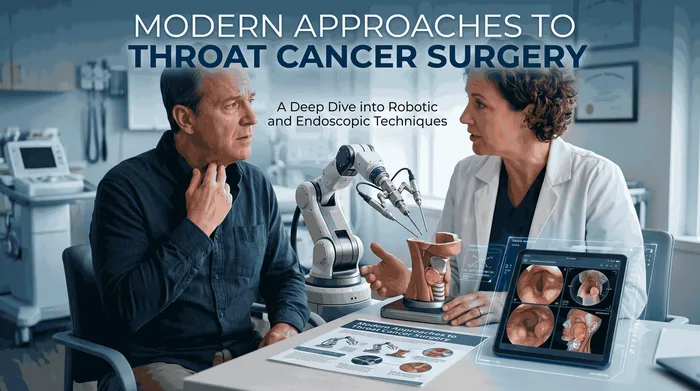
Throat cancer can affect important structures involved in speaking, swallowing, breathing, and eating. For this reason, treatment is not simply about removing a tumor. Modern cancer care aims to control the disease while preserving as much normal function and quality of life as possible.
Throat Cancer Surgery remains an important treatment option for selected patients, but the surgical approach depends on the location, size, stage, and characteristics of the tumor. Depending on the individual case, surgery may be performed through traditional open techniques or through minimally invasive approaches such as transoral laser microsurgery and transoral robotic surgery (TORS). Surgery may also be combined with radiation therapy, chemotherapy, immunotherapy, or other treatments.
What Is Throat Cancer?
The term “throat cancer” can refer to cancers arising in different parts of the throat and nearby structures. These may include cancers of the oropharynx, hypopharynx, and larynx, depending on the specific anatomical location.
Symptoms can vary according to where the cancer develops. Possible symptoms include:
- Persistent sore throat
- Difficulty or pain while swallowing
- A change in voice or persistent hoarseness
- Difficulty swallowing food
- A lump or swelling in the neck
How Is Throat Cancer Diagnosed?
Before deciding whether surgery is appropriate, doctors need to understand exactly where the cancer is located and how extensively it has developed.
Diagnosis commonly involves a physical examination and visualization of the throat or larynx, often using an endoscope. A biopsy is generally needed to confirm cancer.
Imaging such as CT, MRI, PET-CT, or other appropriate scans can help determine the size and extent of the tumor and whether lymph nodes or other areas are involved.
When Is Throat Cancer Surgery Considered?
Surgery may be considered when the tumor can be removed safely and when surgical treatment is expected to provide meaningful cancer control.
The decision depends on several factors, including:
- Location of the tumor
- Tumor size
- Cancer stage
- Lymph-node involvement
- Whether the cancer has spread
- Relationship of the tumor to important nerves and blood vessels
Transoral Laser Microsurgery
One modern approach for selected throat and oropharyngeal tumors is transoral laser microsurgery (TLM).
Instead of making a large external incision, the surgeon accesses the tumor through the mouth using specialized instruments and a microscope. A laser can be used to remove the tumor with precision.
TLM may be appropriate for carefully selected tumors that can be adequately accessed through the mouth.
Transoral Robotic Surgery
Transoral robotic surgery (TORS) is another minimally invasive approach used for selected tumors of the oropharynx and certain other head and neck locations.
During TORS, specialized robotic instruments are introduced through the mouth. The surgeon controls the instruments from a console, allowing precise movements and visualization of difficult-to-reach areas.
The objective is to remove the tumor while limiting unnecessary disruption of surrounding structures.
Why Is Minimally Invasive Surgery Important?
The throat contains structures that are essential for everyday functions. Aggressive treatment can sometimes affect swallowing, speech, breathing, or other aspects of quality of life.
For suitable patients, minimally invasive surgery may allow surgeons to access and remove certain tumors while avoiding some of the tissue disruption associated with traditional approaches.
However, minimally invasive does not mean risk-free, and it does not mean that robotic or laser surgery is always superior.
The primary goals remain:
- Removing the cancer adequately
- Achieving appropriate surgical margins
- Protecting important structures when possible
Surgery and Reconstruction
Some larger or more advanced tumors may require removal of a substantial amount of tissue. In such cases, reconstruction can become an important part of treatment.
Reconstructive procedures may use tissue from another part of the patient’s body to rebuild the affected area. The goal is to restore structure and, where possible, functions such as swallowing, speaking, chewing, or breathing.
Can Surgery Be Combined With Other Treatments?
Yes. Surgery does not always represent the entire treatment plan.
Depending on the pathology and stage, additional treatment may be recommended after surgery. This may include radiation therapy, chemotherapy, targeted therapy, or immunotherapy.
The need for additional treatment can depend on factors such as:
- Surgical margins
- Lymph-node involvement
- Extracapsular or extranodal extension
How Doctors Choose the Right Surgical Approach
There is no single surgical technique that works for every throat cancer.
A multidisciplinary team may consider:
- The exact location of the tumor
- Tumor size and depth
- Stage and lymph-node status
- HPV or other relevant biological characteristics
The Importance of Multidisciplinary Cancer Care
Throat cancer can be complex because treatment can affect several important functions. A multidisciplinary team may include a head and neck surgeon, medical oncologist, radiation oncologist, radiologist, pathologist, dentist, speech and swallowing specialist, dietitian, and rehabilitation professionals.
Conclusion
Modern Throat Cancer Surgery has evolved considerably, with techniques such as transoral laser microsurgery and transoral robotic surgery providing minimally invasive options for selected patients. These approaches can help surgeons access certain tumors through the mouth while aiming to preserve important structures and functions.
However, advanced technology is only one part of cancer treatment. The best approach depends on the tumor’s location, size, stage, biological characteristics, lymph-node involvement, and the patient’s overall health and functional priorities.
Original Source: https://pdplex.blog/modern-approaches-to-throat-cancer-surgery/