A mobile app can look great, have a solid feature list, and be built by a capable team, and still miss the problem it was meant to solve. Usually the code isn’t to blame. The real issue is that big decisions were made too early, before anyone understood the users, the technical limits, or what the business actually needed.
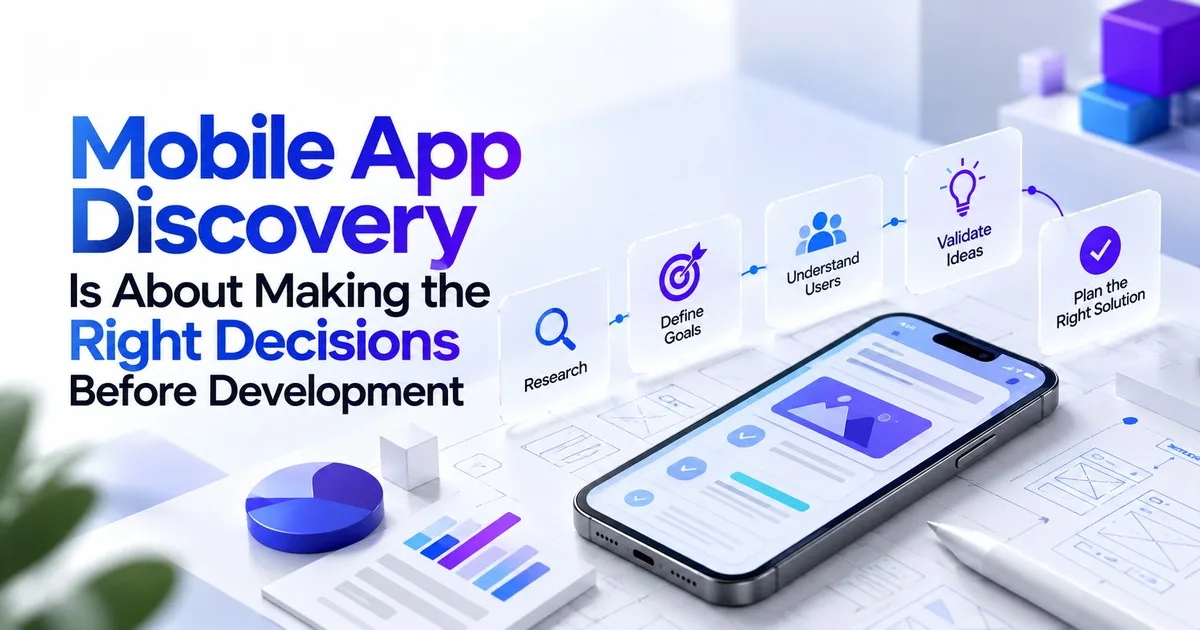
That’s what the discovery phase is for. It gives teams room to question assumptions, compare options, and decide what deserves to be built before serious money and time go into development.
AI can help with parts of this work, especially research prep and organizing information. But it only helps when the team uses it well. In a good discovery process, AI supports decisions. It doesn’t make them without evidence.
Start With the Problem, Not the Feature List
Most app conversations begin with features. A client might ask for user accounts, notifications, dashboards, payments, reports, and an admin panel.
That list tells you what the client wants. It doesn’t tell you why the app should exist.
Take a business building an app for its field technicians. The first request might include job assignments, customer records, photos, and digital signatures. A discovery team should dig into the problem underneath:
- Are technicians losing too much time on paperwork?
- Do dispatchers struggle to see how a job is progressing?
- Are customer records often incomplete?
Does poor connectivity stop technicians from closing jobs at remote sites?
Each answer points to a different priority.
Where AI Helps Here
AI can draft interview questions, turn workshop notes into themes, and flag assumptions worth checking. What it can’t do is talk to the people doing the work. The team still has to hear from them directly and decide which problems come first.
Use AI for Research, but Verify the Findings
Competitor research is another place where AI saves prep time. Instead of building every comparison by hand, a team can use it to organize what’s known about rival products: features, integrations, and pricing models.
The catch is that the output is only as good as the evidence you feed it.
Say a competitor’s website mentions offline access but never explains how changes sync once the connection returns. The right move is to note that gap, not to assume the feature works a certain way.
Different Sources Answer Different Questions
- Product documentation explains what a product says it can do.
- App store reviews show what real users report.
- Demos reveal how things actually behave.
- User interviews uncover needs nobody is meeting yet.
The same goes for market research. An AI summary is a decent starting point, but it isn’t proof of demand. A business still has to confirm that its target customers feel the problem and would value the solution.
Test Technical Assumptions Before They Become Expensive
Some of the most important discovery decisions are about feasibility.
An app might need to plug into an existing CRM, take payments through an outside provider, or work where internet access is shaky. Any of these can change the architecture, the security approach, the development effort, and the timeline.
Back to the field-service example. Technicians need to update job records and take photos offline. When the connection comes back, the app has to sync everything without losing data or creating conflicting records.
A feature checklist can’t tell you whether that will work reliably. Engineers may need to:
- Build a small prototype
- Test syncing under poor network conditions
- Check how the app handles simultaneous updates
AI can help compare architecture options or draft questions about API authentication, rate limits, and sync conflicts. Engineers still need to verify everything against the real systems, devices, and working conditions.
This is why technical discovery should come before a detailed budget or delivery date. A small experiment can expose a big unknown while the project is still flexible enough to change course.
Define the MVP Around Evidence
An MVP isn’t just the smallest pile of features you can ship. It’s the first release that delivers enough value to test the product’s main purpose.
Choosing what goes in takes more than ranking features by popularity or build effort.
Picture a team planning a service-management app. AI suggests pushing photo uploads to the second release because syncing them is technically tricky. Then interviews show that technicians can’t finish a job without photo proof, and prototype testing shows many work sites have no reliable signal.
The evidence flips the decision. Offline photo capture becomes essential, and something less critical, like a detailed parts inventory screen, can wait.
That’s the point: AI can help organize priorities, but the team has to weigh them against user needs, business goals, dependencies, and technical limits.
A good MVP decision also records why a feature was included or deferred. That makes later conversations much easier when stakeholders ask for additions or new information shifts the plan.
Treat Discovery as a Shared Responsibility
Discovery works best when everyone contributes:
- Business stakeholders clarify goals and constraints.
- Designers study user journeys and spot usability problems.
- Engineers assess feasibility and integration risks.
Users explain how the product fits into their daily work.
A good development partner brings these views together instead of taking a feature list and starting to build. Businesses comparing a mobile app development company in USA should ask how discovery decisions get made, who takes part, and how technical uncertainties are tested before development starts.
What a Team Should Have at the End
By the end of discovery, there should be a documented set of outcomes:
- Agreed goals
- User journeys
- Prioritized requirements
- An initial architecture
- Identified risks
An estimate with clearly stated assumptions
These don’t remove uncertainty. They make what’s left visible enough to manage.
Know What AI Can and Cannot Decide
AI can speed up prep, summarize large amounts of information, suggest questions, and help structure early plans. That’s valuable when it frees people to spend more time on the issues that matter.
Its limits matter just as much. AI can’t confirm that a target customer will adopt the app, that an undocumented integration will work, or that a workflow meets every applicable requirement. Those conclusions need evidence and real expertise.
Teams should also be careful about what they share with AI tools. Customer records, credentials, confidential documents, and sensitive project details belong only in tools approved for that purpose.
If you want a more detailed breakdown of the activities and decisions involved, here’s a week-by-week guide to AI in the mobile app discovery phase.
The Real Outcome of Discovery
The value of discovery isn’t how many documents you produce or how fast you finish the workshops. It’s the quality of the decisions that come out of it.
A strong process shows a business which problem it’s solving, what the first release must achieve, which technical risks need testing, and which assumptions drive the estimate.
AI can make preparation more efficient, but evidence, collaboration, and engineering judgment stay at the center.
Before committing to development, a team should be able to explain what they plan to build, why those features matter, how the riskiest assumptions were tested, and what they still need to learn. That clarity gives the project a far more reliable starting point.
Read Also: What Businesses Should Evaluate Before Choosing a Mobile App Development Partner