Market Overview:
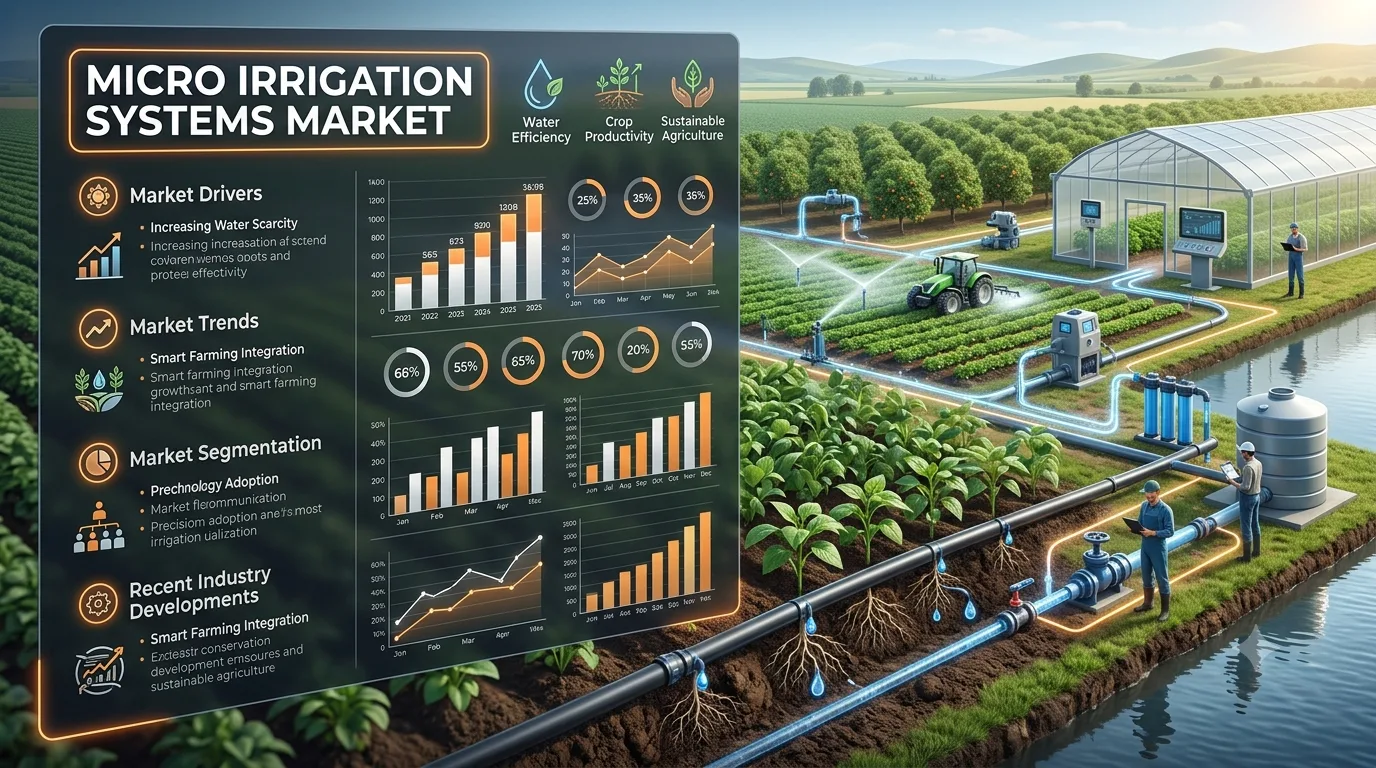
According to IMARC Group's latest research publication, "Micro Irrigation Systems Market: Global Industry Trends, Share, Size, Growth, Opportunity and Forecast 2026-2034", The global micro irrigation systems market size reached USD 13.5 Billion in 2025. Looking forward, IMARC Group expects the market to reach USD 24.9 Billion by 2034, exhibiting a growth rate (CAGR) of 7.01% during 2026-2034.
This detailed analysis primarily encompasses industry size, business trends, market share, key growth factors, and regional forecasts. The report offers a comprehensive overview and integrates research findings, market assessments, and data from different sources. It also includes pivotal market dynamics like drivers and challenges, while also highlighting growth opportunities, financial insights, technological improvements, emerging trends, and innovations. Besides this, the report provides regional market evaluation, along with a competitive landscape analysis.
How Technology and Policy Are Reshaping the Micro Irrigation Systems Market
- Drip irrigation systems dominate the type segment as they deliver water directly to the plant root zone, reducing water waste from runoff and evaporation compared to conventional flood irrigation methods.
- Asia Pacific holds the leading regional position with over 39% market share, driven by large agricultural land coverage, government subsidy programs, and the rising adoption of precision farming technologies across India, China, and Southeast Asia.
- India's Per Drop More Crop (PDMC) scheme has brought more than 115 lakh hectares under micro-irrigation as of July 2026, benefitting 12.30 lakh farmers, with around 20% of beneficiaries being women.
- In February 2025, Netafim launched its patented Hybrid Dripline system, described as the first integral dripline with a built-in outlet that combines the advantages of both integral and on-line dripper systems into a single solution.
- Under India's Union Budget 2026-27, an allocation of Rs. 6,587 crore (USD 731.89 million) was made for the Pradhan Mantri Krishi Sinchai Yojana (PMKSY), supporting continued irrigation expansion and water-use efficiency across the agricultural sector.
Download a sample PDF of this report: https://www.imarcgroup.com/micro-irrigation-systems-market/requestsample
Key Trends in the Micro Irrigation Systems Market
- Water Conservation Becoming a Central Agricultural Priority: Agriculture accounts for nearly 70% of total freshwater withdrawals worldwide, and traditional flood and furrow irrigation methods lose substantial water to evaporation and deep percolation. Micro irrigation systems, by delivering moisture precisely at the root zone, reduce water usage by 40-80% compared to conventional methods. In regions facing persistent drought and groundwater depletion, such as California, Rajasthan, and parts of Sub-Saharan Africa, drip and sprinkler systems have become essential tools for sustaining agricultural output.
- Smart and AI-Integrated Irrigation Systems Gaining Traction: The sector is rapidly moving beyond basic hardware toward digitally enabled solutions. In January 2026, Kubota Corporation released a smart micro-irrigation kit with IoT sensors, and in October 2025, Lindsay Corporation introduced drought-adaptive micro-sprinkler technology with modular zoning for variable rate irrigation, targeting vineyards operating under strict water restrictions. Rivulis also launched an AI-powered tool within its Knowledge Hub platform, leveraging decades of agronomic expertise to provide tailored irrigation recommendations and predictive analytics to farmers.
- Government Subsidies and Schemes Accelerating Adoption in Emerging Economies: In India, the PMKSY Per Drop More Crop component provides subsidies of up to 55% for small and marginal farmers and up to 45% for other categories on drip and sprinkler irrigation systems, with some states supplementing these further through state budgets. During 2025-26, a total of Rs. 8,957.72 crore was released under PM-RKVY, of which Rs. 3,226.36 crore was specifically dedicated to the PDMC micro-irrigation scheme. These financial supports are enabling millions of smallholder farmers to transition away from water-intensive flood irrigation.
- Orchard and High-Value Crop Segments Driving Premiumization: Orchard crops represent the leading crop-type segment in the market, as fruit growers increasingly rely on precision irrigation to maximize yield quality and manage water inputs on high-investment crops such as grapes, citrus, apples, and berries. The demand for consistent moisture delivery, fertigation integration, and reduced labor costs makes micro irrigation indispensable for these value-intensive agricultural operations.
- Fertigation and Chemigation Expanding the Value Proposition of Micro Irrigation: Micro irrigation systems increasingly serve as delivery mechanisms not only for water but also for fertilizers and crop protection chemicals through fertigation and chemigation. By integrating nutrient delivery directly into the irrigation process, farmers improve fertilizer use efficiency, reduce input costs, and achieve more uniform crop growth. This multipurpose functionality is broadening the appeal of micro irrigation systems beyond basic water management.
We explore the factors driving the growth of the market, including technological advancements, consumer behaviors, and regulatory changes, along with emerging micro irrigation systems market trends.
Growth Factors in the Micro Irrigation Systems Market
- Rising Global Food Demand Requiring Higher Agricultural Productivity: The world population is projected to reach 8.6 billion and food production systems must scale accordingly, particularly in water-scarce regions where conventional irrigation is no longer viable. Micro irrigation systems allow farmers to consistently deliver moisture and nutrients to crops, reducing the risk of under- or over-watering, and thereby improving yield reliability and food output per unit of land.
- Government Infrastructure Investment and Program Expansion: Under PMKSY-AIBP in India, 71 out of 123 irrigation projects had been completed as of May 2026, achieving 57.72% project completion and creating irrigation potential across 2,940.97 thousand hectares. Simultaneously, the Indian government has promoted underground pipelines, micro-irrigation, and SCADA-based monitoring systems as core technologies for improving water-use efficiency at the national level, signaling strong and sustained institutional support.
- Precision Agriculture and Digital Farming Integration: The integration of IoT sensors, weather-linked automation, smartphone-based controls, and remote monitoring platforms is transforming how micro irrigation systems are deployed and managed. Smart irrigation systems that adjust watering schedules based on real-time soil and climate data reduce over-irrigation, lower labor requirements, and improve crop outcomes. These digital capabilities are making micro irrigation systems attractive to a broader range of commercial and institutional agricultural operators.
- Kenya's Regulatory Formalization Opening New African Market Opportunities: The February 2026 Guidelines for Promotion, Development and Management of Irrigation in Kenya have formalized licensing, quality assurance, and oversight frameworks for irrigation schemes. This regulatory structure is raising the importance of compliant system integrators and raising the barrier for low-quality alternatives, thereby channeling investment toward certified and professionally deployed micro irrigation solutions in one of Africa's fastest-growing agricultural economies.
- Industrial Segment Emerging as a Fast-Growing End-Use Category: While the agricultural sector remains the dominant end user, the industrial segment is projected to be the fastest-growing end-use category. Applications include landscape and turf irrigation for commercial properties, golf courses, public parks, and urban green infrastructure, all of which require precision water delivery to maintain aesthetics and meet local water use regulations. This diversification is expanding the addressable market for micro irrigation system manufacturers beyond traditional farmland.
Leading Companies Operating in the Global Micro Irrigation Systems Industry:
- Antelco
- Chinadrip Irrigation Equipment (Xiamen) Co., Ltd
- Hunter Industries Inc.
- Irritec S.p.A
- Irritrol
- Jain Irrigation Systems Ltd.
- Mahindra Agri Business
- Nelson Irrigation Corporation
- Netafim
- Rain Bird Corporation
- Rivulis Irrigation
- Sistema Azud S.A
- The Toro Company
Micro Irrigation Systems Market Report Segmentation:
Breakup By Type:
- Drip Irrigation System
- Sprinkler Irrigation System
Drip irrigation systems account for the largest share owing to their ability to deliver water directly to the root zone, minimizing waste and supporting precision nutrient management across a wide range of crop types.
Breakup By Crop Type:
- Field Crops
- Orchard Crops
- Landscape and Turf
- Others
Orchard crops currently exhibit clear dominance in the market, driven by the high value of fruit cultivation and the need for precise moisture and nutrient delivery to maximize yield quality and protect investment in permanent crop plantations.
Breakup By End User:
- Agricultural
- Industrial
The agricultural sector accounts for the largest market share as micro irrigation systems are integral to sustainable crop production, particularly in water-scarce regions where efficient use of limited water resources is essential for farm viability.
Breakup By Region:
- North America (United States, Canada)
- Asia Pacific (China, Japan, India, South Korea, Australia, Indonesia, Others)
- Europe (Germany, France, United Kingdom, Italy, Spain, Russia, Others)
- Latin America (Brazil, Mexico, Others)
- Middle East and Africa
Asia Pacific holds the leading regional position owing to the vast agricultural land base, large smallholder farming population, active government subsidy programs, and accelerating precision agriculture adoption across countries such as India, China, and Japan.
Recent News and Developments in the Micro Irrigation Systems Market
- February 2025: Netafim launched its patented Hybrid Dripline system, positioning it as the first integral dripline with a built-in outlet that combines the advantages of integral and on-line dripper systems into a single product, designed to deliver clog-resistant, leak-free performance with reduced labor requirements during installation.
- January 2026: RM Drip and Sprinklers Systems announced the acquisition of Brahmanand Pipes Private Ltd. to expand its manufacturing capabilities for pipes and related irrigation products, enabling the company to develop new product lines while increasing production capacity to meet the growing demand for micro irrigation equipment.
- February 2026: Rain Bird Corporation unveiled an advanced AI-integrated micro irrigation controller with real-time soil moisture analytics, enhancing precision water delivery for orchards and row crops, with the system designed to reduce water usage by up to 30% while simultaneously improving yield outcomes.
Note: If you require specific details, data, or insights that are not currently included in the scope of this report, we are happy to accommodate your request. As part of our customization service, we will gather and provide the additional information you need, tailored to your specific requirements. Please let us know your exact needs, and we will ensure the report is updated accordingly to meet your expectations.
About Us:
IMARC Group is a global management consulting firm that helps the world's most ambitious changemakers to create a lasting impact. The company provides a comprehensive suite of market entry and expansion services. IMARC offerings include thorough market assessment, feasibility studies, company incorporation assistance, factory setup support, regulatory approvals and licensing navigation, branding, marketing and sales strategies, competitive landscape and benchmarking analyses, pricing and cost research, and procurement research.
Contact Us:
IMARC Group
134 N 4th St. Brooklyn, NY 11249, USA
Email: [email protected]
Tel No: (D) +91 120 433 0800
United States: +1-201-971-6302