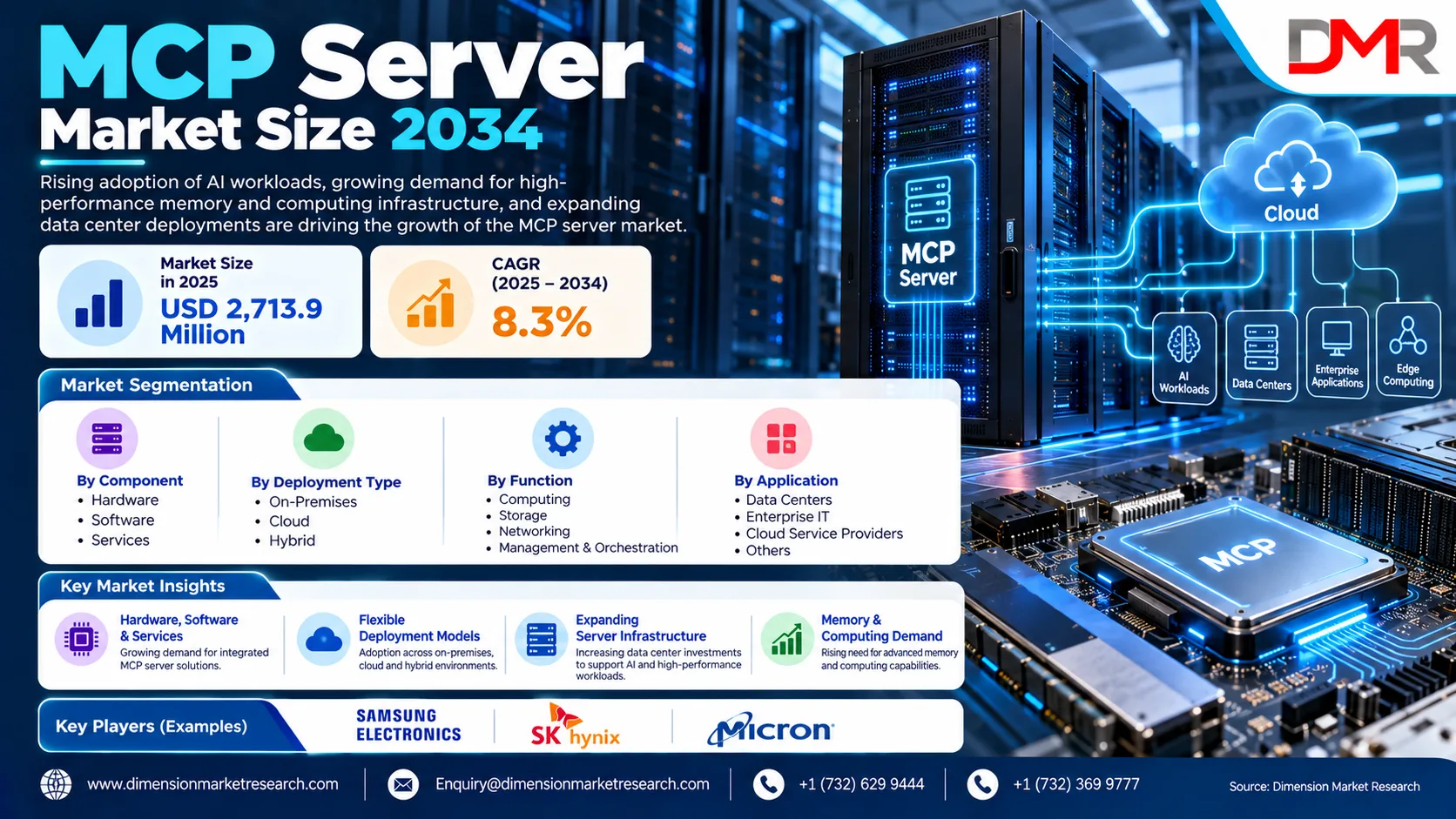
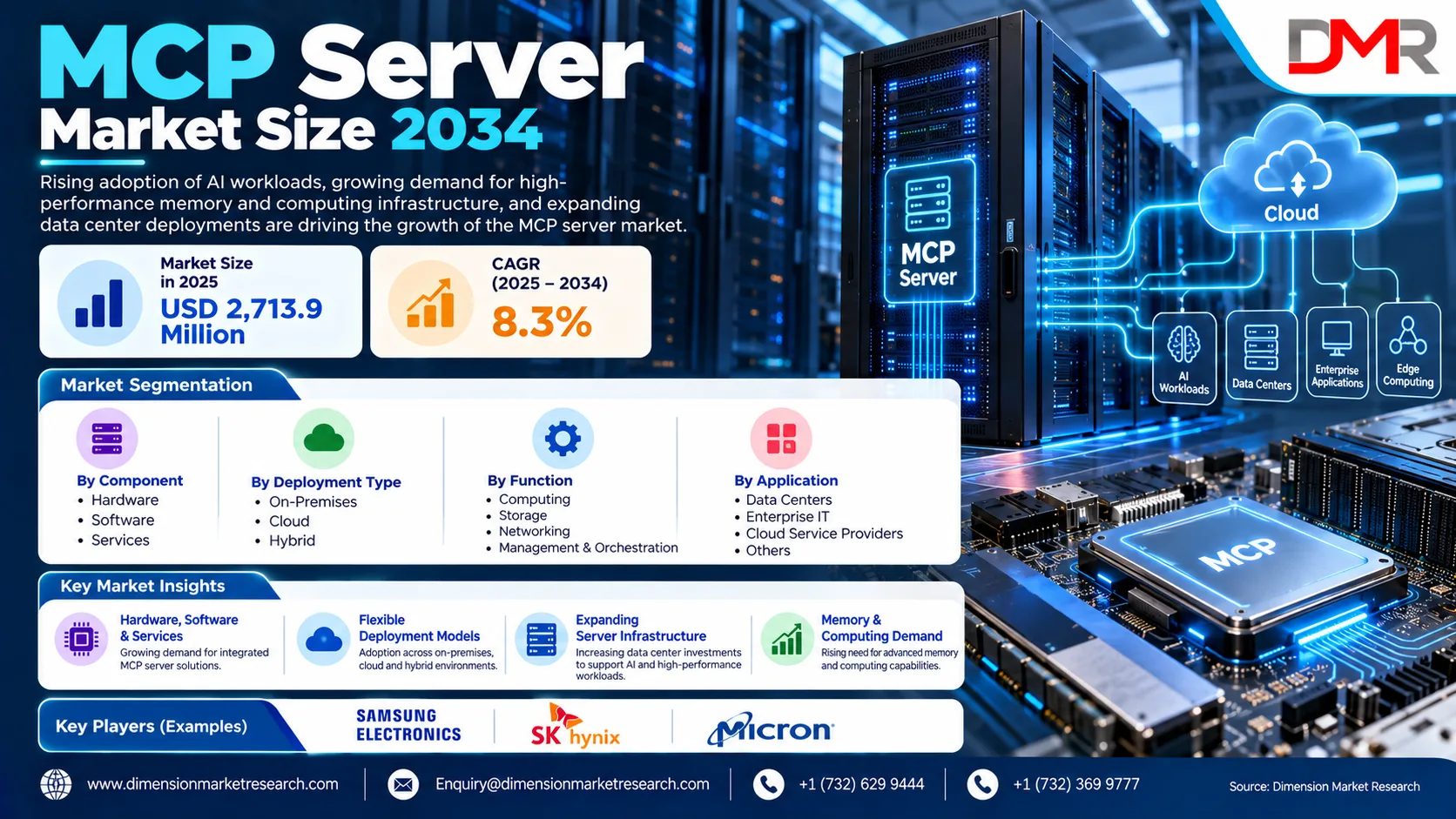
The MCP Server Market is expanding as enterprises increasingly require scalable platforms to create, manage, localize, automate, and distribute digital content across multiple channels. Organizations across media, retail, BFSI, healthcare, education, and government are adopting MCP servers to manage complex publishing workflows while maintaining consistent content across websites, mobile applications, digital publications, and enterprise communication channels.
According to Dimension Market Research, the market is projected to reach USD 2,713.9 million in 2025 and increase to USD 5,565.6 million by 2034, expanding at a CAGR of 8.3%. Growth is supported by cloud adoption, AI-powered content workflows, increasing digital publishing volumes, multilingual content requirements, real-time analytics, and the transition toward composable and API-first publishing architectures.
MCP platforms are also becoming more intelligent. Artificial intelligence, machine learning, natural language processing, automated metadata tagging, personalization, and workflow orchestration are allowing enterprises to create and distribute larger volumes of content with greater speed and consistency.
What Is the MCP Server Market?
MCP, or Multi-Channel Publishing, servers are platforms used to manage content creation, editing, workflow automation, localization, publishing, and performance tracking across multiple digital and traditional channels.
These platforms help organizations maintain centralized control over content while distributing it across:
- Websites
- Mobile applications
- Digital publications
- E-books
- Product catalogs
- Customer communications
- E-learning platforms
- Policy documents
- Marketing channels
The market includes hardware, software, and services, with software representing the primary value layer because it enables content management, version control, publishing automation, analytics, and integrations.
Why Is the MCP Server Market Growing?
Rising Digital Content Volumes
Organizations are producing more digital content than ever before.
Retailers manage thousands of product descriptions, media companies publish continuously, banks generate regulated customer communications, and healthcare organizations distribute clinical and educational information.
Managing this content manually across multiple channels creates duplication, inconsistency, and slower publishing cycles.
MCP servers provide centralized content control while allowing teams to distribute the same information across several formats and platforms.
Expansion of Cloud and Hybrid IT
Cloud adoption is one of the strongest market drivers.
Cloud-based MCP platforms allow teams to access publishing tools from different locations while reducing the need for extensive on-premise infrastructure.
Businesses can scale publishing capacity according to demand and integrate MCP platforms with CRM systems, marketing automation, analytics, e-commerce engines, and digital asset management tools.
Growing Need for Personalized Content
Consumers increasingly expect relevant and personalized digital experiences.
AI-enabled MCP platforms can analyze audience behavior, segment users, and adjust content recommendations according to interests, location, device type, or engagement history.
This is helping publishers and enterprises improve engagement while making content distribution more data-driven.
Get a Free Sample of the MCP Server Market Report
Publishers, enterprises, technology providers, investors, retailers, financial institutions, and digital transformation leaders can explore the sample report for deeper insights into components, deployment types, functions, applications, regional opportunities, and competitive developments.
https://dimensionmarketresearch.com/request-sample/mcp-server-market/
Key Trends Shaping the MCP Server Market
AI-Powered Publishing Workflows
Artificial intelligence is changing how content is created and managed.
Modern MCP platforms can use AI for:
- Automated content tagging
- Metadata generation
- Content recommendations
- Workflow routing
- Predictive analytics
- Personalization
- Translation assistance
- Content quality monitoring
AI can reduce repetitive editorial work while helping enterprises produce content faster.
Composable Publishing Architectures
Organizations increasingly want modular publishing systems rather than large monolithic platforms.
Composable architectures allow businesses to combine content management, analytics, commerce, personalization, and marketing technologies through APIs.
This creates greater flexibility and allows enterprises to replace individual components without rebuilding the entire digital ecosystem.
Headless Content Management
Headless CMS adoption is closely connected with MCP server development.
Content can be created once and delivered through APIs to websites, mobile apps, connected devices, digital signage, and other channels.
This architecture is particularly valuable for companies pursuing omnichannel strategies.
Growing Edge Computing Integration
Edge computing is becoming more relevant as businesses seek faster content delivery and real-time processing.
Placing processing resources closer to users can reduce latency and improve digital experiences, particularly for media streaming, interactive content, IoT applications, and mobile services.
Major Applications of MCP Servers
Media and Publishing
Media and publishing represents one of the most important application areas.
Newspapers, magazines, and digital publishers rely on rapid workflows to create, approve, update, and distribute content.
MCP platforms support:
- Editorial workflows
- Version management
- Multi-format publishing
- Digital subscriptions
- Content analytics
- Localization
Newspapers remain particularly important because of their high publishing frequency and large content volumes.
Retail and E-Commerce
Retailers use MCP systems to manage product catalogs, marketing materials, promotions, and digital commerce content.
Centralized publishing helps ensure that product information remains consistent across websites, apps, marketplaces, and physical retail channels.
BFSI
Banks and financial institutions use MCP platforms for reports, compliance documents, customer communication, disclosures, and digital engagement.
Strong governance and version control are particularly important because financial content often requires regulatory review.
Healthcare
Healthcare organizations use MCP systems to manage medical journals, patient education materials, digital publications, and regulated communications.
Education
Educational institutions can use MCP platforms for e-learning, digital textbooks, course materials, and academic content distribution.
Key Factors Driving Market Growth
One of the strongest drivers is enterprise digital transformation.
Businesses increasingly operate across multiple digital channels and require infrastructure capable of keeping information synchronized.
Remote and distributed work is another important factor. Cloud-based publishing allows teams in different locations to collaborate on content without relying on centralized physical infrastructure.
Multilingual publishing is also becoming increasingly important as organizations expand across regions.
MCP platforms can streamline translation and localization workflows while maintaining brand and regulatory consistency.
Increasing integration with analytics is another major driver because enterprises want to understand how content performs across different channels.
Market Segmentation
By Component
Major categories include:
- Hardware
- Software
- Services
Software is expected to remain the leading component.
Software provides the core capabilities required for centralized authoring, version control, workflow automation, publishing, localization, personalization, and analytics.
Hardware supports processing and storage, while services include consulting, implementation, customization, maintenance, and technical support.
By Deployment Type
The market includes:
- On-Premise
- Cloud-Based
Cloud-based MCP deployment is expected to remain the leading model.
Cloud environments provide scalability, lower infrastructure requirements, remote accessibility, and easier integration with external enterprise platforms.
On-premise systems remain relevant to organizations with strict security, data residency, or regulatory requirements.
By Function
Major functions include:
- Content Authoring & Management
- Multi-Format Publishing
- Workflow Automation
- Localization & Translation
- Analytics & Performance Tracking
Content Authoring & Management is expected to remain the leading function.
Centralized content creation is the foundation for version control, publishing automation, localization, and omnichannel distribution.
By Application
Major applications include:
- Media & Publishing
- Retail & E-Commerce
- BFSI
- Healthcare
- Education
- Government
- Other Applications
Media and publishing remains a particularly important application area because digital publishers require continuous content distribution across multiple formats.
Regional Outlook
North America is projected to account for approximately 39.4% of market revenue in 2025, making it the leading region.
The region benefits from mature digital publishing ecosystems, strong cloud adoption, enterprise technology spending, and extensive use of AI-enabled content platforms.
The U.S. MCP Server Market is projected at USD 899.3 million in 2025 and is expected to reach USD 1,767.2 million by 2034, expanding at a 7.8% CAGR.
Europe is estimated at USD 407.0 million in 2025 and is projected to reach USD 748.4 million by 2034, expanding at a 7.0% CAGR.
European demand is supported by digital transformation, multilingual publishing, data sovereignty requirements, and cloud adoption.
Japan is projected at USD 162.8 million in 2025 and is expected to reach USD 325.6 million by 2034, growing at a 7.6% CAGR.
Asia Pacific is expected to record the fastest overall regional growth as internet penetration, mobile usage, e-commerce, e-learning, and digital publishing continue to expand.
Key Challenges
High Implementation Costs
Enterprise-grade MCP deployments can require significant investment in software, integration, migration, configuration, and training.
Smaller organizations may find advanced platforms difficult to justify without clear operational benefits.
Legacy System Integration
Many enterprises still operate older content management and publishing technologies.
Integrating modern MCP platforms with legacy databases, publishing tools, and enterprise systems can create technical challenges and extended migration timelines.
Data Governance
Organizations publishing content across multiple regions need to manage privacy, localization, access control, regulatory requirements, and data sovereignty.
These requirements can increase platform complexity.
Skills Requirements
Advanced publishing ecosystems require expertise in cloud architecture, APIs, workflow design, content operations, security, and digital analytics.
Shortages of specialized talent can slow implementation.
Future Outlook
The MCP Server Market is expected to become increasingly cloud-native, AI-enabled, composable, and analytics-driven.
AI will play a larger role in content creation, personalization, workflow automation, metadata generation, translation, and performance optimization.
Enterprises are also likely to adopt more API-first and headless architectures as they distribute content across websites, mobile platforms, commerce systems, connected devices, and emerging digital interfaces.
Real-time analytics will allow organizations to continuously optimize publishing strategies according to audience behavior.
Edge infrastructure may also become more important as interactive content, streaming, and low-latency digital experiences expand.
With the market projected to grow from USD 2,713.9 million in 2025 to USD 5,565.6 million by 2034, MCP servers are positioned to remain an important part of enterprise digital publishing and content infrastructure.
Explore the Complete MCP Server Market Analysis
The complete report provides deeper insights into market size, components, deployment types, publishing functions, application industries, regional opportunities, AI adoption, digital transformation, and competitive developments.
https://dimensionmarketresearch.com/checkout/mcp-server-market/
Frequently Asked Questions
1. What is the MCP Server Market?
It includes hardware, software, and services used to create, manage, automate, localize, publish, and analyze content across multiple digital and traditional channels.
2. What is driving the MCP Server Market growth?
Growth is driven by cloud adoption, digital publishing, AI-powered workflows, omnichannel strategies, content personalization, and increasing enterprise content volumes.
3. What are the major applications?
Major applications include media and publishing, retail and e-commerce, BFSI, healthcare, education, government, and enterprise communication.
4. Which regions or segments are important?
North America is projected to hold approximately 39.4% of market revenue in 2025, while software, cloud-based deployment, and content authoring and management are expected to lead their respective segments.
5. What is the future outlook for the MCP Server Market?
The market is projected to reach USD 5,565.6 million by 2034, supported by AI-powered publishing, cloud platforms, composable architecture, headless CMS, automation, and real-time analytics.
Conclusion
The MCP Server Market is evolving as enterprises move toward faster, more automated, and more personalized digital publishing environments. Cloud deployment, AI, workflow automation, and multi-format distribution are enabling organizations to manage increasingly complex content ecosystems.
Future competition will increasingly depend on scalability, integration flexibility, AI capabilities, security, localization, and real-time analytics. Vendors that provide flexible publishing platforms capable of supporting diverse channels and enterprise workflows will be positioned to benefit from continued digital content growth.