Opening the Door to an Intelligent Future
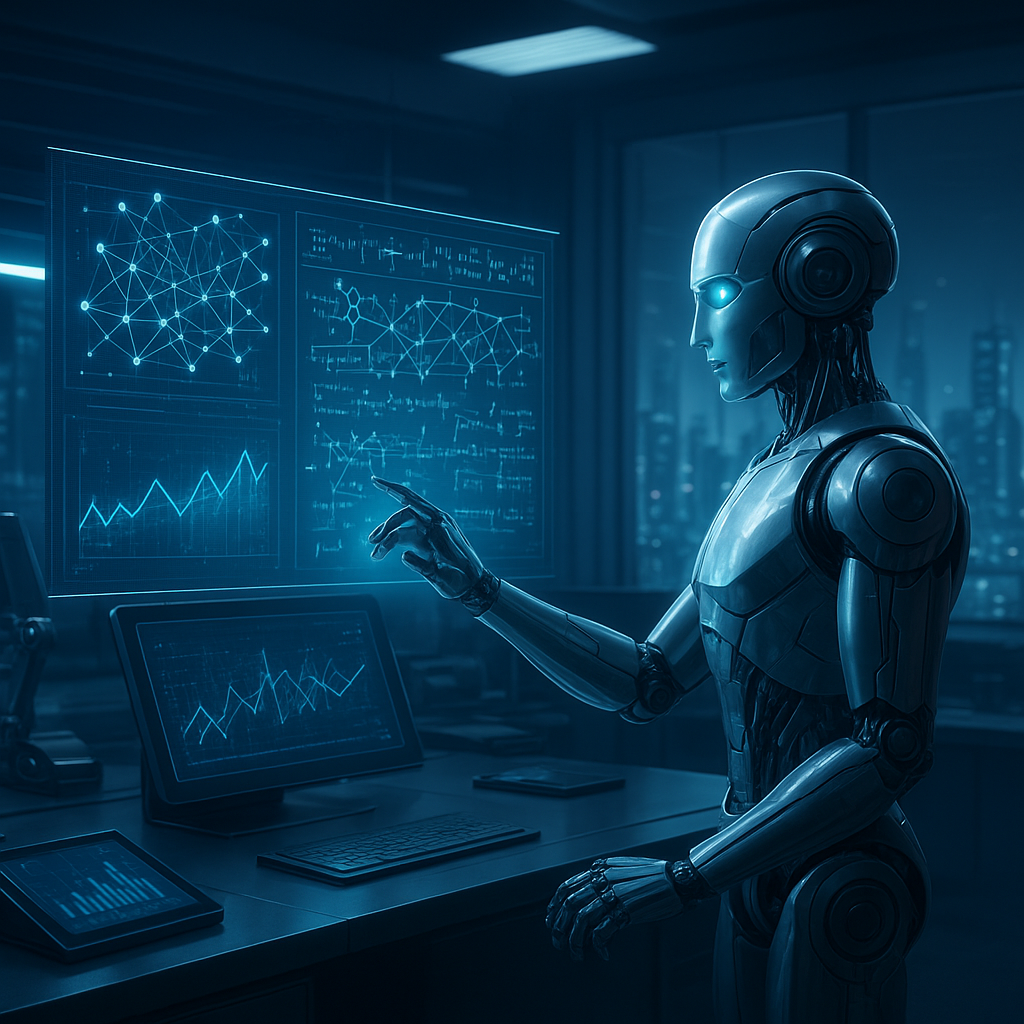
In 2026, artificial intelligence (AI) is no longer a distant concept confined to research labs or science fiction. Instead, it permeates daily life—from robotic assistants in hospitals to predictive algorithms steering global logistics. A remarkable scene unfolds in a state-of-the-art manufacturing facility outside Tokyo, where autonomous robots collaborate seamlessly with human workers. These robots, empowered by advanced machine learning models and sophisticated algorithms, adapt in real-time to changes in the assembly line, optimizing output with unparalleled precision.
This vivid example echoes a broader trend: AI’s evolution into a multidimensional force combining machine learning, robotics, and algorithmic innovations. According to industry reports, the global AI market surpassed $350 billion in 2025, driven largely by these three pillars. Yet, understanding how these components interlock—and where they are headed—requires a deep dive into their origins, current capabilities, and future trajectories.
At its core, AI’s strength lies in the synergy between learning systems, mechanical agents, and the computational logic that guides them. This article explores those facets in detail, drawing on the latest developments and expert analyses to illuminate the transformative power reshaping industries and societies alike.
Tracing the Path: From Theory to Tangible Intelligence
The roots of AI trace back to the mid-20th century when pioneers like Alan Turing and John McCarthy laid the conceptual foundations. Early AI efforts focused on symbolic reasoning and rule-based systems, but the limitations quickly became evident. The real breakthrough emerged with the advent of machine learning, which allowed systems to improve through experience rather than explicit programming.
Robotics, meanwhile, evolved from simple automatons to complex machines capable of perception, dexterity, and autonomous navigation. Algorithms, the backbone of computation, saw parallel advancements in optimization, statistical inference, and now, deep learning architectures. These developments converged around the 2010s with the rise of neural networks and big data, setting the stage for the AI renaissance of the 2020s.
Today’s AI landscape reflects decades of iterative progress:
- Machine Learning: Transitioned from basic classifiers to sophisticated models like transformers and reinforcement learning agents.
- Robotics: Shifted from programmed motions to adaptive, sensor-driven behaviors enabling collaboration and complex task execution.
- Algorithms: Became more efficient and capable of handling vast data streams, real-time decision-making, and probabilistic reasoning.
Understanding this historical context is crucial to appreciate how current AI systems operate and interact, blending learning, mechanical execution, and logic into cohesive intelligent frameworks.
Dissecting the Core: Machine Learning, Robotics, and Algorithms in 2026
Machine learning remains the engine powering AI’s cognitive capabilities. In 2026, over 75% of AI implementations rely on advanced learning paradigms, including self-supervised learning and causal inference models. These approaches allow AI to generalize beyond training data, improving robustness and adaptability.
Robotics, once a separate domain, now integrates tightly with machine learning. Autonomous robots possess embedded AI chips running real-time algorithms that interpret sensor data and execute complex motor commands. For instance, Boston Dynamics’ latest Atlas units incorporate multi-modal learning to navigate dynamic urban environments, a milestone achieved through years of algorithmic refinement.
Algorithms underpin both machine learning and robotics, orchestrating data processing, optimization, and decision-making. Innovations in quantum-inspired algorithms have recently accelerated problem-solving speeds, enabling AI to tackle previously intractable challenges in logistics, healthcare, and finance.
“The fusion of learning algorithms with robotic hardware is unlocking unprecedented levels of autonomy and efficiency,” notes Dr. Maya Chen, lead AI researcher at TechNova Labs.
Concrete data highlights this integration:
- AI-Powered Robotics Market: Expected to reach $125 billion by 2027, with growth driven by manufacturing, agriculture, and healthcare sectors.
- Algorithmic Efficiency Gains: New optimization algorithms have reduced computational costs by 40% in large-scale AI models, according to the International AI Consortium.
- Machine Learning Adoption: 68% of Fortune 500 companies report deploying machine learning models embedded in robotics or operational algorithms.
The interplay among these fields creates a virtuous cycle: better algorithms improve learning; enhanced learning refines robotic control; and advanced robotics provide richer data for algorithmic improvement.
2026 Highlights: Breakthroughs and Industry Shifts
This year, several landmark developments exemplify AI’s rapid maturation. Open-source platforms now offer modular AI toolkits that integrate machine learning models with robotic control algorithms, democratizing access and accelerating innovation.
One notable breakthrough is the emergence of "Cognitive Robotics as a Service" (CRaaS) platforms, which enable businesses to deploy adaptive robots without heavy upfront investment. Startups like SynthoDynamics have pioneered flexible robotic arms powered by continuous learning algorithms, capable of switching tasks on-the-fly in warehouses and production lines.
“CRaaS is redefining how companies approach automation—shifting from rigid hardware to intelligent, evolving systems,” explains CEO Javier Morales of SynthoDynamics.
In healthcare, AI-driven surgical robots now leverage real-time machine learning to adjust to patient variability during complex procedures, reducing operation times and improving outcomes. Meanwhile, in logistics, algorithms optimizing drone fleets have cut delivery times by 30%, according to industry analyses.
These trends reflect broader shifts:
- Hybrid AI Systems: Combining symbolic reasoning with learning-based methods to enhance explainability and reliability.
- Edge AI Integration: Robotics increasingly operate autonomously at the edge, processing data locally to reduce latency and bandwidth dependence.
- Ethical and Regulatory Focus: Governments and organizations are crafting frameworks to ensure AI transparency, safety, and accountability.
These developments highlight the sector’s move toward scalable, adaptable, and responsible AI solutions.
Expert Insights and Industry Impact
Industry leaders emphasize that the convergence of machine learning, robotics, and algorithms is not merely technological but strategic. According to a panel discussion at the 2026 Global AI Summit, executives from major firms like IBM, NVIDIA, and Siemens highlighted how integrated AI solutions drive competitive advantage through operational agility and innovation.
Dr. Elena Rossi, Chief Scientist at NVIDIA, remarked, “Our investments in AI chips tailored for robotics and algorithmic processing are enabling a new generation of intelligent machines that learn and adapt in real time.”
This integration is reshaping labor markets, prompting re-skilling initiatives worldwide. Robotics augmented with learning capabilities are taking on repetitive or dangerous tasks, freeing human workers for creative and supervisory roles. However, this transition also raises concerns about job displacement and equitable access to AI benefits.
Moreover, sectors such as autonomous vehicles, smart cities, and precision agriculture are experiencing rapid transformations. Algorithms optimize traffic flows, machine learning predicts crop diseases early, and robots maintain infrastructure autonomously, collectively enhancing efficiency and sustainability.
For comprehensive strategic insights, see Why Algorithms, Robotics, and Machine Learning Are Reshaping AI Innovation and Unlocking Intelligence: How Algorithms, Robotics, and Machine Learning Shape Our Future.
What Lies Ahead: The Road to Truly Intelligent Machines
Looking forward, AI’s trajectory points toward increasingly autonomous, context-aware, and collaborative systems. Key areas to watch include:
- Explainable AI: Developing transparent algorithms that clarify decision processes to users and regulators.
- Neuromorphic Robotics: Combining brain-inspired hardware with learning algorithms to achieve low-power, high-efficiency cognition.
- Swarm Intelligence: Deploying coordinated multi-robot systems that collectively solve complex problems beyond individual capabilities.
- Human-AI Collaboration: Enhancing interfaces for seamless interaction between humans and intelligent machines.
Additionally, ethical frameworks and governance mechanisms will be pivotal in guiding AI’s integration into society responsibly.
“The future of AI hinges on harmonizing technical breakthroughs with societal values to build trust and maximize positive impact,” asserts Prof. Anil Mehta, AI ethics expert at Stanford University.
Organizations and researchers are actively pursuing these goals, drawing from interdisciplinary fields spanning computer science, cognitive psychology, and social sciences.
In sum, the triad of machine learning, robotics, and algorithms continues to redefine intelligence itself—not as a static property but as an evolving, dynamic capability embedded in machines increasingly interwoven with human environments.