Driven by startup innovation, industrial automation, and government initiatives, India is emerging as a major hub for the adoption of robotics engineering. With robotic applications spanning agriculture, logistics, and defence, the future of robotics in India looks bright. Industries are transforming with robotics that combines electronics, programming, mechanical engineering, automation, AI, and intelligent control systems. Robots have become an integral part of modern engineering environments, finding their place in warehouse operations and assembly lines to advanced manufacturing and autonomous vehicles. With robots finding application across diverse industries, there is a growing demand for robotic engineers who can design, develop, program, and maintain sophisticated robotic systems.
Understanding the Foundations of Robotics Engineering
Robotics engineering is an integration of mechanical engineering, electronics, computer science, and artificial intelligence, using which a functional robot is created. This engineering program offers a structured pathway for engineering professionals to develop abilities to design and build intelligent machines. The program covers the entire journey of designing and building robots, from providing an understanding of robot design and mechanical systems to sensing, programming, control, and industrial automation. The foundation of this engineering program is laid with fundamental engineering concepts in which candidates gain an understanding of how mechanical, electrical, and computational components work together to create a functional robot. The fundamental concepts are essential to develop an understanding of the behavior of a robotic system in a specific way and about the contribution of individual components to its overall performance.
Learning Robot Design and Development
A vital part of the comprehensive robotics engineering program is robot design and development, in which candidates learn mechanical structure, electronic systems, and software programming. Right from conceptualizing a robotic system to translating that idea into an engineering design, candidates develop an understanding of the entire process. Candidates learn to make use of CAD tools to create 3D models of robot components and assemblies. While considering factors like load, movement, precision, and operating conditions, candidates may learn to work with joints, mechanical structures, actuators, end-effectors, as well as some other components. Robots designing introduce candidates to concepts like robot configuration, motion and kinematics, actuators, robot workspace, end-effectors, computer-aided engineering, and design optimization. This program is a fine blend of theoretical and practical knowledge that provides learners with an understanding of how robots are built for real-world applications.
Exploring Sensors and Embedded Systems
Sensors play an important role in modern robotic systems, which are supposed to perceive their environment and monitor their operations. Therefore, participants of this engineering program are introduced to different types of sensors that are mostly used for detecting force, distance, position, speed, temperature, and other parameters. Participants also learn about how a robotic controller collects, processes, and uses sensor data. Another important component of the robotic system is the embedded system that, along with microcontrollers, allows robots to execute programmed instructions and respond to sensor inputs. Practical exposure allows students to explore the way through which sensors, controllers, motors, and software interact. This knowledge proves extremely useful for developing robots that operate with some level of autonomy.
Developing Robotics Programming Skills
Programming skills are essential for modern robotics because software determines a robot's performance and its response to its environment. Thus, participants of this program are introduced to programming concepts such as algorithms, control logic, data processing, and robotic software frameworks that are relevant to robotics. They learn to work with tools and programming languages that are used in robotics development. Participants also get to explore areas like robot programming, computer vision, Artificial Intelligence, motion planning, simulation, control algorithms, robot operating systems, and data acquisition and processing. Students gain an understanding of how software translates into physical robot behavior through lab projects and programming exercises.
Learning Kinematics and Robot Motion
The study of robot motion is of great importance in the robotics engineering program. Candidates also need to learn kinematics that help them understand the relationship between robot joint movement and the robot’s end-effector position. The program also introduces learners to forward and inverse kinematics that help them determine robotic mechanism movements and how robots achieve a specific position. With the same concept, robotic arms are implemented in assembly, manufacturing, welding, inspection, and material handling. Knowledge of robot motion is also essential to support the development of motion-planning strategies. Engineers learn to design trajectories that facilitate the efficient movement of robots, avoiding collisions and meeting application requirements.
Moving From Robotics to Industrial Automation
Industrial automation and robotics are closely connected, and if learners understand individual robot operation, they can also explore ways through which robots become a part of larger automated production systems. Industrial automation integrates robots with sensors, drives, motors, industrial networks, human-machine interfaces, programmable logic controllers, and other control technologies. Candidates of this program are exposed to automation concepts like machine integration, automated material handling, industrial control systems, PLC programming, process monitoring, industrial communication, and safety systems. Students can look at automation from a broader systems perspective instead of considering robots as isolated machines.
Understanding Robot Simulation
Simulation allows engineers to test designs and program in virtual environments before actually deploying on physical systems. This program introduces learners to different simulation tools that help them create virtual robots, analyze performance, test movements, and determine potential problems. Thus, simulation is believed to reduce development time and minimize risk associated with testing complex robotic systems. This further allows students to experiment with different robot configurations, trajectories, and control strategies without a physical prototype for iteration. Students get prepared for the engineering environments where digital models and virtual commissioning are increasingly used.
Integrating Artificial Intelligence with Robotics
AI plays a vital role in robotics evolution because automation earlier was restricted to predefined instructions, whereas intelligent robotic systems make use of data to interpret environments, identify objects, and adapt their behavior. Thus, modern robotics engineering programs introduce students to AI applications like machine learning, computer vision, predictive systems, object recognition, and autonomous decision-making. For example, computer vision allows robotic systems to identify objects on a production line, whereas AI-based algorithms support inspection and quality-control applications. Engineers learn about AI interaction with robotics that allows them to understand emerging applications in smart manufacturing, logistics, healthcare, autonomous systems, and other sectors.
Developing Hands-On Engineering Experience
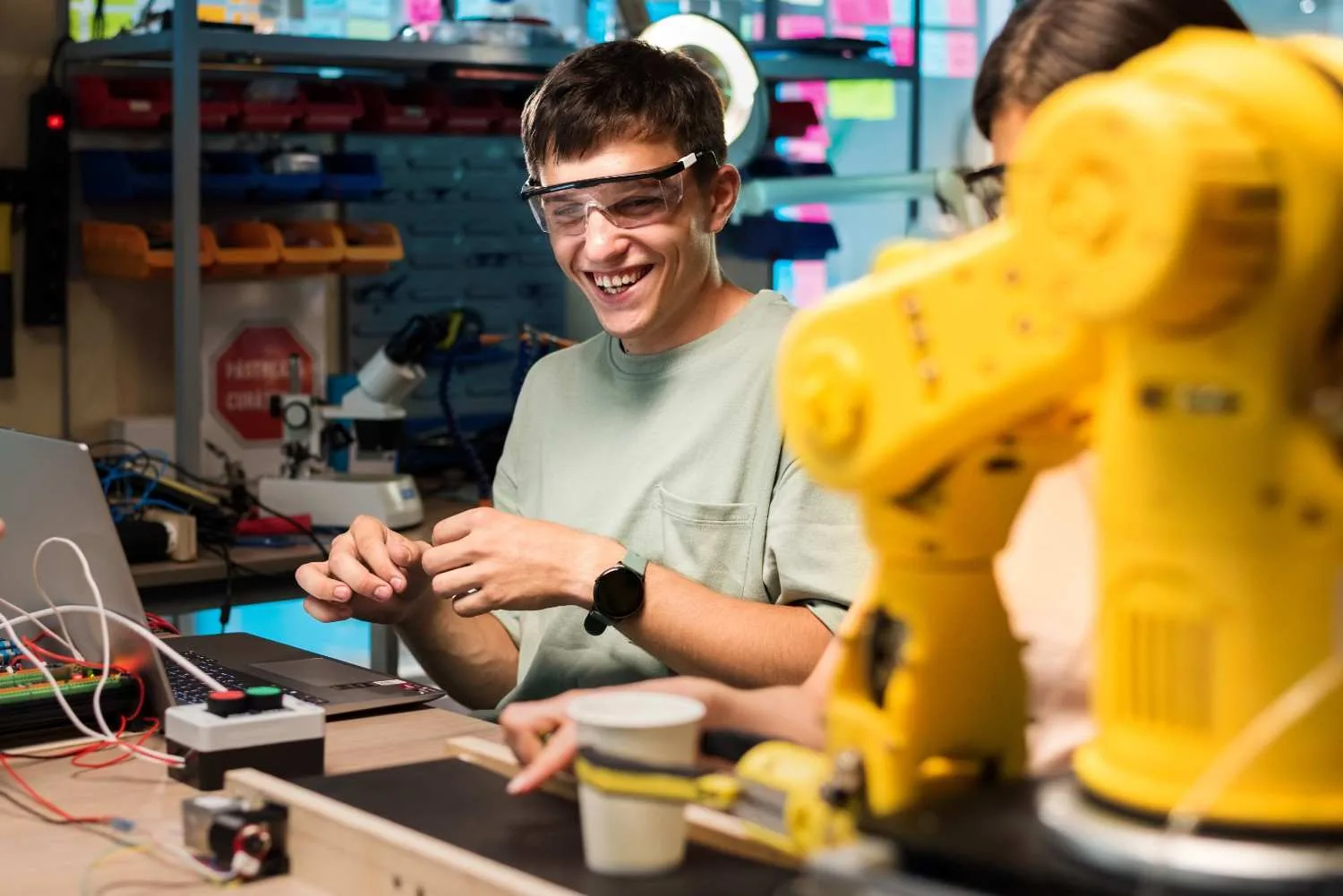
Practical learning is extremely valuable in robotics engineering as it is a practical discipline. Hence, this engineering program combines classroom learning with laboratories, projects, simulations, and industry-oriented assignments, helping learners to apply concepts in realistic situations. Learners work on projects involving autonomous mobile robots, robotic arms, automated production systems, machine vision, or robotic inspection that develop problem-solving skills in them. Candidates are trained to identify mechanical issues, troubleshoot electrical connections, modify programming logic, or optimize robot movements for achieving desired results.
End Note
Robotics engineering is evolving and hence is in need of engineers whose knowledge is not just restricted to mechanical design or robot programming. Engineers need to have a sound understanding of mechanical systems, electronics, software, automation, AI, sensors, and the workings of industrial networks. Engineers looking for this multidisciplinary foundation can pursue a robotics engineering program that teaches them from robot design and kinematics to programming, sensing, simulation, automation, and intelligent systems. To provide them with a broader understanding of robotic engineering, the program also exposes them to practical projects and industry-oriented learning. Professionals with interdisciplinary robotics expertise play a significant role in designing and implementing the technologies shaping the next generation of industry. This well-designed program allows learners to build the technical foundation that is essential to contribute to this evolving field.