Behind every high-performing decentralized exchange (DEX) is a carefully engineered technology stack. While the user sees a clean trading dashboard, the real magic happens at the infrastructure level smart contracts executing trustless trades, liquidity pools balancing token ratios, oracles feeding real-time price data, and Layer 2 solutions keeping gas fees manageable. Choosing the right technologies is the single most important decision in decentralized exchange development.
Whether you're launching a new DeFi exchange platform or upgrading an existing one, understanding the core technologies that power modern DEX platforms gives you a critical advantage in building something scalable, secure, and future-ready.
Blockchain Networks — The Foundation
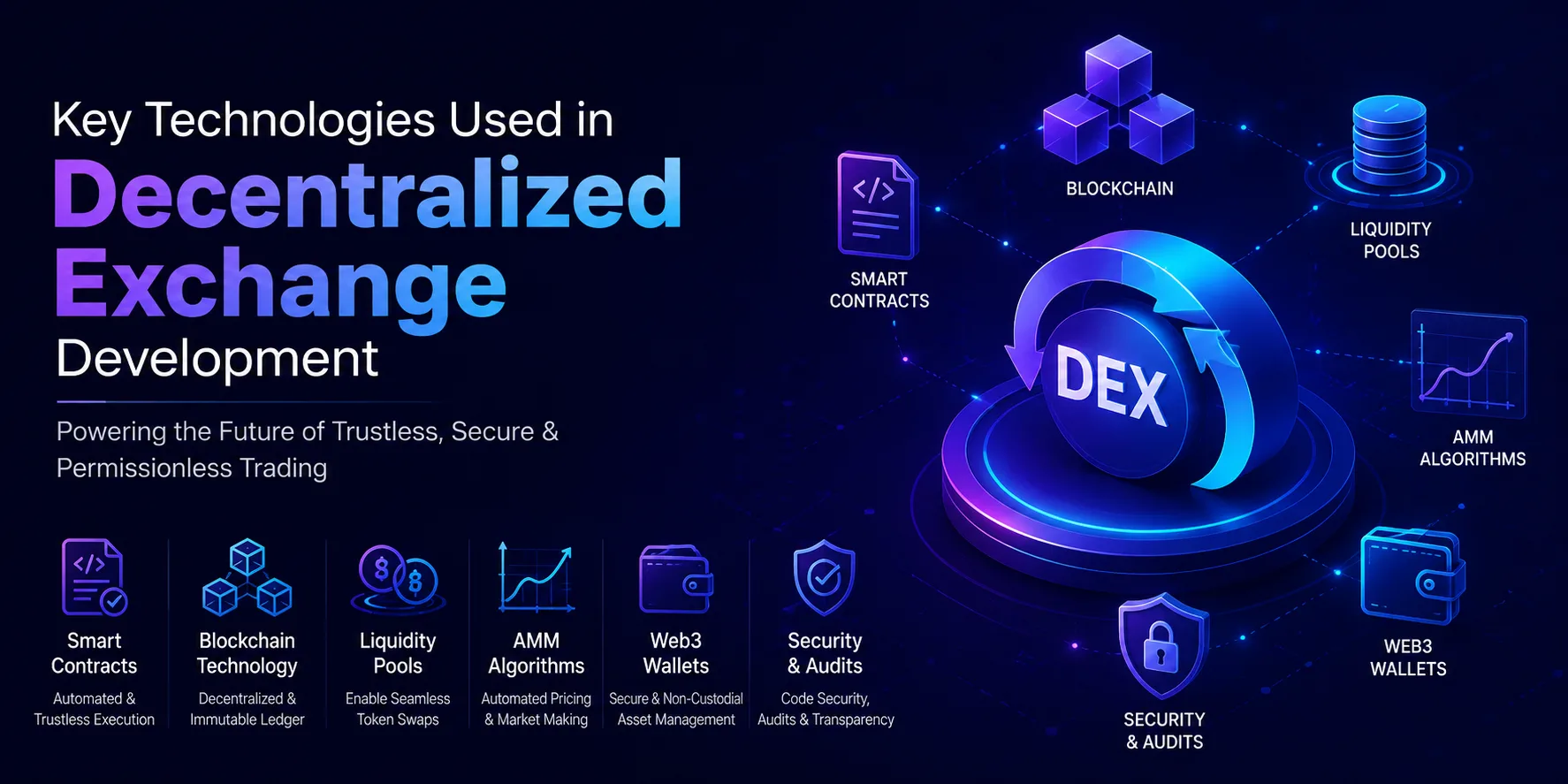
Every DEX runs on a blockchain, and your network choice defines your platform's speed, cost, security, and ecosystem access. The leading networks in 2026 are Ethereum (the gold standard for DeFi, widest developer ecosystem), BNB Chain (fast transactions, low fees, massive user base), Polygon (Layer 2 scalability with Ethereum compatibility), and Solana (ultra-high throughput for performance-intensive DEX platforms). Each network brings distinct trade-offs between decentralization, transaction speed, and cost making this the foundational technology decision that shapes everything downstream.
Smart Contracts — The Engine of Every DEX
Smart contracts are self-executing programs stored on the blockchain that automate every DEX function trade execution, fee distribution, liquidity management, and governance. Solidity is the dominant language for Ethereum, BNB Chain, and Polygon-based DEX development. Rust powers high-performance contracts on Solana. Writing secure, gas-optimized, modular smart contracts using audited libraries like OpenZeppelin is non-negotiable for any production-grade blockchain exchange platform.
AMM Protocols & Liquidity Pool Mechanisms
The Automated Market Maker (AMM) protocol is the algorithmic backbone of most modern DEX platforms. Instead of order books, AMMs use mathematical formulas — most commonly the constant product formula (x × y = k) — to price assets based on token pool ratios. Popular AMM models include Uniswap V3 (concentrated liquidity), Curve Finance (stablecoin-optimized), and Balancer (weighted multi-token pools). Liquidity pool mechanisms manage token pair creation, LP reward distribution, and impermanent loss mitigation all governed by smart contracts deployed on your chosen blockchain.
Frontend Technologies & Web3 Integration Libraries
The user-facing layer of your DEX platform is typically built with React.js or Vue.js — modern JavaScript frameworks that deliver fast, responsive trading interfaces. Connecting your frontend to the blockchain requires Web3 integration libraries — specifically Ethers.js (lightweight, widely adopted) or Web3.js (full-featured, battle-tested). These libraries handle wallet connections, smart contract calls, transaction signing, and real-time blockchain event listening — forming the critical bridge between your UI and the on-chain infrastructure.
Wallet Integration & Backend Technologies
Seamless crypto wallet integration using MetaMask, WalletConnect, Coinbase Wallet, and Trust Wallet allows users to authenticate and trade without creating accounts or sharing personal data. On the backend, Node.js handles API services, off-chain data processing, and middleware that connects blockchain events to your frontend in real time. A well-designed backend supports fast data indexing, transaction history retrieval, and performance analytics without compromising the decentralized nature of your platform.
Oracles, Layer 2 Solutions & Cross-Chain Technologies
Decentralized price oracles like Chainlink provide tamper-proof, real-time market data feeds to your smart contracts — protecting against price manipulation attacks that have devastated poorly designed DeFi protocols. Layer 2 scaling solutions including Optimistic Rollups (Arbitrum, Optimism) and zk-Rollups (zkSync, StarkNet) dramatically reduce gas fees and increase transaction throughput — making your Layer 2 DEX accessible and cost-efficient for everyday users. Cross-chain interoperability protocols and bridge technologies enable multi-chain token swaps, expanding your platform's reach beyond a single blockchain ecosystem.
Security Technologies, Storage & DevOps Tools
Smart contract security tools like Slither, MythX, Echidna, and Foundry are essential for vulnerability detection during development and pre-launch auditing. IPFS (InterPlanetary File System) and Arweave provide decentralized storage for off-chain data like token metadata, user interface assets, and governance documents. On the DevOps side, Hardhat and Truffle are the industry-standard development and deployment frameworks, supporting local blockchain simulation, automated testing, and CI/CD pipeline integration for reliable, repeatable smart contract deployments.
DAO Governance, Analytics & Future Technologies
DAO-based governance mechanisms powered by token voting protocols — give your community direct control over platform upgrades, fee structures, and protocol parameters. On-chain analytics tools and performance monitoring dashboards provide real-time visibility into trading volume, liquidity depth, and user behavior. Looking ahead, AI-powered smart contract security, zero-knowledge proof (ZK) technology for privacy-preserving transactions, and account abstraction for simplified user onboarding are the emerging technologies that will define the next generation of secure decentralized exchange platforms.
Conclusion
The technology stack behind a successful DEX platform is complex, interconnected, and constantly evolving. From Solidity smart contracts and AMM protocols to Chainlink oracles, Layer 2 rollups, and zero-knowledge proofs every technology layer plays a vital role in delivering a platform that is fast, secure, transparent, and scalable.
Getting the tech stack right from day one separates platforms that thrive from those that fail. If you are ready to build with the right foundation, connect with a professional team offering custom decentralized exchange development solutions for blockchain startups delivering end-to-end DEX architecture, smart contract engineering, and multi-chain deployment expertise built for real-world success.