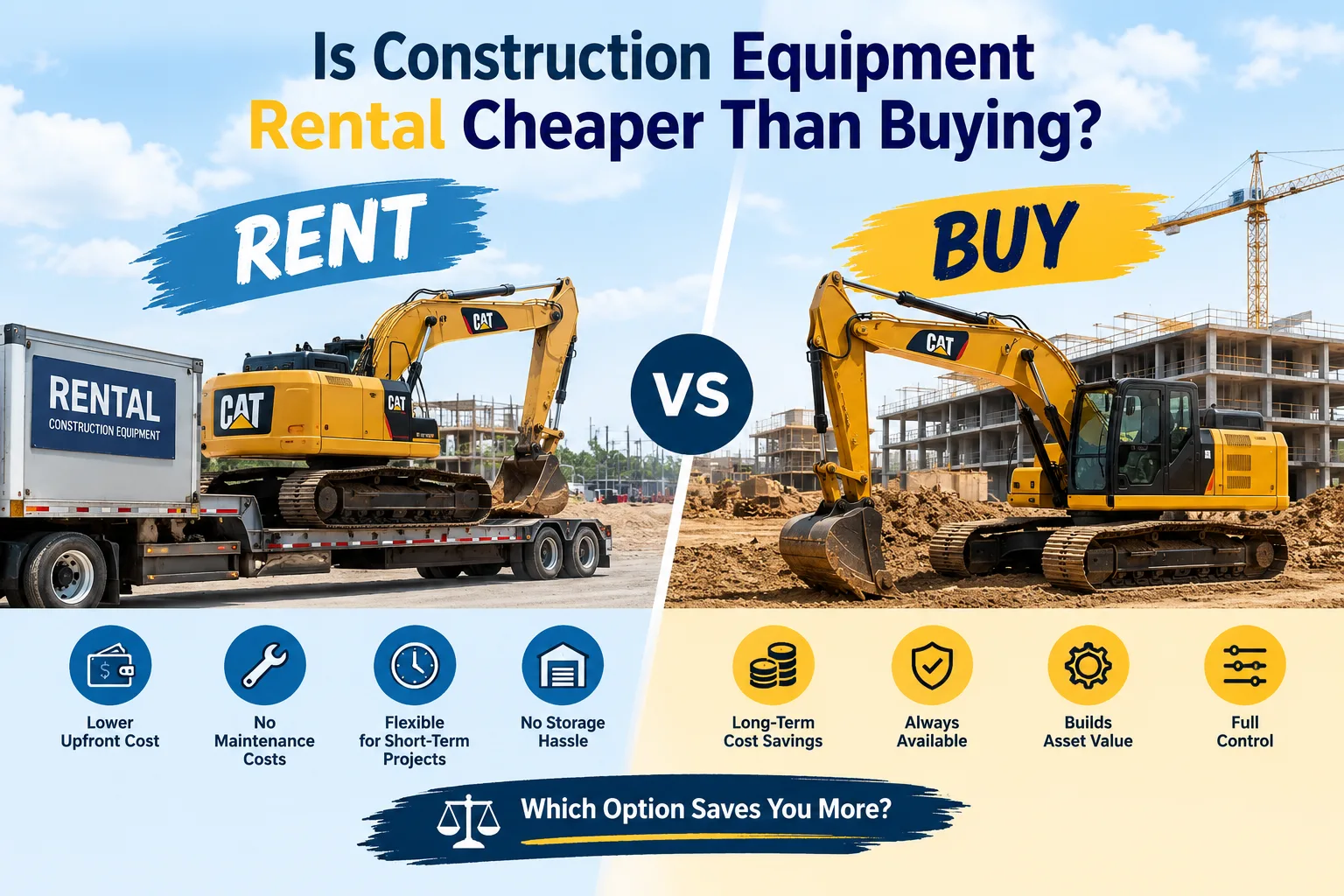
A single wheel loader can cost more than a house. A large excavator can run well into six figures before you've moved a shovel of dirt. So when a project lands on your desk and you're staring down a fleet requirement, the question isn't really "rent or buy" — it's "which one protects my margins?"
For most contractors, the honest answer is that construction equipment rental is cheaper than buying, at least for the majority of jobs. But "most" isn't "all," and the math changes depending on how often you'll use a machine, how long you'll keep it, and what kind of equipment you need. This article walks through the real costs on both sides — ownership and rental — so you can make the call with numbers instead of guesswork, using common examples like excavator rentals, wheel loader rentals, and specialty equipment like a Morooka rental for soft or unstable ground.
Quick Summary
- Buying makes sense when a machine will run at high utilization for years and you have the capital and maintenance capacity to support it.
- Renting makes sense for seasonal work, one-off jobs, specialty equipment, and any project where cash flow matters more than long-term ownership.
- Rental costs include the machine, delivery, and support — but skip depreciation, storage, insurance overhead, and resale risk.
- A simple utilization test (below) tells you which side of the line your project falls on.
- Specialty machines, like a Morooka rental for wet or unstable terrain, almost always make more financial sense to rent than to own.
What Does It Actually Cost to Own Construction Equipment?
Ownership costs go well beyond the purchase price. The first paragraph of any cost conversation should start here, because this is where most budgets go wrong.
Owning equipment means carrying:
- Purchase or financing cost — often 5–10 year loan terms with interest
- Depreciation — heavy equipment loses value every year it sits, whether it's working or not
- Maintenance and repairs — scheduled service, wear parts, and unplanned breakdowns
- Storage — yard space, security, and sometimes a dedicated lot
- Insurance — coverage that scales with the value of your fleet
- Operator training and certification for specialized machines
- Resale risk — used equipment values fluctuate with the market, and you're rarely guaranteed to recover what you expect
A machine that sits idle for six months of the year is still costing you money every one of those months. That's the core problem ownership creates: cost doesn't pause when the work does.
What Does Construction Equipment Rental Actually Include?
Construction equipment rental shifts most of that risk to the rental company. When you rent, you're typically paying for:
- The machine itself, for the exact duration you need it
- Delivery and pickup
- Routine maintenance (handled by the rental provider, not your crew)
- Access to a newer, well-maintained fleet without a capital outlay
What you're not paying for is the part that quietly drains ownership budgets: depreciation, off-season storage, and the administrative overhead of managing a fleet. You rent a wheel loader for the six weeks you need it, and when the job wraps, so does the cost.
The Utilization Test: A Simple Way to Decide
Here's a practical rule of thumb used across the industry: if a piece of equipment will be in active use more than 60–70% of the working year, ownership starts to make financial sense. Below that threshold, rental almost always wins.
- Estimate how many weeks per year you'd realistically use the machine.
- Divide that by 52.
- If the result is below roughly 0.6, rental is the more cost-efficient choice.
- If it's above that, run a full cost comparison with your accountant, since financing terms and tax treatment (like Section 179 depreciation) can shift the math.
This single calculation resolves the rent-vs-buy question for the majority of contractors before you even look at a spreadsheet.
Rental vs. Buying: A Side-by-Side Comparison
FactorRentingBuyingUpfront costLow — no capital outlayHigh — full purchase or down paymentMaintenanceHandled by rental providerYour responsibilityStorageNot neededRequired, often year-roundFlexibilityMatch equipment to each jobLocked into one machine typeAccess to newer modelsFrequentLimited to your purchase cycleBest forSeasonal, short-term, or specialty jobsHigh-frequency, long-term, predictable useRisk of depreciationNoneSignificant
When Renting Makes the Most Sense
Renting isn't just the budget-friendly option — for certain project types, it's the operationally smarter one.
Seasonal or short-term projects. If you need an excavator for a six-week grading job and won't touch one again for months, buying ties up capital that could go toward labor, materials, or the next bid.
Specialty equipment you use occasionally. A Morooka rental is a good example. Morooka track trucks are built for soft, muddy, or unstable ground where standard equipment gets stuck — invaluable on the right site, but not something most contractors need on every job. Renting gives you access to that capability exactly when the terrain demands it, without carrying a specialty machine through months where it has no use.
Unpredictable or scaling workloads. Growing contractors often don't know yet what their equipment needs will look like in two years. Renting keeps you flexible while your business — and your understanding of your own utilization patterns — matures.
Cash flow protection. Rental payments are predictable operating expenses. They don't require financing approval, they don't sit on your balance sheet as debt, and they free up capital for payroll, materials, and bidding on the next job.
When Buying Might Still Be the Better Call
Buying isn't wrong — it's just situational. It tends to make sense when:
- A machine, like a compact wheel loader, will be in near-daily use across most of the year
- You have the crew, space, and systems to maintain it properly
- Your project pipeline is predictable enough to guarantee high utilization
- You want the equipment as a long-term business asset with resale value
If those conditions describe your operation, ownership can outperform rental over a long enough timeline. The mistake most contractors make isn't choosing to buy — it's buying equipment they only need a handful of weeks a year.
Best Practices for Deciding Between Renting and Buying
- Run the utilization test on every major purchase decision before signing a loan.
- Track how often equipment actually sits idle on past jobs — most contractors underestimate this.
- Separate "core" equipment (used constantly) from "situational" equipment (used occasionally) and treat them differently.
- Build relationships with a rental provider that carries both standard equipment (excavator rentals, wheel loader rentals) and specialty machines, so you're not scrambling when a job calls for something unusual.
- Revisit the decision annually — utilization patterns change as your business grows.
Key Takeaways
For the majority of contractors, construction equipment rental is the more cost-effective choice, particularly for seasonal work, specialty machines, and projects where cash flow matters more than long-term asset ownership. Ownership earns its keep only when utilization is consistently high and you have the infrastructure to support a fleet. The clearest way to know which side you're on is to run the numbers on actual usage, not gut feeling.
Whether you need excavator rentals for a grading job, wheel loader rentals for material handling, or a Morooka rental for ground that standard equipment can't handle, matching the equipment to the job — rather than committing to ownership by default — is usually what protects your bottom line. If you're weighing a rental against a purchase for an upcoming project, talk through your utilization numbers with a rental provider who can walk you through the real costs on both sides.