Every website, VPS, cloud server, and dedicated server relies on an IP address to communicate over the internet. Whether you’re launching a personal website, hosting business applications, or managing enterprise infrastructure, understanding the difference between IPv4 vs IPv6 has become increasingly important.
While IPv4 has powered the internet for decades, the rapid growth of connected devices has accelerated the adoption of IPv6. Many hosting providers, cloud platforms, and internet service providers now support IPv6 alongside IPv4, making it essential for website and server owners to understand how both protocols work.
In this guide, we’ll explain the differences between IPv4 and IPv6, compare their features, discuss real-world use cases, and help you decide what your server needs.
What is an IP Address?
An Internet Protocol (IP) address is a unique identifier assigned to every device connected to the internet. Think of it as the digital address that allows information to travel between computers, websites, and servers.
Whenever someone visits your website, their browser sends requests to your server using its IP address. Without IP addresses, internet communication simply wouldn’t be possible.
There are currently two major versions:
- IPv4
- IPv6
Both serve the same purpose but differ significantly in design, capacity, and future scalability.
What is IPv4?
IPv4 (Internet Protocol Version 4) is the original addressing system introduced in the early days of the internet.
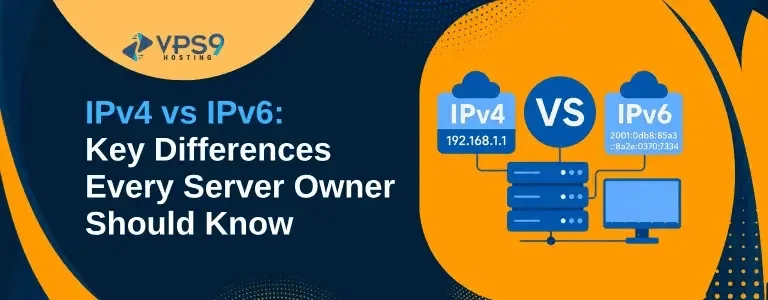
It uses a 32-bit addressing scheme, allowing approximately 4.3 billion unique IP addresses.
An IPv4 address looks like this:
192.168.10.15
Although billions of addresses sound like a lot, the explosive growth of smartphones, cloud computing, IoT devices, and online services has exhausted much of the available IPv4 space.
Today, obtaining new public IPv4 addresses has become increasingly expensive because they are limited resources.
What is IPv6?
IPv6 is the next-generation internet protocol designed to overcome the limitations of IPv4.
Instead of 32 bits, IPv6 uses 128-bit addresses, creating an almost unlimited number of unique IP addresses.
An IPv6 address appears like this:
2001:0db8:85a3:0000:0000:8a2e:0370:7334
The available address pool is so enormous that every internet-connected device can have its own globally unique address for the foreseeable future.
Besides solving address shortages, IPv6 also introduces improvements in efficiency, routing, security, and network management.
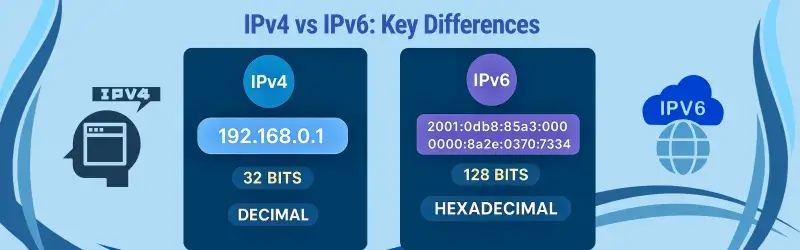
IPv4 vs IPv6: Key Differences
FeatureIPv4IPv6Address Length32-bit128-bitAddress FormatDecimalHexadecimalTotal Addresses4.3 Billion340 UndecillionNAT RequiredUsually YesUsually NoAuto ConfigurationLimitedBuilt-inRouting EfficiencyGoodBetterHeader SizeVariableSimplifiedSecurityOptionalNative IPsec SupportBroadcastSupportedNot UsedFuture ScalabilityLimitedExtremely HighAlthough IPv6 offers numerous advantages, IPv4 remains widely used because much of today’s internet infrastructure still depends on it.
Why IPv4 is Still Widely Used
Despite IPv6’s advantages, IPv4 continues to dominate many hosting environments.
Some reasons include:
- Older software compatibility
- Legacy business applications
- Existing enterprise infrastructure
- Broad ISP support
- Easier migration for traditional networks
Many organizations continue operating dual-stack networks, allowing both IPv4 and IPv6 to function simultaneously.
Benefits of IPv6 Hosting
Modern hosting environments increasingly support IPv6 hosting because it provides several technical advantages.
Nearly Unlimited IP Addresses
IPv6 virtually eliminates address shortages, making it ideal for expanding cloud environments and growing businesses.
Improved Routing
Its simplified packet headers reduce routing overhead, improving efficiency across large networks.
Better Network Performance
IPv6 removes many complexities introduced by Network Address Translation (NAT), allowing more direct communication between devices.
Enhanced Security
IPv6 was designed with IPsec support, making encrypted communication easier to implement across networks.
Better Support for Modern Technologies
Cloud computing, IoT devices, containerized applications, and future internet services are increasingly optimized for IPv6.
Challenges of IPv6 Adoption
Despite its benefits, IPv6 isn’t without challenges.
Legacy Compatibility
Some older applications and networking equipment still operate only on IPv4.
Learning Curve
Network administrators may need additional knowledge to configure IPv6 correctly.
ISP Support
Although adoption continues growing, not every internet provider offers full native IPv6 connectivity.
Mixed Infrastructure
Many organizations still operate hybrid environments requiring both IPv4 and IPv6 management.
Should Your Website Use IPv6?
For most websites, the answer is yes—if your hosting provider supports it.
Enabling IPv6 offers:
- Better future compatibility
- Improved scalability
- Modern networking standards
- Additional routing flexibility
- Enhanced global connectivity
However, websites should generally continue supporting IPv4 as well to ensure compatibility with visitors whose networks still rely on it.
This dual-stack approach provides the best experience for all users.
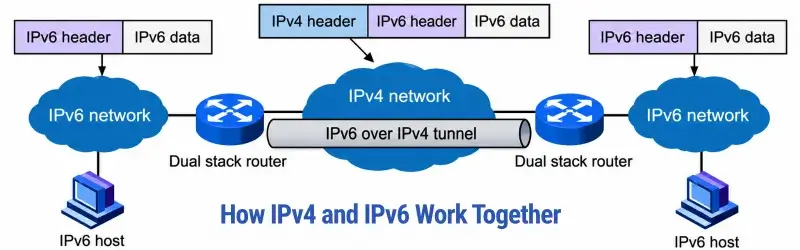
How IPv4 and IPv6 Work Together
Instead of replacing IPv4 overnight, most hosting providers use a dual-stack configuration.
In this setup:
- Your server receives both an IPv4 address and an IPv6 address.
- Visitors automatically connect using whichever protocol their internet connection supports.
- No manual selection is required.
This ensures maximum compatibility while preparing for the internet’s long-term transition to IPv6.
To Know More Information Visit : https://www.vps9.net/blog/ipv4-vs-ipv6-key-differences/