
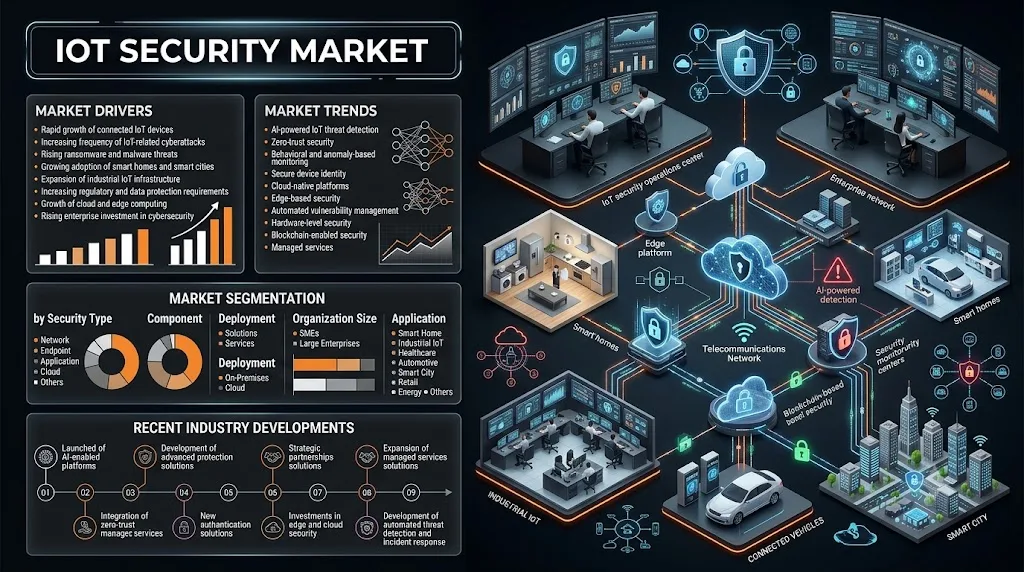
Market Overview:
According to IMARC Group's latest research publication, "IoT Security Market: Global Industry Trends, Share, Size, Growth, Opportunity and Forecast 2026-2034", The global iot security industry size was valued at USD 7.78 Billion in 2025 and is projected to reach USD 47.49 Billion by 2034, exhibiting a CAGR of 22.25% during the forecast period 2026-2034.
This detailed analysis primarily encompasses industry size, business trends, market share, key growth factors, and regional forecasts. The report offers a comprehensive overview and integrates research findings, market assessments, and data from different sources. It also includes pivotal market dynamics like drivers and challenges, while also highlighting growth opportunities, financial insights, technological improvements, emerging trends, and innovations. Besides this, the report provides regional market evaluation, along with a competitive landscape analysis.
How AI is Reshaping the Future of the IoT Security Market
- AI-powered behavioral analytics now baseline normal IoT device activity across fleets of millions of endpoints, flagging deviations in real time and reducing mean-time-to-detect for firmware-level attacks on industrial controllers and connected medical devices.
- Machine learning models embedded in cloud-native IoT security platforms enable automated threat containment, compensating for a global cybersecurity workforce gap of approximately 4.8 million professionals that enterprises cannot fill through traditional hiring.
- Government mandates such as the U.S. Cyber Trust Mark program, launched in January 2025, are accelerating AI-driven compliance monitoring, enabling manufacturers to continuously verify that certified devices meet evolving security labelling requirements without manual audits.
- Vendors including IBM are rolling out agentic AI capabilities that autonomously investigate and respond to IoT security incidents, with the goal of enabling security operations centers to manage a growing attack surface of over 21.1 billion connected devices without proportional headcount increases.
- AI is being embedded at the silicon level, with chipmakers integrating machine learning accelerators into IoT-grade processors to enable on-device anomaly detection, secure boot verification, and cryptographic key management without relying on cloud round-trips.
Download a sample PDF of this report: https://www.imarcgroup.com/iot-security-market/requestsample
Key Trends in the IoT Security Market
- Zero-Trust Architecture Replacing Perimeter Models: Enterprises are abandoning static perimeter defenses in favor of identity-centric, continuously verified access for every IoT endpoint. Solutions segment dominates the market with a 67.0% share in 2025, anchored by unified platforms that bundle device discovery, micro-segmentation, and runtime policy enforcement into a single management layer, replacing the patchwork of legacy point products that zero-trust mandates are making obsolete.
- Cloud Security Commanding the Largest Segment Share: Cloud Security holds 76.8% of global IoT security revenue in 2025, equivalent to approximately USD 5.97 Billion, driven by enterprise migration of IoT workloads to hyperscaler platforms. AWS IoT Device Defender, Azure Defender for IoT, and Google Cloud IoT Device Management are expanding device lifecycle protection capabilities, making cloud-delivered security the standard rather than the exception for enterprises operating large connected device fleets.
- Regulatory Mandates Reshaping Procurement Globally: The EU Cyber Resilience Act, the U.S. IoT Cybersecurity Improvement Act, and Singapore's Cybersecurity Labelling Scheme are standardizing baseline controls across geographies. North America leads with a 35.0% global revenue share in 2025, directly driven by federal cybersecurity appropriations exceeding USD 13 Billion in FY2025 and the launch of the U.S. Cyber Trust Mark, which is turning compliance into a purchasing prerequisite for both consumer and enterprise device buyers.
- Energy and Utilities Vertical Leading Deployment: The energy and utilities sector accounts for 20.1% of IoT security vertical revenue in 2025, reflecting the critical exposure of smart grid infrastructure, connected pipelines, and remote monitoring systems to operational disruption and ransomware. Regulatory requirements under ISA/IEC 62443 and NIS2 Directive are compelling operators to embed security across the device lifecycle rather than relying on network-layer compensating controls.
- Hardware Roots of Trust Becoming Standard in IoT Silicon: Chipmakers including Intel, Infineon, and Arm are embedding cryptographic accelerators, secure elements, and trusted execution environments into IoT-grade silicon, enabling device identity provisioning at the fab, secure boot, and tamper-resistant over-the-air update verification. This shift is moving IoT security from a software add-on to a hardware-anchored baseline, particularly in automotive, industrial, and healthcare device categories where long lifecycle assets cannot be easily patched post-deployment.
Growth Factors in the IoT Security Market
- Exponential Growth in Connected Device Base: Connected IoT devices surpassed 21.1 billion globally in 2025, growing at 14% year-over-year. Each additional unsecured endpoint multiplies the enterprise attack surface, creating structural and recurring demand for identity management, encryption, and continuous monitoring solutions that scale alongside the expanding device estate rather than requiring proportional increases in security staff.
- Escalating Severity of IoT-Targeted Cyberattacks: IoT-targeted malware incidents grew more than 400% between 2023 and 2025, with ransomware campaigns increasingly targeting industrial controllers, connected hospital equipment, and building management systems. High-profile incidents have driven boardroom-level prioritization of IoT security investment, shortening enterprise procurement cycles and raising average deal sizes as CISOs seek integrated platform solutions over reactive point-product deployments.
- Asia Pacific Emerging as the Fastest-Growing Region: Asia Pacific holds 28.6% of global IoT security revenue in 2025, with growth driven by China's smart manufacturing programs, India's Smart Cities Mission, Japan's IoT safety guidelines, and Singapore's Cybersecurity Labelling Scheme. Rapid enterprise cloud adoption, expanding manufacturing near-shoring in Southeast Asia, and enforcement of national data protection laws are collectively creating multi-year demand for locally delivered IoT security services and products.
- Managed Security Services Expanding Access for Mid-Market Buyers: The services component is growing at the fastest rate within the IoT security component mix, as organizations shift from capital expenditure models to managed detection and response subscriptions. Mid-market enterprises, which previously lacked the internal teams and budgets to deploy enterprise-grade IoT security, are now able to consume cloud-delivered managed IoT security as an operational expense, broadening the addressable market beyond large enterprise and government buyers.
- Post-Quantum Cryptography Readiness Creating New Investment Cycle: Following NIST's finalization of post-quantum cryptography standards in 2024, defense agencies, financial institutions, and critical infrastructure operators are initiating hybrid quantum-safe deployment programs to protect long-lifecycle IoT assets. This is generating a new wave of procurement for IoT-aware key management platforms, hardware security modules with lattice-based algorithm support, and security architecture consulting, adding a structural growth layer on top of existing cybersecurity spending.
Leading Companies Operating in the Global IoT Security Industry:
- Allot
- Cisco Systems, Inc.
- DigiCert, Inc.
- Fortinet, Inc.
- IBM
- Infineon Technologies AG
- Intel Corporation
- Palo Alto Networks
- SecuriThings
IoT Security Market Report Segmentation:
Breakup By Component:
- Solutions
- Services
Solutions account for the majority of the market with a 67.0% share in 2025, driven by enterprise demand for integrated platforms that consolidate device identity, encryption, firewall, and threat management into a unified stack.
Breakup By Security Type:
- Network Security
- Endpoint Security
- Application Security
- Cloud Security
- Others
Cloud Security dominates with a 76.8% share in 2025, reflecting the rapid migration of IoT workloads to AWS, Azure, and Google Cloud and the adoption of cloud-native security posture management tools at scale.
Breakup By Vertical:
- Energy and Utilities
- Manufacturing
- Automotive
- Transport
- Consumer Electronics
- Healthcare
- Others
Energy and utilities leads the vertical segment with a 20.1% share in 2025, driven by the critical exposure of smart grid infrastructure and remote monitoring systems to operational disruption, and by stringent compliance requirements under ISA/IEC 62443 and the NIS2 Directive.
Breakup By Region:
- North America (United States, Canada)
- Asia Pacific (China, Japan, India, South Korea, Australia, Indonesia, Others)
- Europe (Germany, France, United Kingdom, Italy, Spain, Russia, Others)
- Latin America (Brazil, Mexico, Others)
- Middle East and Africa
North America holds the leading position with a 35.0% global revenue share in 2025, driven by federal cybersecurity appropriations exceeding USD 13 Billion, the U.S. IoT Cybersecurity Improvement Act, and the January 2025 launch of the U.S. Cyber Trust Mark program, which is accelerating labelled-device procurement across both enterprise and government buyers.
Recent News and Developments in the IoT Security Market
- January 2025: The U.S. government officially launched the Cyber Trust Mark labelling program for consumer IoT devices, establishing a voluntary certification scheme that allows manufacturers to display a security label on products meeting defined cybersecurity standards. The initiative is intended to help consumers make informed purchasing decisions while creating procurement incentives that raise baseline security requirements across the connected device industry.
- January 2026: ServiceNow announced its intent to acquire Armis, a proactive IoT and asset intelligence security platform, in a cash deal valued at USD 7.75 Billion. The acquisition is designed to integrate Armis's device visibility, vulnerability management, and threat detection capabilities into ServiceNow's security operations platform, enabling enterprises to manage IoT risk alongside broader IT and OT security workflows from a single system.
- June 2026: Accenture announced a major strategic investment in Dragos, a leading operational technology and IoT security platform provider, to strengthen its industrial cybersecurity capabilities. The partnership is intended to scale OT and IIoT security delivery across energy, manufacturing, and critical infrastructure clients globally, combining Accenture's systems integration reach with Dragos's specialized platform for industrial threat detection and incident response.
Note: If you require specific details, data, or insights that are not currently included in the scope of this report, we are happy to accommodate your request. As part of our customization service, we will gather and provide the additional information you need, tailored to your specific requirements. Please let us know your exact needs, and we will ensure the report is updated accordingly to meet your expectations.
About Us:
IMARC Group is a global management consulting firm that helps the world's most ambitious changemakers to create a lasting impact. The company provides a comprehensive suite of market entry and expansion services. IMARC offerings include thorough market assessment, feasibility studies, company incorporation assistance, factory setup support, regulatory approvals and licensing navigation, branding, marketing and sales strategies, competitive landscape and benchmarking analyses, pricing and cost research, and procurement research.
Contact Us:
IMARC Group
134 N 4th St. Brooklyn, NY 11249, USA
Email: [email protected]
Tel No: (D) +91 120 433 0800
United States: +1-201-971-6302