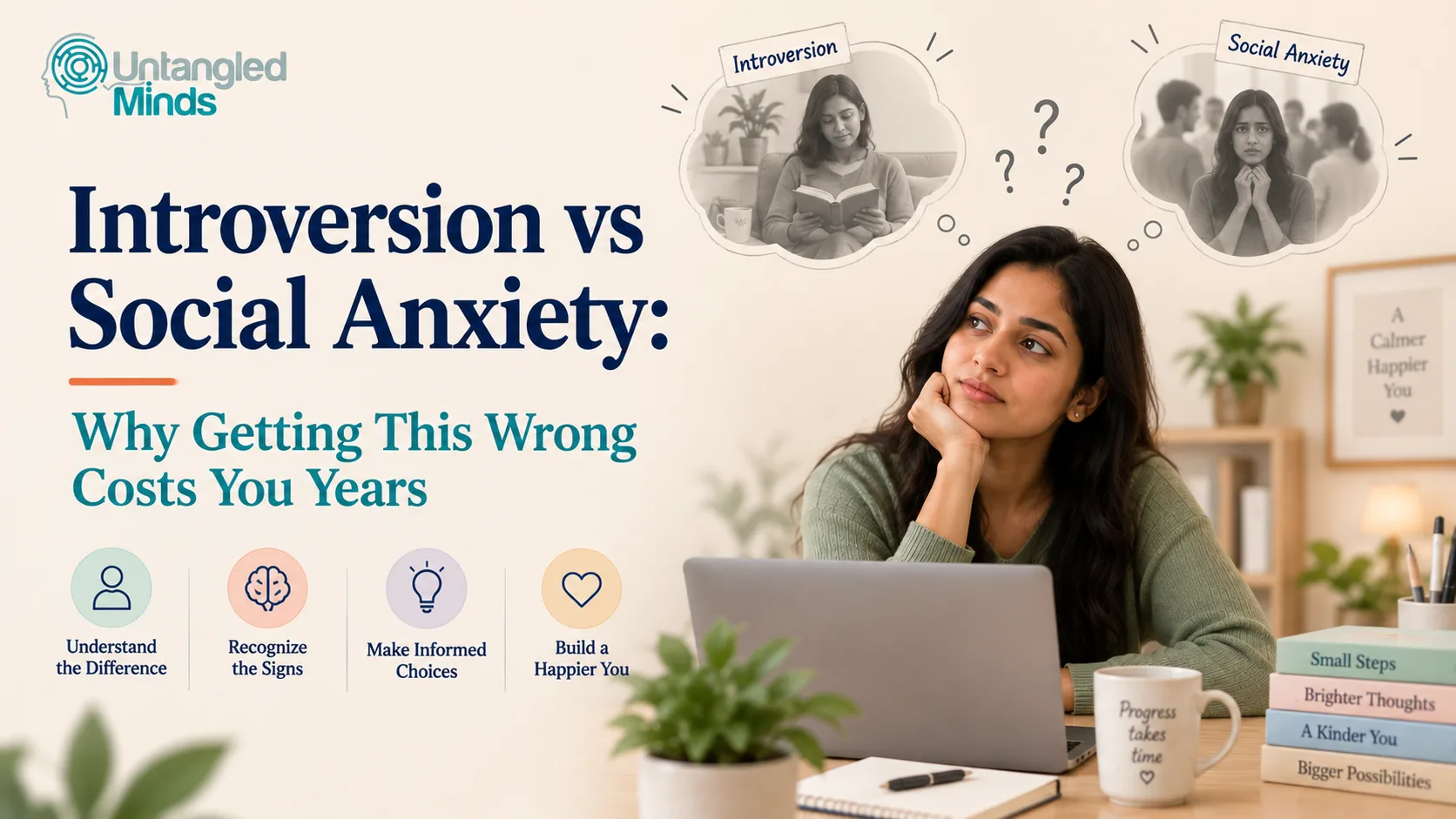
There's a question I hear from people who have spent a significant portion of their lives being described as "shy" - sometimes admiringly, sometimes critically - and it usually comes after they've started reading about anxiety or after someone close to them has mentioned it.
"Am I actually introverted, or do I have social anxiety?"
It's a real question. The two things can look identical from the outside - both produce social withdrawal, both result in someone spending more time alone than in groups, both can make large gatherings exhausting. The difference is in the experience underneath. And that difference changes what actually helps completely.
The Distinction That Actually Matters
An introvert recharges alone. After social interaction, particularly in groups, they need solitary time to restore their energy. They may enjoy social situations while they're in them - just in smaller doses. The preference for quiet and space is a feature of their nervous system, not a response to perceived threat.
Social anxiety is something different. It involves fear - specifically, the fear of being judged, embarrassed, or negatively evaluated by others. The social situations that an introvert simply prefers to moderate are situations that a person with social anxiety actively dreads in advance, monitors carefully throughout, and reviews critically afterward. The heart rate goes up before entering the room. The conversation gets replayed afterward. The canceled plan produces relief rather than disappointment.
These feel completely different from the inside. They look more similar from the outside, which is part of why misidentification is so common.
The Cost of Getting It Wrong
For introverts who get misidentified as socially anxious: they sometimes end up in therapy trying to "fix" a preference that isn't pathological. The preference for less social stimulation is healthy and valid. It doesn't need treatment.
For people with social anxiety who get misidentified as introverts: this is where the real cost accumulates. Years of assuming that the discomfort around people is just personality, that the avoidance is just preference, that the anxiety before social events is just "how they are" - when in fact there's something clinically present that responds well to treatment.
I worked with someone in their early thirties who'd described themselves as introverted their entire adult life. They'd built their life around it - a job that minimized public interaction, social habits that kept them largely with one or two close people, a reputation among friends as someone who "just prefers their own company." When we started working together, it quickly became clear that the social withdrawal wasn't preference - it was avoidance. The situations they were avoiding were ones they actually wanted to participate in. The avoidance was driven by a fear of judgment that they'd never had language for, because it had always been called introversion.
In India, This Confusion Has a Specific Shape
In Indian families and social contexts, being quiet is frequently praised. The compliant, unobtrusive child who doesn't demand attention or push back is often the "good" child. This means social anxiety in Indian children can be not just unaddressed but actively reinforced - the behavior that's a symptom of the anxiety is being rewarded as a virtue.
By the time these children become adults, the pattern is deeply established. The social anxiety has been running for twenty years unchallenged, confirmed by cultural approval rather than questioned by it.
How Social Anxiety Is Actually Treated
This is the part most content doesn't cover - and it's the part that matters if you're reading this because you suspect you might have it rather than just being introverted.
CBT for social anxiety specifically targets the fear and avoidance cycle. It involves, among other things, identifying the specific feared situations, understanding the predictions the anxiety is making about those situations, and gradually - carefully, at a pace that doesn't overwhelm - testing those predictions by actually entering the avoided situations.
It's not comfortable. Exposure work is uncomfortable by design, because it involves approaching rather than avoiding. But what it produces is genuine learning that the feared outcome usually doesn't arrive, or isn't as catastrophic when it does. Over time, the anxiety reduces to a level where it's no longer running your choices.
Introversion doesn't need this work because it doesn't involve fear. Introversion needs respect and accommodation, not treatment.
About Shyamolie Desai
I'm a Clinical Psychologist in Mumbai working with social anxiety and related presentations. Sessions available in person across Chembur, Sion, Wadala, and Santacruz, and online. Every client works directly with me.
Frequently Asked Questions
Can you be both introverted and have social anxiety?
Yes. These are independent - an introverted person can develop social anxiety, and an extroverted person can develop it too. The introversion describes an energy preference; the anxiety describes a fear response.
How do I know which one I have?
The key question is whether the social withdrawal involves relief from preference, or relief from fear. If social avoidance produces relief that feels like escape from danger, that's more likely anxiety than introversion.
Is social anxiety common?
Yes. It's one of the most prevalent anxiety disorders, though it often goes undiagnosed because the avoidance behaviors it produces are socially inconspicuous.