India has 4,523 industrial parks mapped on the India Industrial Land Bank, covering about 7.70 lakh hectares. Only around 1.35 lakh hectares were still available for new projects on 23 December 2025, according to PIB. Across more than 6.45 lakh plots, just over 1.25 lakh were vacant.
For a manufacturer, the harder problem is not finding a plot but knowing whether it is safe to buy. That means clean title, permitted zoning, a tenure the lender will accept and rules that will not block expansion. A defect found after payment can strand a fully engineered project.
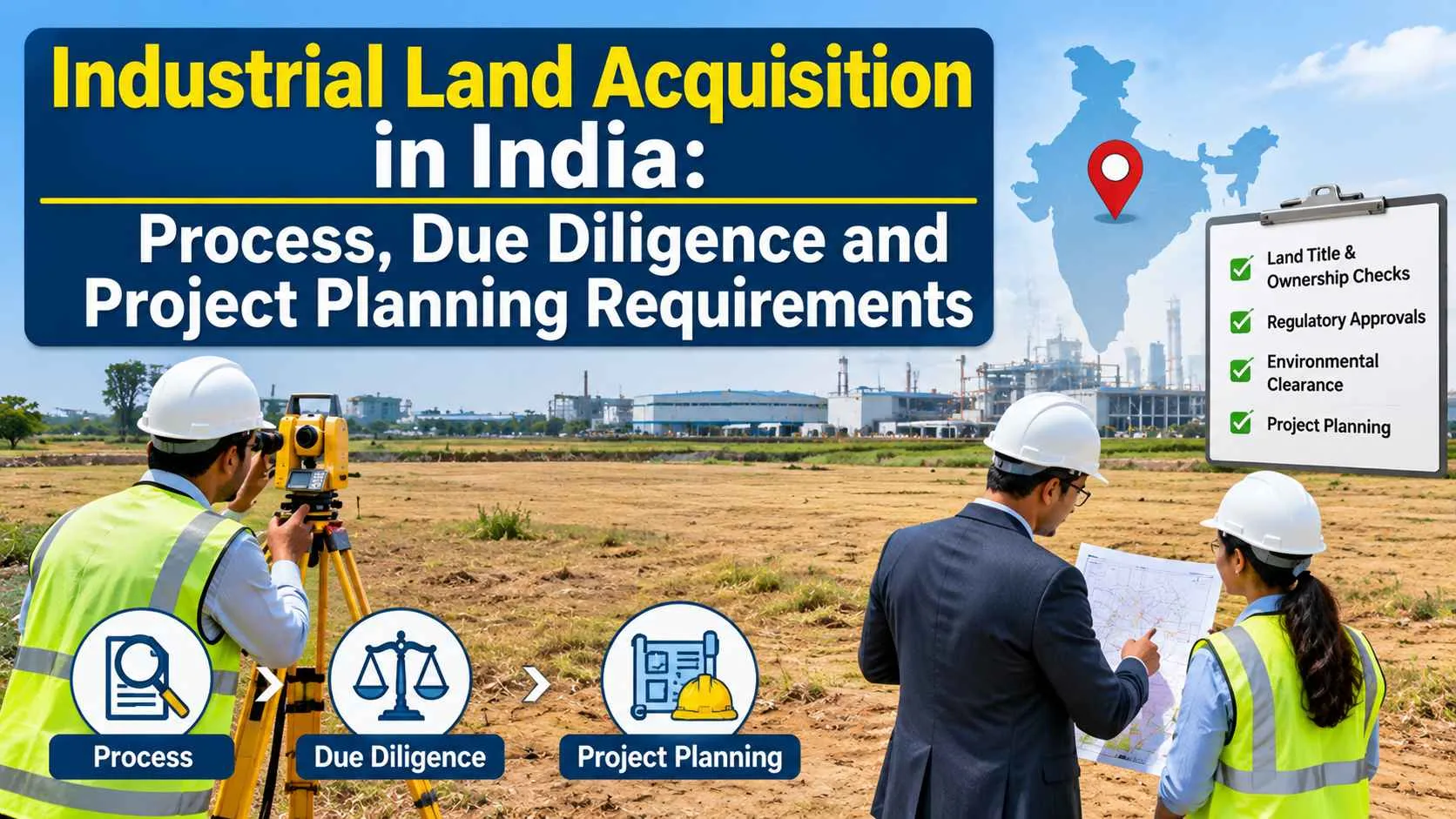
A sound approach to industrial land acquisition in India follows a fixed sequence: define the land need, shortlist sites, verify title and zoning independently, structure the transaction and plan the project around approvals. This guide covers each step with current data.
What Are the Routes to Acquire Industrial Land in India?
Manufacturers generally use one of three routes, and each carries different rights and risks:
- Industrial park allotment: plots from state authorities such as MIDC, GIDC, SIPCOT and KIADB. India has 306 plug-and-play parks, and 20 more NICDC-led parks and smart cities are under development, of which four are complete.
- Freehold purchase: a registered sale deed from a private seller, with price negotiated and title verified by the buyer.
- Private lease: a right to use land for a fixed term. Leases above one year need registration under Section 107 of the Transfer of Property Act, 1882.
Compulsory acquisition under the RFCTLARR Act, 2013 is a separate regime. It requires prior consent of 80% of affected families for private companies and 70% for PPP projects, along with a Social Impact Assessment. Old acquisition notices can still cloud a plot, so diligence must check for them.
How Much Does Industrial Land Cost in India?
There is no single national rate, and authority allotment prices differ sharply from private market prices. JLL’s 2025 industry report lists these private-market ranges:
- Chakan, Pune: INR 6.5-8 crore per acre
- Oragadam-Vallam, Chennai: INR 4.5-5.7 crore per acre
- Shoolagiri, Hosur: INR 2.5-3.5 crore per acre
- Sanand-Khoda, Ahmedabad: INR 2.3-2.8 crore per acre
By contrast, MIDC’s 2026 rate list shows INR 9,730 per sq m for industrial plots in Chakan Phase V. Compare both routes before assuming that the allotment rate is the real cost, because duty, premium, conversion and development charges come on top.
What Is the Step-by-Step Process for Industrial Land Acquisition?
- Step 1, define the requirement: size the plot from a concept layout covering built-up area, storage, roads, utilities, fire access and expansion.
- Step 2, shortlist sites: use the India Industrial Land Bank for park and plot-level data, then screen for power, water, connectivity and market access.
- Step 3, agree commercial terms: negotiate price, premium or ground rent, and sign an agreement to sell or receive an allotment letter.
- Step 4, run legal due diligence: typically 2-3 weeks for clean titles, 4-6 weeks for complex chains and up to 6-8 weeks where conversion or litigation checks are needed.
- Step 5, execute and register: pay stamp duty, register the sale or lease deed and take possession.
- Step 6, complete post-acquisition steps: mutation, building-plan approval and pollution-board consents.
What Does Legal Due Diligence Cover?
Due diligence is an independent check of ownership, encumbrances, litigation and compliance before capital is committed. Digital records now make this easier. A January 2026 Standing Committee review reported that 99.8% of Records of Rights were computerised, 97.4% of cadastral maps were digitised, 95.7% of Sub-Registrar Offices were computerised and 88.6% of registration offices were integrated with revenue offices.
Digital records still do not prove title, and mutation entries do not independently establish ownership. A thorough review covers:
- Title chain: registered deeds, encumbrance certificates, revenue records such as the 7/12 extract, survey documents and mutation entries. A 30-year search is common but not universal.
- Encumbrances and litigation: mortgages, liens, SARFAESI proceedings and execution petitions, plus district court and High Court searches.
- Seller authority: powers of attorney, succession documents and corporate approvals.
- Restricted land: government-assigned, ceiling-surplus, inam, waqf and tribal land need specific legal checks.
- Zoning and conversion: confirm industrial land use, change-of-use or NA orders, and forest, coastal, airport-height and highway restrictions.
- Parcel identity: match the 14-digit ULPIN (Bhu-Aadhaar) and survey numbers to the plot on the ground, followed by a DGPS survey.
What Are the Most Common Acquisition Problems and How Do You Solve Them?
- Defective or disputed title: verify from primary sources rather than seller copies, and protect the deal with indemnities and retention of part of the consideration.
- Unconverted agricultural land: make conversion orders a condition precedent to payment.
- Risky allotment covenants: read construction deadlines, transfer limits and resumption clauses against your financing and expansion plan before signing.
- Lender rejects the tenure: obtain written lender feedback first, since lenders often want lease tenure to outlast the loan.
- Hidden costs: budget stamp duty, registration, conversion and development. Sale of land is outside GST under Schedule III of the CGST Act, but lease premiums need a separate assessment.
- Costly exit: authority transfer consent can carry a fee, indicatively 10-25% of premium or value increment, so model it up front.
Which Project Planning Requirements Follow Land Acquisition?
- Approvals: mutation, building plan, fire safety, factory licence under the OSH Code (effective 21 November 2025) and Consent to Establish and Operate from the pollution board.
- Site investigation: geotechnical survey, flood levels, drainage outfall and high-tension line easements.
- Utilities: sanctioned power load, water source, wastewater arrangements and fire-protection infrastructure.
- Financial model: compare total occupation cost over a common horizon, such as 10 years, using verified quotations and sensitivity tests.
- Incentives: confirm in the current state notification whether land cost or stamp duty qualifies before adding any subsidy to the model.
- Expansion: reserve land now, because sub-division and product changes need authority approval.
How IMARC Engineering’s Expertise Can Help in Industrial Land Acquisition and Due Diligence
- Independent assessment with no ties to sellers, brokers or developers
- Primary-source verification across revenue, Sub-Registrar, court, municipal and DILRMP records
- Litigation searches covering district courts, High Courts and the Supreme Court
- Review of MIDC, GIDC, KIADB and APIIC allotment and lease conditions
- Lender-ready reports for SIDBI, NABARD and scheduled banks
- Title defect remediation, sale deed structuring and support through to completion
Consult With Our Experts: https://www.imarcengineering.com/contact?service=land-acquisition-legal-due-diligence
Conclusion:
Industrial land is the first and least reversible commitment in a manufacturing project. Choose the acquisition route that fits your financing and expansion plans, verify title and zoning from primary sources, and read every allotment covenant before paying. Build conversion, consents and site investigation into the schedule early. A due diligence report costing a few weeks is far cheaper than a stranded plot, so make it the first step, not the last.
Contact Us:
IMARC Engineering
Phone: +91-120-433-0800
Email: [email protected]
India: C-130, Sector 2, Noida, Uttar Pradesh 201301
LinkedIn: https://www.linkedin.com/showcase/imarc-engineering/