
Market Overview & Summary
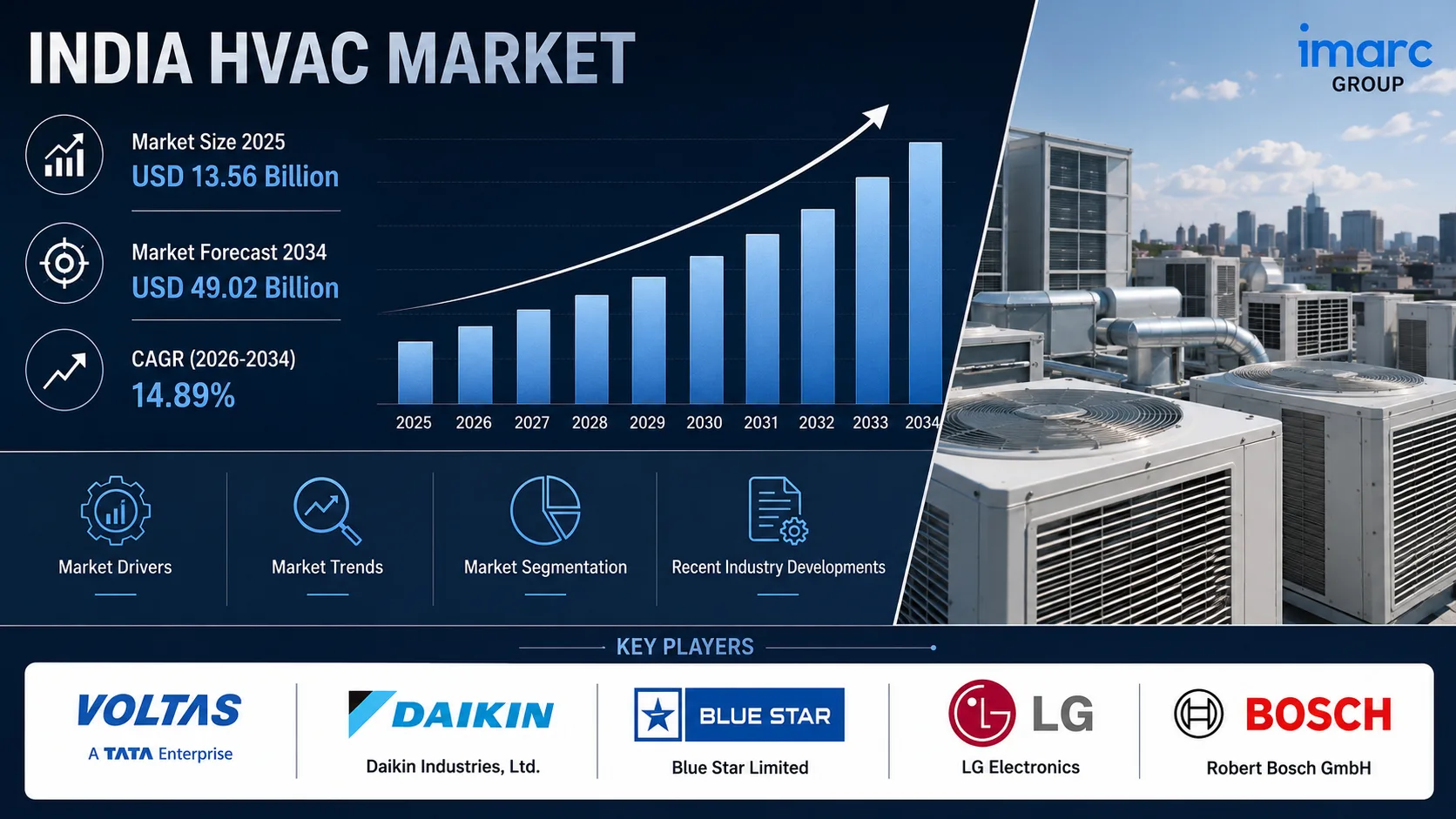
The India HVAC market size reached USD 13.56 Billion in 2025 and is projected to reach USD 49.02 Billion by 2034, growing at a compound annual growth rate (CAGR) of 14.89% from 2026-2034. The industry is being driven by intensifying summer heat, rapid urbanization, rising household incomes, and expanding commercial real estate. Air conditioning has moved from an occasional purchase to a near-essential household and workplace fixture, particularly across metro and tier-2 cities. Falling unit prices, accessible EMI financing, and stricter energy-efficiency norms are pushing consumers toward inverter and smart cooling systems, while government-backed manufacturing incentives are strengthening domestic production of compressors and components.
Market Size & Forecast:
- Market Size (2025): USD 13.56 Billion
- Projected Market Size (2034): USD 49.02 Billion
- CAGR (2026 - 2034): 89%
- Leading Regional Market: North India (32.6% Share)
Key Market Trends:
Shift Toward Inverter and Energy-Efficient Air Conditioners
Inverter air conditioners have become the default purchase across urban India, gradually replacing fixed-speed units on account of lower running costs, quieter operation, smoother temperature control, and improved star ratings. Most major brands now offer inverter-only line-ups in the 1 Ton and 1.5 Ton categories, supported by dual-rotor compressors and smart load-sensing technology that optimize part-load efficiency. Repeated tightening of Bureau of Energy Efficiency (BEE) star-labelling norms, with revisions occurring roughly every few years since the early 2010s, is pushing manufacturers to redesign compressors and heat exchangers, while nudging price-sensitive buyers to upgrade sooner rather than delay purchases.
Rise of Smart, IoT, and AI-Enabled Cooling
Connected air conditioners with Wi-Fi control, voice-assistant integration, and AI-based occupancy and weather sensing are gaining traction in metro cities and premium residential developments. Brands are layering predictive maintenance alerts, energy-tracking dashboards, and remote diagnostics onto cloud platforms to differentiate premium models and open up new after-sales service revenue streams. This trend is particularly visible among urban, tech-savvy households and modern commercial buildings that are willing to pay a premium for convenience, monitoring, and long-term running-cost visibility.
Transition to Eco-Friendly Refrigerants
Manufacturers are moving away from legacy refrigerants toward lower global-warming-potential alternatives in line with India's HFC phase-down commitments under international environmental protocols. This shift is prompting redesigns of compressors, heat exchangers, and safety systems to accommodate new refrigerant classes, while also improving overall cooling efficiency. The transition is adding near-term certification and compliance costs for manufacturers, but is expected to strengthen long-term alignment with global sustainability standards and export competitiveness.
Centralized HVAC Demand from Commercial Real Estate and Smart Cities
Large office complexes, hospitals, hotels, data centres, and metro rail projects are increasingly specifying variable refrigerant flow (VRF) systems, water-cooled chillers, and integrated building management systems that coordinate cooling, ventilation, and indoor air quality across zones. Smart-city projects are bundling centralized HVAC alongside energy management and indoor air quality monitoring as a standard specification, reflecting a broader shift from single-room cooling toward whole-building climate management in India's fastest-growing commercial corridors.
Local Manufacturing and PLI-Driven Component Localization
The Production Linked Incentive (PLI) scheme for white goods is encouraging sustained investment in compressors, motors, controllers, and copper-tube manufacturing facilities within India. This is strengthening domestic supply chains, reducing dependency on imported components, and improving cost competitiveness for both domestic and multinational manufacturers, while also supporting India's ambitions to become a regional export hub for air-conditioning and cooling equipment.
➤ Request Sample Report (TOC & Charts): https://www.imarcgroup.com/india-hvac-market/requestsample
Strategic Market Dynamics:
Growth Drivers:
- Rising Heatwave Frequency and Climate Stress:
Increasing summer temperatures and longer heat seasons are turning HVAC ownership into a near-essential purchase, with cooling demand peaking between March and June each year. India recorded one of its hottest years on record in 2025, with the national average temperature running well above the long-period average, and previous summers have seen several hundred heatwave days recorded nationally by the India Meteorological Department. Prolonged and more frequent heatwaves are steadily converting air conditioning from a discretionary comfort purchase into a health and productivity necessity, particularly across North and Central India.
- Rapid Urbanization and Housing Density:
City migration and accelerating tier-2 and tier-3 housing growth are driving steady demand for split air conditioners, packaged units, and centralized HVAC across new residential and mixed-use developments. India's urban population is projected to expand significantly over the coming decade, and this densification is increasing the number of new housing units, offices, and retail spaces that require built-in or retrofitted cooling infrastructure from the outset.
- Rising Disposable Income and Easy Financing:
Higher household incomes and the spread of zero-cost and low-cost EMI schemes are bringing first-time air conditioner ownership within reach for middle-income households across smaller cities. Retailers and financing partners are increasingly bundling extended warranties, installation, and annual maintenance contracts with EMI plans, lowering the effective barrier to purchase and encouraging faster replacement cycles among existing owners.
- Government Energy Efficiency and PLI Schemes:
BEE star-labelling revisions and the PLI scheme for air-conditioning components are jointly encouraging local manufacturing, supporting energy-efficient product development, and reducing import dependency. These policy measures are also accelerating replacement demand, as trade partners and consumers move to secure current pricing ahead of stricter norms, while manufacturers ramp up domestic capacity to meet both compliance and growth targets.
- Expanding Commercial and Institutional Cooling Demand:
Growth in office space, organized retail, healthcare infrastructure, hospitality, and data centre construction is expanding demand for centralized and semi-centralized HVAC systems. Rising investment in variable refrigerant flow systems and energy-efficient chillers for large institutional buildings is broadening the addressable market well beyond traditional residential room air conditioners.
Market Restraints:
- High Upfront Equipment Cost:
Centralized chillers, variable refrigerant flow systems, and premium inverter air conditioners still represent a meaningful capital outlay for households and small businesses, slowing adoption in rural and lower-income segments. Even with EMI financing, the combined cost of the unit, installation, and electrical upgrades can remain out of reach for a large share of price-sensitive first-time buyers in smaller towns.
- Electricity Tariff and Operating Cost Pressures:
Air conditioning accounts for a significant share of summer power demand, and rising slab tariffs in metropolitan areas can discourage longer running hours and slow upgrade cycles in smaller homes. Households in states with steep tariff slabs often ration usage during peak summer months, which in turn tempers overall unit-consumption growth even as ownership rates increase.
- Refrigerant Phase-Out and Compliance Costs:
The shift from legacy refrigerants to lower-GWP alternatives, in line with environmental regulations, is increasing product certification requirements and adding complexity to component sourcing for manufacturers and importers. Smaller regional manufacturers in particular face higher relative compliance costs, which can slow their ability to compete on price against larger, more vertically integrated players.
- Cold Chain and Skilled-Installer Infrastructure Gaps:
Unreliable power supply, limited access to trained installation and servicing technicians, and inadequate infrastructure in tier-2/3 and rural India restrict geographic expansion. Demand for skilled technicians for installation, refrigerant handling, and maintenance is outpacing local availability in several states, which can slow new project rollouts and affect after-sales service quality, particularly for commercial and centralized systems.
➤ Explore the Full Report with Charts, Table of Contents, and List of Figures: https://www.imarcgroup.com/india-hvac-market
Competitive Landscape & Key Company Insights:
The India HVAC market is moderately fragmented, with a mix of homegrown leaders and global majors competing on channel depth, energy-efficiency credentials, and price-tier coverage. Market leaders are investing in inverter and smart technology, deeper localization under production-linked incentive schemes, and wider service networks, while regional and challenger brands compete on price-to-feature ratio in entry-level segments. Consolidation is accelerating through joint ventures, capacity expansions, and component-localization investments.
Some of the key players include:
- Voltas
- Daikin Industries, Ltd.
- Blue Star Limited
- LG Electronics
- Robert Bosch GmbH (Hitachi)
Deep-Dive Segment Insights:
Product Type Insights:
The India HVAC market by product type is segmented into Direct Expansion Systems and Central Air Conditioning Systems. Among these, the direct expansion systems segment dominated the market, accounting for a 62.4% share in 2025. The segment's leadership is driven by the following factors:
- Mass-Market Affordability: Lower upfront costs and easier installation compared with centralized systems, particularly for split and window air conditioners.
- Household Penetration: Widespread demand for single-unit cooling in homes and small commercial premises across urban and semi-urban India.
- Dealer and Online Reach: Broad availability through multi-brand retailers, exclusive brand outlets, and e-commerce channels.
End User Insights:
The India HVAC market by end user is segmented into Residential and Commercial. Among these, the residential segment dominated the market, accounting for a 55.8% share in 2025. The segment's leadership is driven by the following factors:
- Rising Household Incomes: Growing disposable incomes are shifting cooling from a luxury to a comfort necessity.
- Longer Summers: Extended and more intense heat seasons are lengthening the annual cooling-purchase window.
- Tier-2/3 City Uptake: Improving affordability and financing options are accelerating adoption beyond metro markets.
Regional Insights:
The India HVAC market by region is segmented into North India, South India, West India, and East India. Among these, North India dominated the market, accounting for a 32.6% share in 2025. The segment's leadership is driven by the following factors:
- Extreme Summer Heat: Prolonged high temperatures across Delhi-NCR, Punjab, and Uttar Pradesh sustain strong cooling demand.
- Dense Urban Housing: A large, concentrated urban population supports high HVAC penetration across residential and commercial buildings.
- Strong Institutional Demand: Large-scale infrastructure and commercial real-estate projects reinforce regional consumption.
Recent Developments:
- In June 2026, Daikin Industries' board approved the establishment of Daikin Research and Development India Private Limited in Haryana, marking the company's first global R&D subsidiary outside Japan; the centre, slated for completion by June 2028, will focus on product development for chillers and air-conditioning systems serving data centres and the wider Global South region.
- In 2026, Blue Star Limited announced a capital expenditure plan of roughly ₹200 crore to expand manufacturing, R&D, and marketing capacity, alongside a refreshed line-up of new room air conditioner models, while flagging price increases linked to revised BEE energy-efficiency norms.
- Voltas has been scaling up its Chennai room-air-conditioner factory, with capacity progressing toward 1.5-2.0 million units, as the company continues incremental capex to support rising demand for split and inverter air conditioners across southern and western India.
Customization Note: If you require any specific information not covered within this report's scope, we will provide it as part of the customization.
➤ Request a Customized Report: https://www.imarcgroup.com/request?type=report&id=29756&flag=E
Frequently Asked Questions (FAQs):
Q1. What is the current size of the India HVAC market?
Ans. The India HVAC market reached a value of USD 13.56 Billion in 2025.
Q2. What is the expected growth rate of the India HVAC market?
Ans. The market is projected to grow at a compound annual growth rate (CAGR) of 14.89% during 2026-2034.
Q3. What is the projected market value by 2034?
Ans. The market is expected to reach USD 49.02 Billion by 2034.
Q4. Which product segment holds the dominant share in the market?
Ans. Direct expansion systems lead the market, accounting for 62.4% of the share, supported by mass-market split and window air conditioner adoption.
Q5. What are the key growth drivers for the market?
Ans. Major growth drivers include rising heatwave intensity, rapid urbanization, growing disposable incomes, easy EMI financing, and supportive government energy-efficiency and PLI programs.
Strategic Insight & Verdict:
Through this analysis, it is evident that the India HVAC market is on a strong growth trajectory, driven by intensifying summer heat, rapid urbanization, and rising household incomes supported by evolving consumer preferences toward energy-efficient cooling. The expansion of inverter and smart HVAC technology, eco-friendly refrigerant adoption, PLI-led component localization, and growing commercial cooling demand are further strengthening market potential. Companies focusing on energy efficiency, smart connectivity, service-network depth, and domestic manufacturing capabilities are expected to strengthen their competitive position over the forecast period.