What happens when growth support comes with less control over vendors, branding, patient outreach, and day-to-day decisions?
That question now defines a large part of the conversation around private practice optometry. Many owners want scale, better purchasing terms, and stronger marketing support, but they do not want a model that pushes them into rigid contracts or strips away operational freedom. That is why the idea of an independent eyecare community in the USA has moved from a niche concept to a serious business strategy.
Independent practices do not need another layer of bureaucracy. They need better patient acquisition, tighter operations, cleaner vendor coordination, and a way to compete with larger networks without becoming one of them. That shift is pushing attention toward community-led platforms that combine commercial support with ownership control.
Why Traditional Buying Models No Longer Solve Enough
Older buying groups helped practices secure rebates and supplier access. That still has value, but it no longer fixes the larger business problem. Most practices now deal with rising acquisition costs, fragmented billing, inconsistent online visibility, weaker recall systems, and too many disconnected tools.
In that environment, an independent eyecare community in the USA works best when it goes beyond pricing support and addresses growth at the practice level. It should strengthen local visibility, improve patient retention, simplify vendor coordination, and remove admin friction that slows teams down.
This is where many providers still fall short. They focus on discounts but leave the practice to solve marketing, workflow, and retention alone. OptiOpto takes a different position. It connects purchasing support with operational tools and AI-driven growth functions built for optical practices, not for general healthcare use.
What A Modern Community Platform Should Actually Deliver
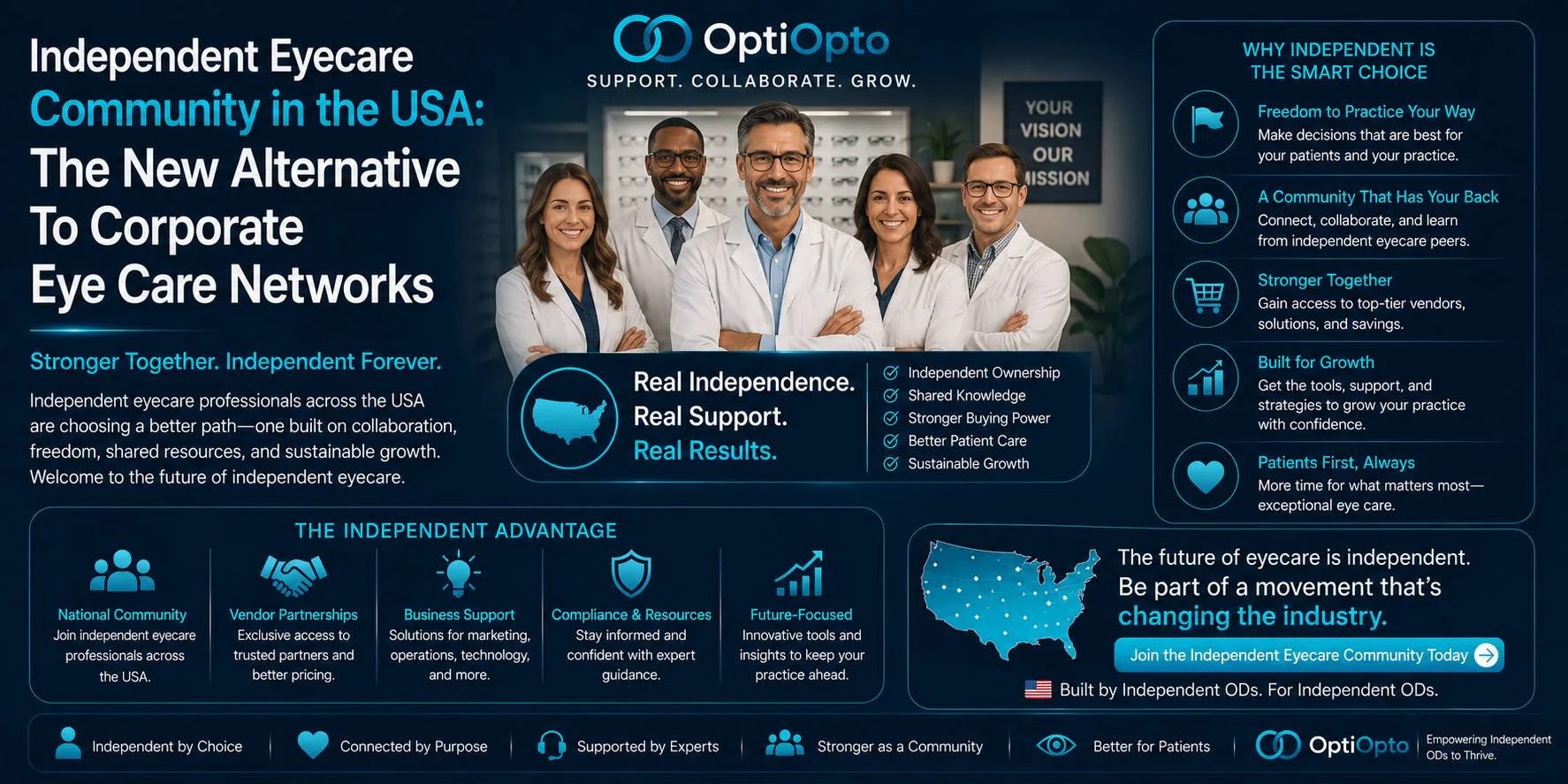
The stronger model is not built around one benefit. It is built around connected functions that work together. A serious independent eyecare community in the USA should help a practice stay independent while improving performance across the front office, supplier relationships, and patient pipeline.
That is also where smart eyecare marketing campaigns become relevant. Marketing cannot remain separate from scheduling, recall, review management, and patient reactivation. When those systems work in silos, results flatten, and teams waste time fixing handoff problems.
A more effective platform should include:
- AI-based patient growth tools that identify new local demand and support recall efforts
- Vendor advocacy that helps resolve disputes without draining staff time
- Consolidated billing that reduces payment complexity across suppliers
- Review and local SEO support that improves digital visibility
- Workflow tools that support retention, appointment flow, and outreach
- Vendor flexibility so practices keep control over business decisions
OptiOpto fits this direction because it is not framed as a corporate consolidator. It is built to support independent optometrists who want stronger performance without giving up control of the practice they built.
Corporate Networks vs Independent Community Models
The real distinction is not size. It is structured. A corporate network usually standardizes the business around the network. A community model should strengthen the business around the practice.
Decision AreaCorporate Network ModelIndependent Community ModelPractice IdentityOften narrowed by group rulesPractice keeps its own brandVendor ChoiceCan be restrictedGreater freedom to choose vendorsGrowth SupportMay follow centralized prioritiesBuilt around local practice needsOperationsMore layers and approvalsFaster decisions at the practice levelMarketing ExecutionBroader network playbooksMore targeted local strategiesOwnership ControlReduced flexibilityFull business control stays in placeThat difference shapes daily execution. When an independent eyecare community in the USA is structured well, it supports growth without replacing the owner’s authority. It also makes room for smart eyecare marketing campaigns that reflect local search behavior, patient history, and reputation signals instead of generic outreach.
How To Evaluate The Right Platform For Long-Term Growth
Not every community platform will deliver the same result. Some still operate like old buying groups with a newer label. Others add software but fail to connect it to actual business outcomes.
A practice should evaluate whether an independent eyecare community in the USA can improve four areas at the same time: patient growth, operational clarity, vendor efficiency, and financial performance. If one of those is missing, the model stays incomplete.
Look closely at how the platform handles patient reactivation, local SEO support, review generation, consolidated billing, rebate visibility, and supplier coordination. Also, review whether the platform protects vendor flexibility and brand control. Those two points usually reveal whether the model supports independence in practice, not just in language.
The right decision is rarely about joining the largest network. It is about choosing a structure that helps the practice grow with less friction, stronger margins, and better control over execution.
Conclusion
The next phase of private practice growth will favor models that combine technology, purchasing leverage, and operational support without forcing owners into corporate-style constraints. For practices that want better performance while protecting independence, the more practical path is an independent eyecare community in the USA.