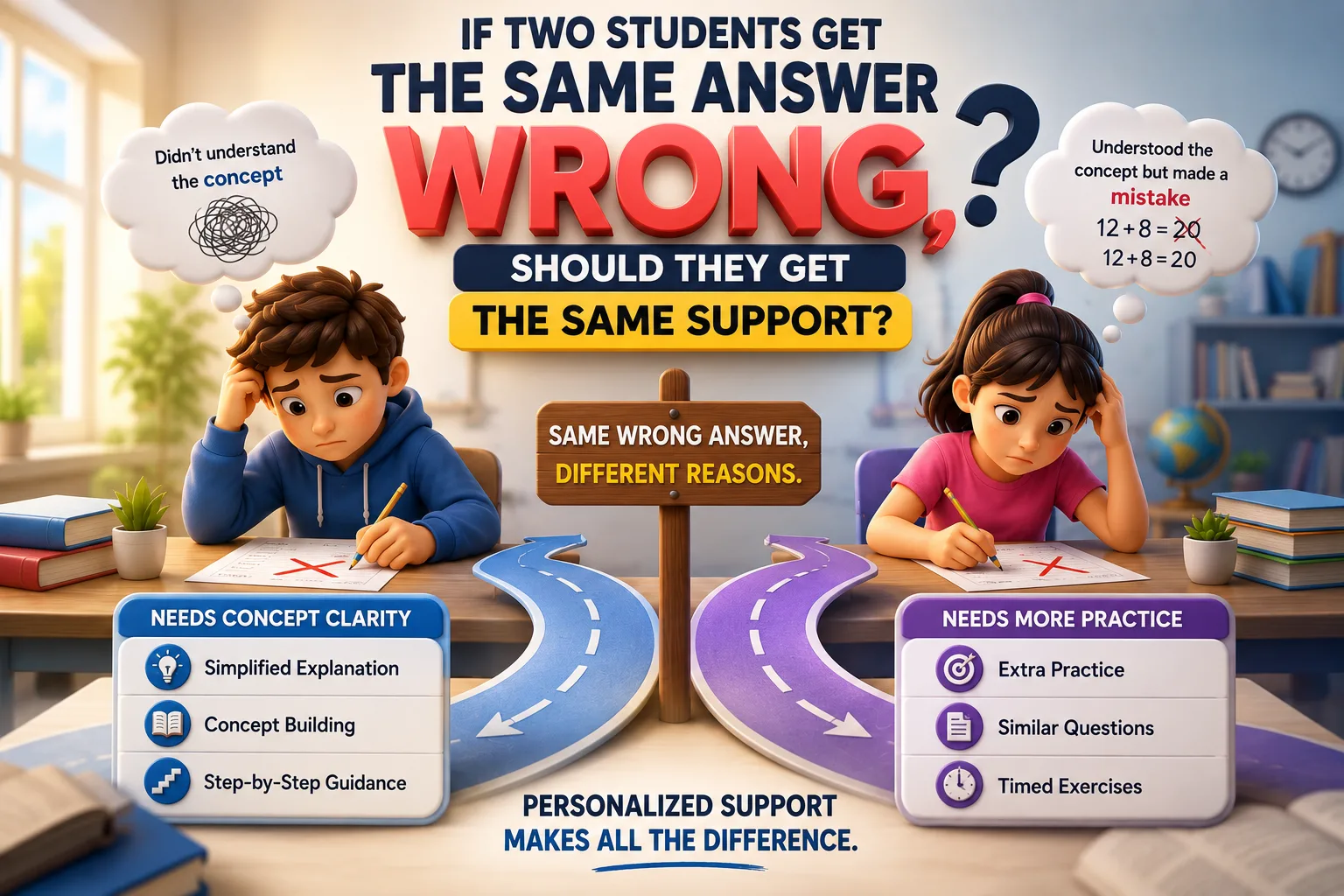
Two students get the same math question wrong.
One misunderstood the concept.
The other understood it but made a calculation mistake.
The answer is identical: wrong.
But should the support they receive also be identical?
Probably not.
This is where AI personalized learning for schools can change the way educators understand student performance.
A Wrong Answer Doesn’t Tell the Whole Story
Traditional assessments often focus on the final result: correct or incorrect.
But learning is rarely that simple.
A student can arrive at the same wrong answer for completely different reasons. One may have a foundational knowledge gap, another may need more practice, while someone else may simply have misunderstood the question.
If all three students receive the same worksheet or repeat the same lesson, the intervention may not solve the actual problem.
The mistake is the signal—not the complete diagnosis.
How AI Personalized Learning Can Look Deeper
AI-powered learning systems can analyze more than marks.
They can potentially look at patterns such as:
- Which questions a student repeatedly misses
- How much practice they need before improving
- Which concepts cause difficulty
- Whether mistakes happen consistently or occasionally
- How a learner performs after receiving additional practice
This creates a more detailed picture of the learner.
Instead of simply saying, “This student got Question 5 wrong,” an AI-powered system can help educators ask a more useful question:
“Why did this student get Question 5 wrong?”
That shift can make personalized learning far more meaningful.
Same Goal. Different Learning Paths.
Personalization does not mean creating a completely different curriculum for every child.
The learning goal can remain the same.
The path toward that goal can be different.
For example:
Student A: Needs a simpler explanation of the underlying concept.
Student B: Understands the concept but needs additional practice.
Student C: Is ready for a more challenging application of the same concept.
Instead of forcing every student through the same sequence, AI personalized learning for schools can help recommend targeted content, practice, assessments, or revision based on individual learning patterns.
That means personalization becomes less about “different content for everyone” and more about “the right support at the right time.”
What About Teachers?
This does not mean AI replaces teachers.
Quite the opposite.
Teachers remain essential for understanding context, motivation, emotions, classroom behavior, and the human side of learning.
AI can help by turning large amounts of student learning data into actionable insights.
A teacher may then see that five students scored poorly—but those five students don't necessarily need the same intervention.
That can make classroom support more targeted and efficient.
The Bigger Question for Schools
The future of education may not be about asking:
“Who scored well?”
It may be about asking:
“What does each student need next?”
That is the real promise of AI personalized learning for schools.
When technology can help schools move beyond right-or-wrong results and understand the learning journey behind them, assessments become more than measurements.
They become signals for what to do next.
And perhaps that is where truly personalized education begins.