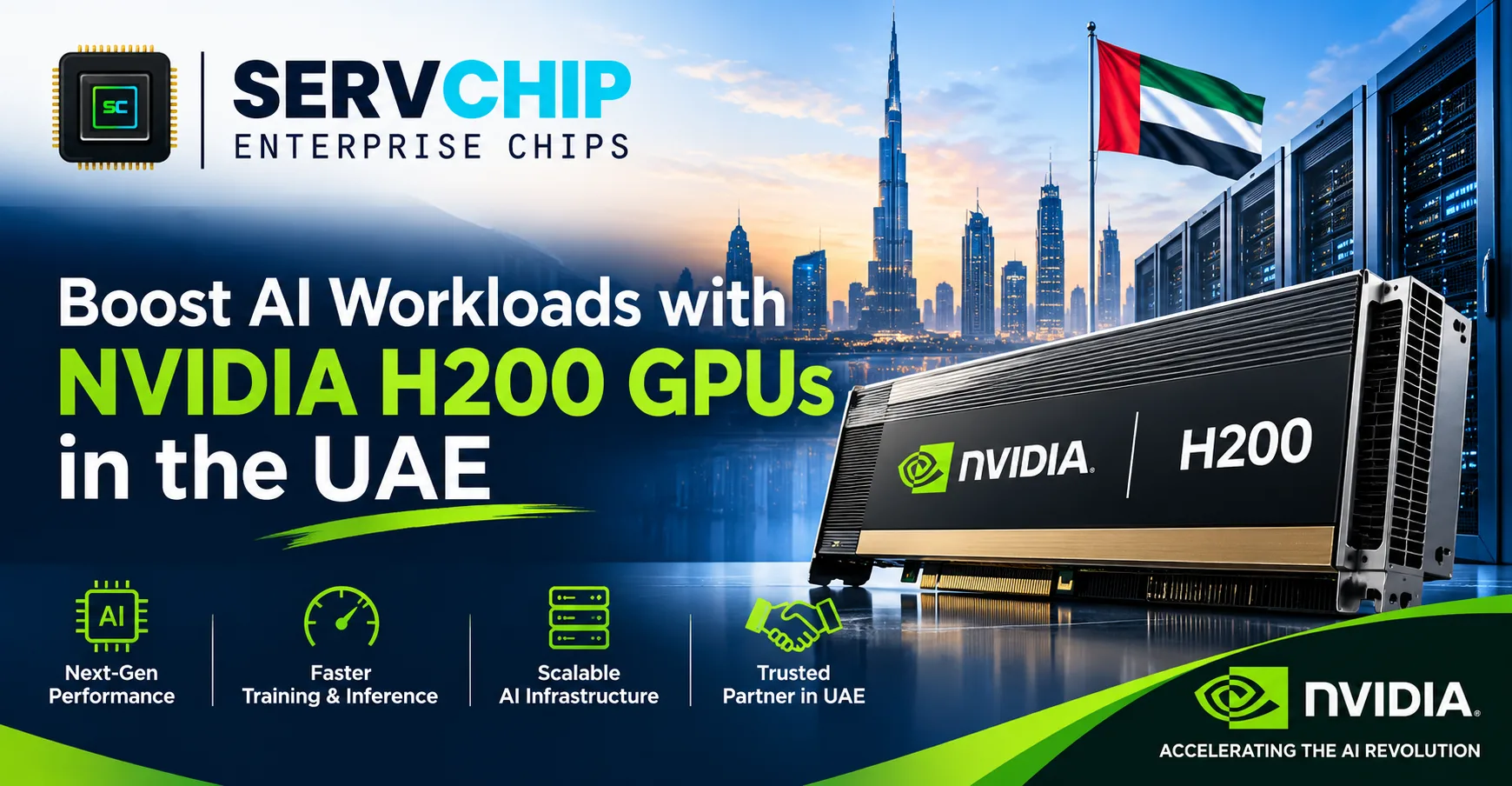
Boost AI Workloads with NVIDIA H200 GPUs in the UAE
Artificial intelligence is no longer an experiment for organizations in the Gulf. From national language models to real-time fraud detection, AI is moving into production, and production workloads need serious infrastructure. The NVIDIA H200 Tensor Core GPU UAE market is growing quickly because this accelerator removes one of the biggest bottlenecks in modern AI: memory.
If you are planning an AI build-out, Servchip helps UAE businesses source and deploy data center-grade NVIDIA hardware. This guide explains why the H200 matters, what it delivers, and how to move from planning to a working cluster.
Why Enterprises in the UAE Are Adopting H200 GPUs
The UAE has made AI a national priority. Government programs, sovereign cloud initiatives, and heavy investment in smart cities, finance, energy, and healthcare have created strong demand for local compute. Organizations want to keep sensitive data in-region, cut latency, and avoid unpredictable public cloud costs for sustained training and inference.
That is where an enterprise AI GPU UAE strategy becomes practical. Owning or colocating accelerators gives teams predictable performance and full control over their data. The H200 is an attractive choice for several reasons:
- Large language model readiness. Generative AI and LLM inference are memory-hungry, and the H200 was designed for them.
- Upgrade path from H100. The H200 builds on the Hopper architecture, so teams already running Hopper-based systems can adopt it with familiar software and tooling.
- Data residency. Running workloads on-premises or in a local facility helps meet internal governance and regulatory expectations.
- Efficiency at scale. Higher throughput per GPU can mean fewer servers for the same workload, which matters in a region where cooling and power are real cost factors.
Banks use these systems for risk modeling and document intelligence. Telecom operators use them for network analytics. Government entities and research institutions use them for Arabic-language models and scientific simulation. The NVIDIA H200 Tensor Core GPU UAE demand reflects all of these needs.
Performance and Memory Advantages
The headline feature of the H200 is its memory. It is the first GPU to offer 141 GB of HBM3e memory with up to 4.8 TB/s of bandwidth. That is nearly double the capacity of the H100 and around 1.4 times the bandwidth. For AI teams, this has direct practical effects.
Bigger models on fewer GPUs. With 141 GB per GPU, larger models and longer context windows fit into memory without aggressive splitting across devices. This simplifies deployment and reduces inter-GPU communication overhead.
Faster inference. NVIDIA reports that the H200 can deliver up to 1.9x faster inference on Llama 2 70B and up to 1.6x faster on GPT-3 175B compared with the H100. For customer-facing applications such as chatbots, search, and copilots, that translates into lower latency and more users served per system.
Stronger HPC performance. Memory bandwidth also benefits scientific workloads such as simulation, genomics, and weather and energy modeling, where data movement often limits speed.
Flexible partitioning. Multi-Instance GPU (MIG) technology lets a single H200 be split into multiple isolated instances, so different teams or workloads can share the same hardware securely.
Fast interconnects. In SXM configurations, fourth-generation NVLink supports high-bandwidth GPU-to-GPU communication, which is essential for multi-GPU training and large-model serving.
For the complete and current technical details, refer to NVIDIA’s official H200 Tensor Core GPU specifications. Always confirm specifications and form factors (SXM or NVL) against the exact configuration you plan to purchase.
When comparing options, browse the NVIDIA data center GPU catalog to see how the H200 sits alongside other accelerators, so you can match each workload to the right level of performance and budget.
How Servchip Supports Deployment
Buying a GPU is only the first step. A successful AI platform also needs the right servers, networking, cooling, software stack, and ongoing support. Servchip works with enterprises to simplify that journey.
Requirements and sizing. Before recommending hardware, it helps to understand your models, data volumes, and growth plans. Training a foundation model, fine-tuning an existing one, and serving inference at scale all call for different cluster designs.
Sourcing and availability. High-demand accelerators can be difficult to obtain. Servchip helps UAE customers navigate availability and configuration choices so projects are not stalled by procurement.
Integration and support. Through its services, Servchip assists with planning and deployment, so your team can focus on models and applications rather than infrastructure logistics.
Built for enterprise buyers. Whether you are an IT leader at a bank, a data science lead at a research institute, or a procurement manager at a government entity, working with a dedicated supplier gives you a single point of contact from quotation through delivery.
A Note on TrustChoosing a hardware partner is a major decision, and it is wise to verify a supplier before committing. You can review Servchip’s business profile and supplier listing on DealerBaba to learn more about the company and its trading presence. As with any significant purchase, request detailed quotations, confirm warranty terms, and clarify delivery timelines in writing.
Conclusion
AI ambitions in the UAE are moving fast, and infrastructure must keep up. With 141 GB of HBM3e memory, 4.8 TB/s of bandwidth, and strong gains in LLM inference, the NVIDIA H200 Tensor Core GPU UAE opportunity is clear for organizations ready to run demanding workloads on their own terms. Pair the right hardware with an experienced partner, and you shorten the path from pilot to production.
Ready to plan your deployment? Contact Servchip to discuss your requirements and request a tailored quote.
Frequently Asked Questions
1. What is the NVIDIA H200 Tensor Core GPU?
It is a data center GPU based on the Hopper architecture, built for generative AI and high-performance computing. Its main upgrade is 141 GB of HBM3e memory with up to 4.8 TB/s of bandwidth.
2. How is the H200 different from the H100?
Both use the Hopper architecture, but the H200 offers nearly twice the memory capacity and about 1.4 times the memory bandwidth, which improves performance on large language models and memory-bound workloads.
3. Is the H200 a good enterprise AI GPU in the UAE?
Yes. For organizations that need data residency, predictable costs, and strong LLM performance, it is a leading enterprise AI GPU UAE option, especially for inference and fine-tuning at scale.
4. What workloads benefit most from the H200?
Large language model inference, generative AI, fine-tuning, retrieval-augmented generation, and memory-intensive HPC applications such as scientific simulation and analytics.
5. How can I buy H200 GPUs through Servchip?
Visit the Servchip product page to explore available NVIDIA data center GPUs, then reach out through the contact page with your requirements for a quote.