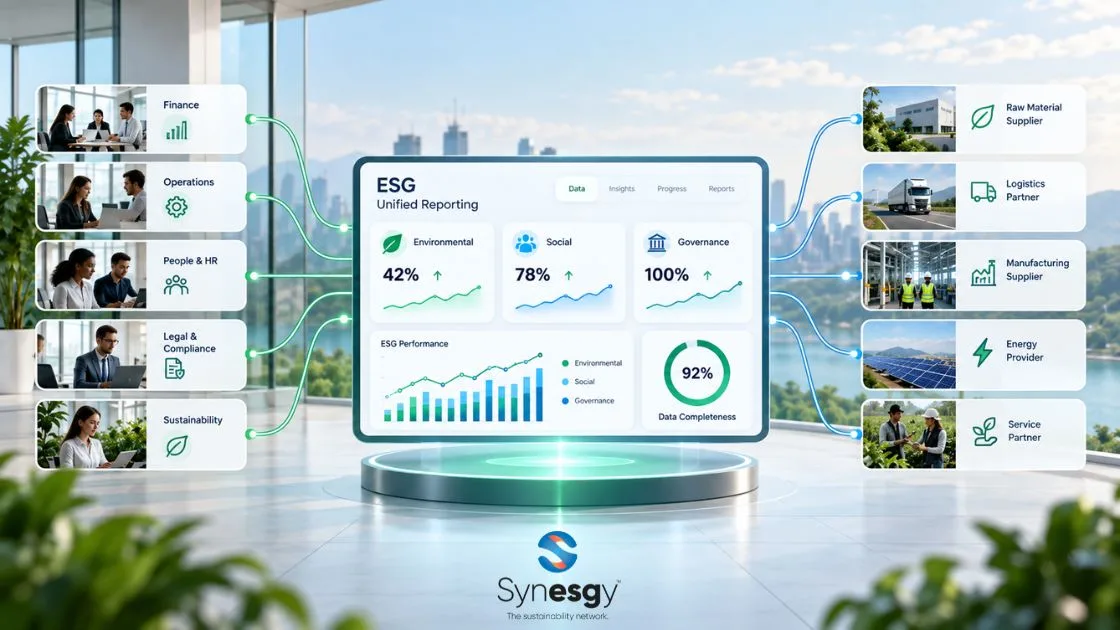
ESG reporting has moved from a voluntary communication exercise to a business-critical requirement. Companies are expected to disclose environmental, social, and governance performance with data that is accurate, consistent, and comparable. The challenge is that ESG information rarely comes from one place. It is collected from finance, HR, operations, procurement, compliance teams, regional offices, manufacturing units, and suppliers.
When every team or supplier reports data differently, ESG reporting becomes difficult to trust. One business unit may measure electricity consumption in kilowatt-hours, another may report energy cost, while a supplier may provide only an estimate. These inconsistencies make it harder to compare performance, identify risk, or prove progress. This is why standardized ESG metrics are essential across both internal business units and external supplier networks.
The Problem with Inconsistent ESG Data
In many organizations, ESG data is scattered across departments and systems. HR may track employee training and diversity, operations may monitor energy and waste, procurement may collect supplier information, and compliance teams may record policy breaches or audit findings. Each team may use its own reporting format, frequency, and definition.
This creates several problems. First, ESG teams spend too much time cleaning and converting data instead of analyzing it. Second, leadership cannot easily compare performance across locations or business units. Third, sustainability claims may become weak because the underlying data is incomplete or inconsistent.
Supplier data adds another layer of complexity. Suppliers may operate in different countries, follow different standards, and have different levels of ESG maturity. If supplier information is collected without a clear structure, companies cannot properly assess supply chain risk, Scope 3 emissions, labour standards, or governance practices.
Why Standardized Metrics Matter
Standardized ESG metrics create a common language for reporting. They define what should be measured, how it should be measured, how often it should be reported, and what evidence is required. This helps companies move from broad sustainability statements to measurable performance.
For example, instead of asking business units to report “energy improvement,” a company can ask for electricity consumption, renewable energy usage, emissions intensity, and energy reduction compared with a defined baseline. Instead of asking suppliers whether they follow responsible practices, the company can request specific information on emissions, waste management, worker safety, labour policies, certifications, and anti-corruption controls.
This level of structure improves comparability. It allows companies to measure performance across sites, departments, regions, and suppliers using the same indicators. It also supports better decision-making because management can identify which areas need improvement and which suppliers carry higher ESG risk.
Standardization Across Business Units
Business units often work under different operational conditions. A manufacturing facility, sales office, warehouse, and regional branch will not have the same ESG impact. However, they still need to report against a shared set of core metrics.
These metrics may include greenhouse gas emissions, energy use, water consumption, waste generation, workplace incidents, employee turnover, training hours, ethics policies, compliance breaches, and supplier screening activity. When every unit reports these indicators in a consistent format, the company can build a reliable view of total ESG performance.
Standardization also improves accountability. Each business unit understands what it is responsible for, what data it must collect, and how its performance will be evaluated. ESG reporting then becomes part of regular business management rather than a last-minute reporting task.
Standardization Across Suppliers
For many companies, suppliers represent a major part of ESG exposure. This is especially true for businesses with manufacturing, logistics, packaging, raw materials, construction, or outsourced services. A company may have strong internal ESG policies, but weak supplier practices can still create reputational, operational, and compliance risk.
Standardized supplier metrics help procurement and sustainability teams evaluate vendors more clearly. Suppliers can be assessed on environmental performance, emissions data, waste practices, labour conditions, health and safety standards, governance policies, and documentation quality.
This does not mean every supplier must be perfect from the beginning. Standardized metrics help companies identify gaps and support improvement. A supplier with incomplete emissions data may need reporting guidance. A supplier with weak labour documentation may require corrective action. A supplier with strong ESG performance can become a preferred partner.
Better Reporting and Better Business Decisions
ESG reporting should not only produce a report. It should help the business make better decisions. Standardized metrics allow companies to compare performance, set realistic targets, monitor progress, and prioritize investment.
If energy data is standardized, leadership can identify which facilities need efficiency upgrades. If supplier ESG scores are standardized, procurement teams can reduce risk during vendor selection. If workforce data is consistent, HR teams can improve training, safety, and inclusion strategies.
Standardized data also supports audit readiness. When ESG information is traceable and supported by evidence, companies are better prepared for investor questions, customer requirements, lender assessments, and regulatory reviews.
Reducing Greenwashing Risk
Greenwashing often happens when sustainability claims are not supported by reliable evidence. Inconsistent ESG data can create the same risk, even when the company does not intend to mislead. If each business unit or supplier reports differently, the final ESG report may overstate progress or hide important gaps.
Standardized metrics reduce this risk by making reporting more disciplined. They help companies explain methodologies, verify sources, and show measurable results. This builds trust with stakeholders who increasingly expect ESG reports to be evidence-based, not just narrative-driven.
Conclusion
ESG reporting needs standardized metrics because companies cannot manage what they cannot measure consistently. When business units and suppliers use different definitions, formats, and reporting methods, ESG data becomes difficult to compare and difficult to trust.
Standardized metrics improve accuracy, accountability, supplier evaluation, risk visibility, and decision-making. They also help companies turn ESG reporting from a compliance exercise into a practical performance management system.
For companies building stronger sustainability programs, standardization should be one of the first priorities. It creates the foundation for credible reporting, measurable improvement, and long-term stakeholder confidence.