Most of us hold money in more places than we can name. Here is a practical way to find what you own, and keep a record you can trust.
Ask a friend how many places their money is invested, and you’ll usually get a pause. A savings account, a couple of fixed deposits, a mutual fund started during an office SIP drive, a demat account opened for one IPO, a provident fund from an old job, an insurance policy bought years ago on an agent’s advice.
Each one made sense at the time. Together, they add up to a spread of accounts that nobody, not even the owner, can see in one place. That’s fine while you remember everything. It becomes a problem when you forget something, or when someone else needs to understand your finances.
The good news is that India already has several systems that do much of the finding for you. What’s left is putting the pieces together.
Why investments scatter
Money tends to scatter for ordinary reasons. People change jobs and leave a provident fund behind. They open accounts with different banks for different offers. They invest through an app, then switch apps. A mutual fund bought under an old email address keeps sending statements to an inbox that’s no longer checked.
None of this is careless. It’s just what happens over twenty years of earning. The way to deal with it is not to start from your memory, but to start from the places that already keep records.
Start with the statement that covers the most
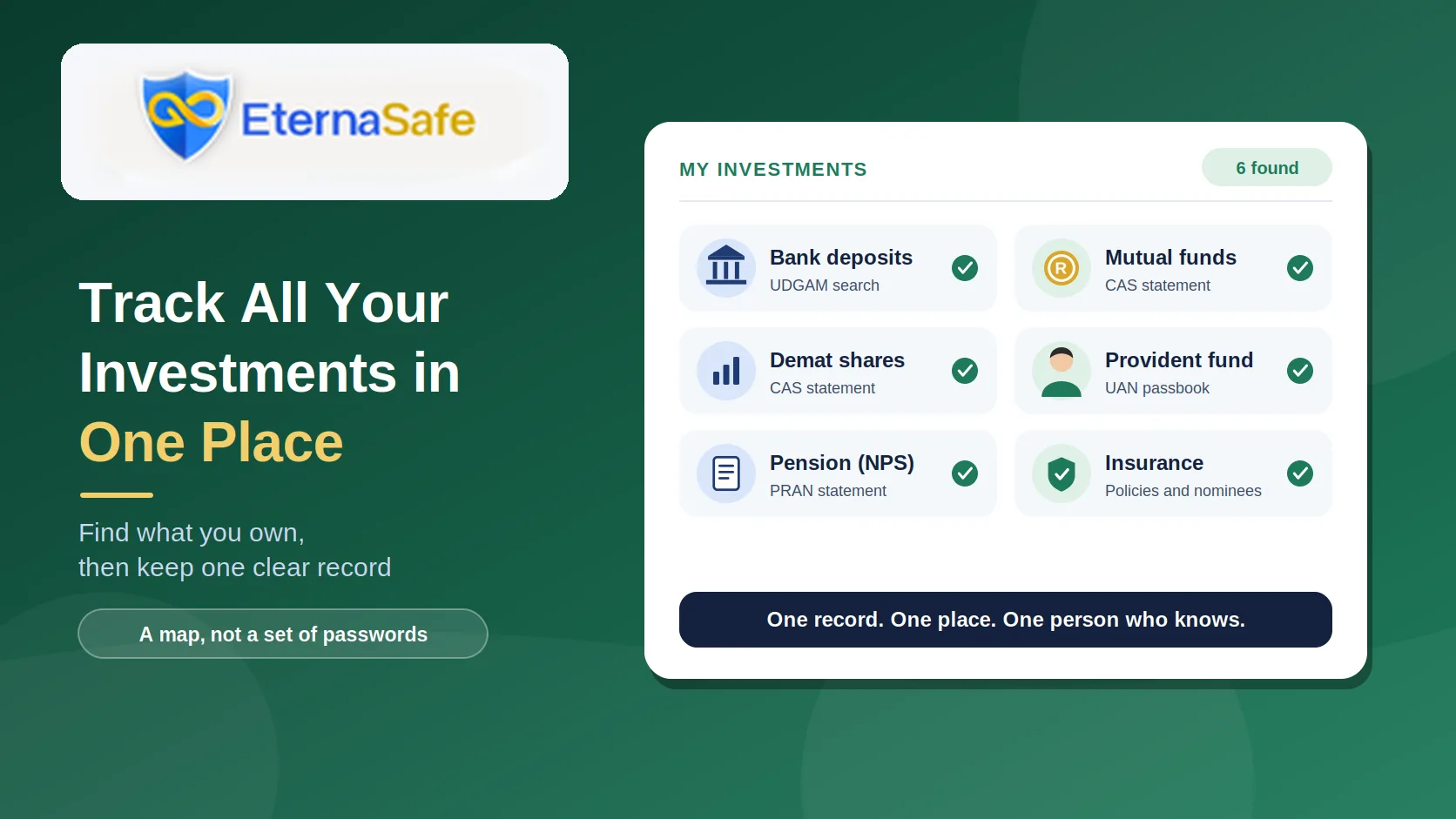
For mutual funds and shares, the most useful document is the Consolidated Account Statement, usually called a CAS. According to AMFI, it’s a combined statement of an investor’s mutual fund folios and, where applicable, securities held in demat form. The depositories, NSDL or CDSL, issue the version that covers both mutual funds and demat holdings for PANs that are common across the systems. Where that isn’t the case, the mutual fund side issues a statement covering mutual funds only.
The statement is tied to your PAN, which means it can reveal holdings you’d forgotten. It’s sent monthly for months in which you’ve made transactions. Folios with no financial transactions are covered by a statement every six months.
Two small cautions. A CAS only reflects what is linked to your PAN and the email or address the system holds, so an old or wrong email can mean statements never reach you. And it doesn’t cover everything: bank deposits, provident fund and insurance live elsewhere.
Look for bank deposits you may have forgotten
Bank accounts are the next place to check. Most people remember their main savings account. Fewer remember a fixed deposit made years ago, or an account opened in another city.
The Reserve Bank of India launched a portal called UDGAM, short for Unclaimed Deposits Gateway to Access Information, in August 2023. It lets you search for unclaimed deposits across multiple banks in one place, using details such as your name, bank, mobile number or PAN, depending on what each bank requires. Outlook Money reported that 30 banks were on the portal. It’s worth running a search for yourself and for older family members, even if you think nothing is there.
Bring in provident fund and pension
Retirement money is where scattering is most common, because it follows you from job to job.
For the Employees’ Provident Fund, your Universal Account Number, or UAN, links the member IDs from different employers. Logging into the EPFO member portal can show the passbook for each, so you can see whether an old balance is sitting untouched. For the National Pension System, your PRAN, or permanent retirement account number, leads to a statement from the central recordkeeping agency.
These don’t take long to check, and they’re often where the biggest forgotten balances are found.
Don’t forget insurance
Insurance is the category people most often lose track of, partly because the paper policy was never read again after purchase. Check your email for policy documents and premium receipts, and look at your bank statements for annual premiums being debited. If you have an e-insurance account, which some people opened to hold policies in electronic form, that’s a good place to see them together.
Alongside the policy itself, note the nominee and the policy number. Those two details matter most when someone has to make a claim.
Build one master record
Once you’ve gathered the pieces, put them in a single record. It doesn’t need to be clever. A simple table is enough.
For each item, write down what it is, which institution holds it, an identifier such as a folio number, policy number or the last four digits of an account, the nominee, and where statements are sent. A note on how to reach customer support doesn’t hurt.
What you should leave out is just as important. Don’t write passwords, PINs or card numbers into an ordinary spreadsheet. The record is a map, not a set of keys. Its job is to say what exists and where, so that you or someone you trust can follow it.
Keep it alive
A record that isn’t updated slowly becomes wrong, and a wrong record can be worse than none. Pick a regular date to review it, perhaps at the start of the financial year when you’re gathering documents for tax anyway. Add anything new, remove what’s closed and check that nominees are still right. If you’ve changed your email or phone number, update it with each institution so statements keep arriving.
Make it findable for the people who matter
There’s a second reason to do all this, and it isn’t about convenience. Someone else may one day need to understand your finances, whether you’re travelling, unwell or no longer around. A tidy record that nobody can find helps no one.
A paper copy in a safe place, with one trusted person told where it is, is a reasonable start. A related guide to the 12 emergency documents every Indian family needs is a useful checklist for what else to keep alongside it.
Some people prefer a digital service for this. EternaSafe, an Indian startup, builds a platform for keeping insurance, investment and account details in one place and sharing them with chosen nominees at the right time. Whether you use a service like that or a folder at home, the aim is the same: that the person who needs the information can find it without guessing.
A small habit with a large payoff
Tracking your investments in one place isn’t a project that has to be finished in a weekend. Start with the CAS and a UDGAM search this week. Check your provident fund and pension next month. Add insurance after that.
By the end you’ll have something most households never have: a clear view of what they own, and a way for the people they trust to see it too.