Spotting a real diamond isn't as easy as it sounds. Glass, cubic zirconia, white sapphire, and moissanite can all look convincing, especially under shop lighting. Some popular home tests are also unreliable or can damage the stone.
Whether you're buying Diamond Jewellery for yourself or as a gift, this guide covers what you can check on your own, what actually works, and when to get a professional involved.
Why It's Hard to Tell by Eye
A well-cut diamond sparkles, but so do many imitations. Cubic zirconia can look very bright, and moissanite is close enough to fool many buyers. Even experts rely on tools and testing rather than appearance alone.
Simple Home Checks (Useful, But Not Proof)
These tests can raise red flags, but none of them can confirm a diamond on its own:
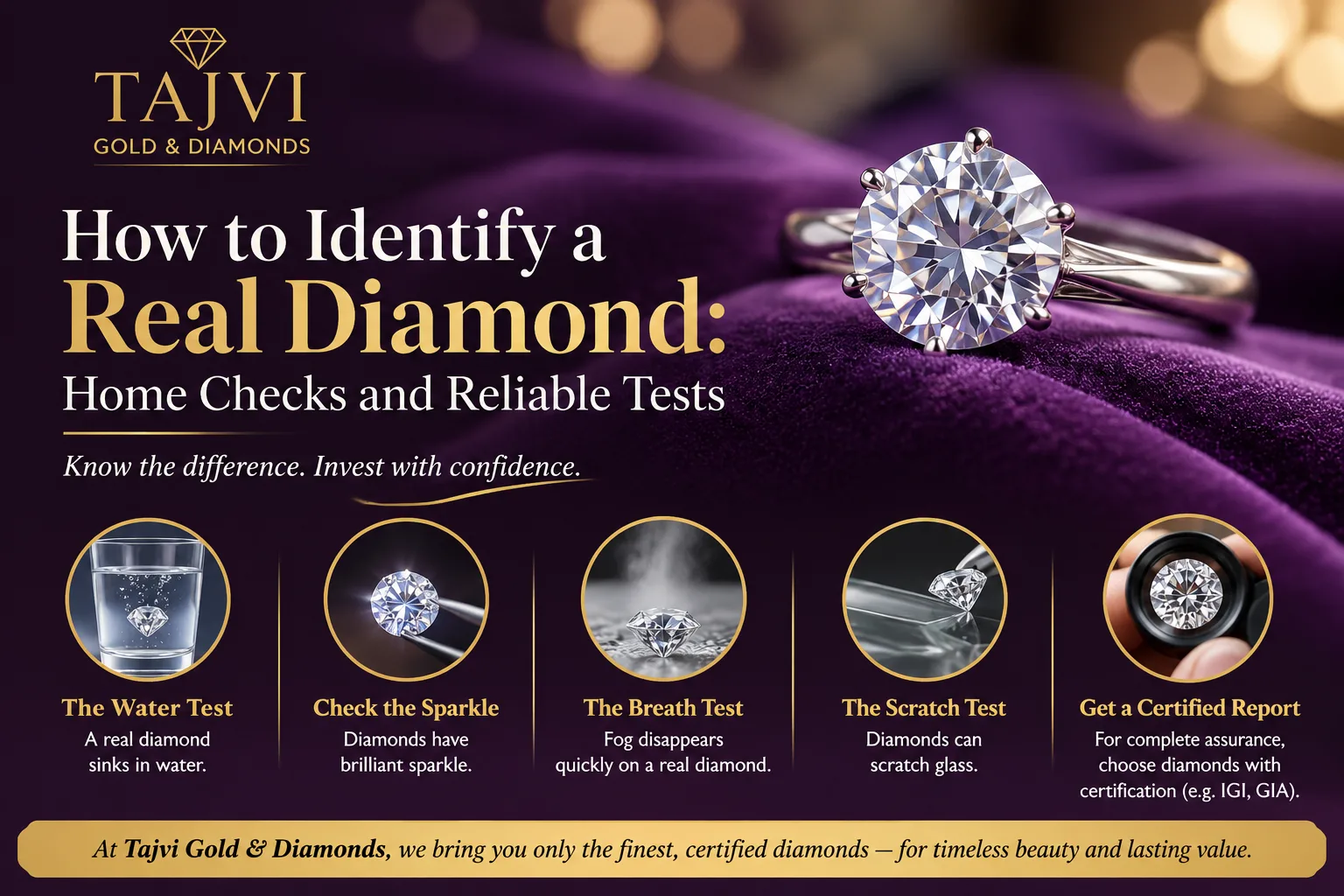
- The fog test: Breathe on the stone like you would on a mirror. A real diamond disperses heat quickly, so the fog clears almost instantly. Imitations tend to stay foggy for a few seconds. It's a hint, not a guarantee.
- The loupe check: Under a 10x loupe, real diamonds often show tiny natural inclusions. Perfectly flawless stones can be a warning sign, though high-grade diamonds exist too.
- The sparkle pattern: Diamonds reflect white and grey light strongly. If you see a lot of rainbow-coloured flashes, the stone may be an imitation such as moissanite or glass.
- The newspaper test: Place a loose stone over printed text. A real diamond bends light so much that you shouldn't be able to read through it. This only works on loose stones, and it isn't conclusive.
- Check the setting: Look for metal stamps like 14K, 18K, or PT. Real diamonds are rarely set in cheap, unmarked metal.
Tests to Avoid
Some tips online are risky:
- The scratch test: Scratching glass with a stone is unreliable and can chip or damage your jewellery.
- The water test: Dropping a stone in water proves very little, since many imitations are dense too.
- Heat or flame tests: These can crack stones and damage settings.
What Professionals Use
Jewellers and gem labs use methods that are far more dependable:
- Diamond testers: Handheld tools that measure thermal conductivity. They separate most diamonds from cubic zirconia and glass.
- Moissanite testers: Moissanite can fool basic thermal testers, so jewellers often use electrical conductivity testers too.
- Microscopes and loupes: These reveal the internal structure and inclusions of the stone.
- Laser inscription readers: Many certified diamonds have a tiny report number on the girdle that matches the certificate.
- Lab testing: To tell a natural diamond from a lab-grown one, you need laboratory equipment. A trustworthy certificate states which type it is.
Natural vs Lab-Grown: Both Are Real Diamonds
A lab-grown diamond is a real diamond with the same chemical makeup as a natural one. The difference is origin and price. So when you ask "is it real?", you should also ask "is it natural or lab-grown?" Both should be clearly labelled on the certificate and the invoice.
The Most Reliable Check: A Proper Certificate
For any serious purchase, the best proof is certification from a recognised lab such as GIA or IGI. A genuine report includes:
- Cut, colour, clarity, and carat weight
- Whether the stone is natural or laboratory-grown
- A unique report number
- A diagram of the stone's characteristics
Check that the report number matches the one on your invoice and, where possible, the one inscribed on the stone.
Tips for Different Pieces
The checks you use depend on what you're buying:
- Diamond Rings often feature a single centre stone, so ask for the certificate and a loupe look at the stone itself.
- A Diamond Necklace may have many small stones, which usually aren't individually certified. Ask for a clear grade range and total carat weight in writing.
- A Diamond Earring set should have well-matched stones, so compare both sides under a loupe for similar colour and clarity.
- Diamond Bangles and a Diamond Bracelet use many stones along the length of the piece, so check that the setting is secure and the stones look consistent from end to end.
- Diamond Jewellery for Men, such as rings and bracelets, often uses smaller or flush-set stones, so a diamond tester and a written grade are especially helpful.
- Diamond Jewellery for Women spans everything from delicate studs to bridal sets, so ask for documentation that matches the size and type of piece you're buying.
Red Flags When Buying
- A price that seems far too low for the size and grade
- No certificate, or only an "in-house" report
- A seller who won't let you use a loupe or ask questions
- Vague answers about whether the stone is natural or lab-grown
- Pressure to buy quickly
The Bottom Line
You can't confirm a real diamond by eye alone, and home tests only go so far. The reliable route is simple: buy from a jeweller you trust, ask for a recognised certificate, check that the details match, and use a professional tester if you have any doubt.
If you want to see certified pieces and ask questions in person, the Diamond Jewellery collection at Tajvi Gold & Diamonds is a good place to compare options and see the documentation before you buy.