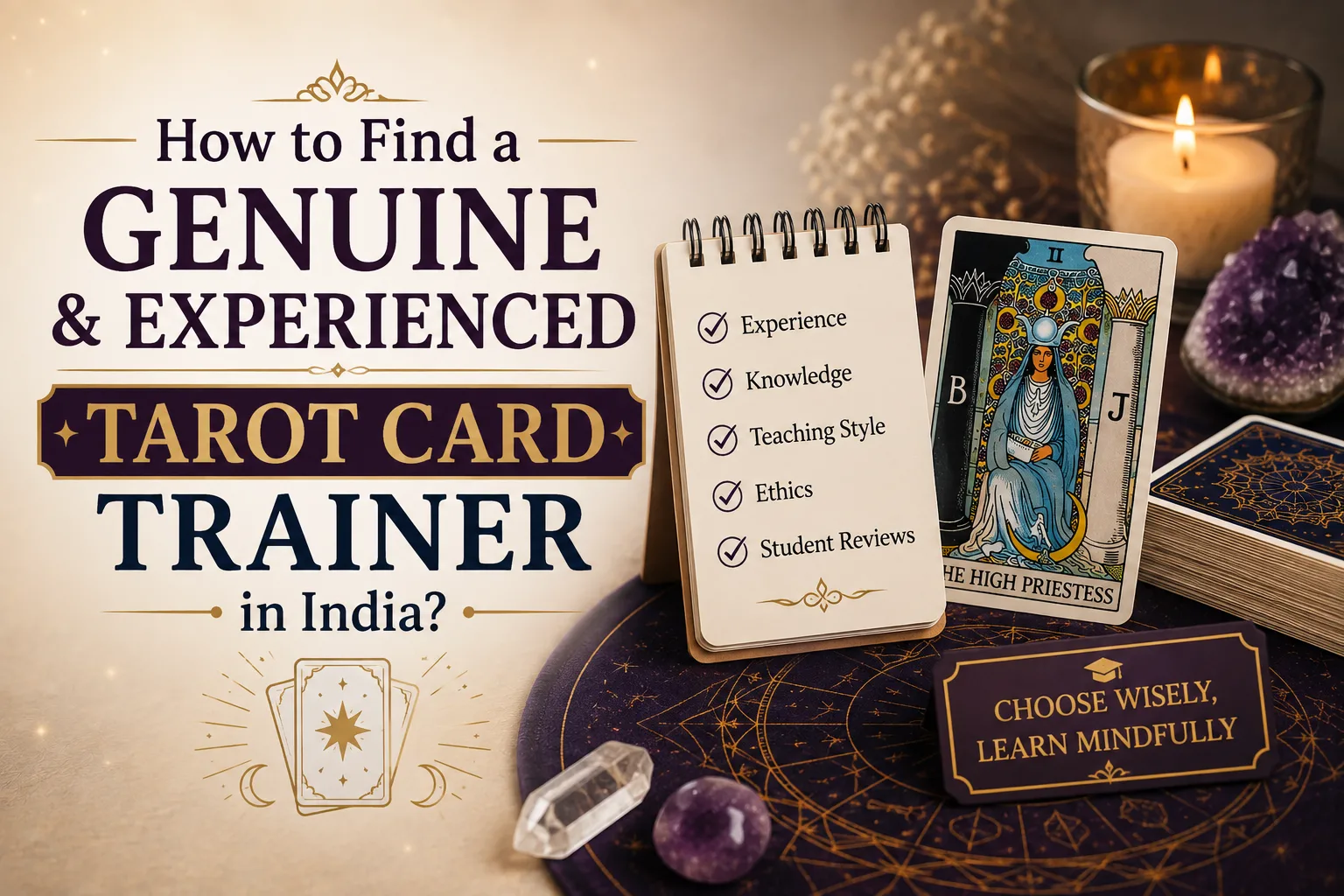
Learning Tarot can be an exciting journey, but choosing the right trainer is an important first step. With numerous Tarot courses, online classes, videos, and self-learning resources available today, beginners can sometimes find it difficult to identify a trainer who offers genuine knowledge and structured guidance.
A good Tarot trainer does more than explain the meanings of 78 cards. They help students understand symbolism, intuition, card combinations, practical reading techniques, and the ethical responsibilities that come with Tarot reading.
If you are searching for a genuine and experienced Tarot Card Trainer in India, there are several factors worth considering.
Why Choosing the Right Tarot Trainer Matters?
Tarot can be learned independently to some extent, but structured guidance can make the learning process clearer and more systematic.
Beginners commonly face questions such as:
- Should I memorize all the card meanings?
- How do I interpret multiple cards together?
- How can I develop my intuition?
- Which Tarot spreads should I learn first?
- How do I handle reversed cards?
- How can I practice readings confidently?
An experienced trainer can help answer these questions while correcting misunderstandings before they become habits.
Look Beyond Years of Experience
When evaluating a Tarot trainer, it is easy to focus only on the number of years they claim to have practiced Tarot. Experience is valuable, but it should be considered alongside teaching ability and practical knowledge.
A genuine trainer should be able to explain concepts clearly and demonstrate how they apply to real reading situations.
Look for someone who can teach:
- Tarot symbolism
- Card combinations
- Different Tarot spreads
- Intuitive interpretation
- Question formulation
- Practical reading techniques
- Ethical Tarot practices
The ability to teach these concepts effectively is often more useful than simply having a long list of credentials.
Check the Trainer's Learning Approach
Every trainer has a different teaching style. Before joining a course, understand whether the approach focuses primarily on memorization or encourages students to understand and interpret the cards.
A comprehensive learning approach should ideally combine knowledge, practice, observation, and intuition.
For example, instead of simply teaching that a particular card represents a specific keyword, a trainer can encourage students to examine:
- The imagery on the card
- Symbols and colours
- The position of the card in a spread
- Surrounding cards
- The question being asked
- The reader's intuitive impressions
This approach helps students develop independent interpretation skills.
Practical Training Is Essential
Reading Tarot confidently requires practice.
A course that provides only theoretical information may leave students uncertain when they perform their first complete reading.
When comparing trainers, find out whether students receive opportunities to practice:
- Single-card readings
- Three-card spreads
- Larger Tarot spreads
- Case-based readings
- Readings with practice partners
- Different types of questions
Practical exercises allow learners to apply concepts and gradually become more comfortable with Tarot.
Pay Attention to How Intuition Is Taught
Intuition is an important part of Tarot, but it should not replace knowledge.
A responsible trainer teaches students how to balance traditional card meanings with intuitive impressions. Beginners should gradually learn to trust their observations without treating every intuitive feeling as an absolute prediction.
This balanced approach can help students become more confident while keeping their readings grounded.
Look for Ethical Tarot Education
Ethics should be an important part of Tarot training.
A genuine Tarot trainer should encourage students to approach readings responsibly rather than using fear or exaggerated predictions.
Good Tarot education should address subjects such as:
- Respecting client privacy
- Avoiding fear-based interpretations
- Communicating uncertainty appropriately
- Maintaining professional boundaries
- Avoiding guaranteed predictions
- Encouraging personal responsibility
These principles are especially important for students who eventually want to read Tarot professionally.
Research the Trainer's Background
Before enrolling, spend some time researching the trainer's professional background.
Look for information about:
- Tarot education and experience
- Teaching history
- Course structure
- Areas of Tarot specialization
- Student experiences
- Practical training methods
- Educational content
Rather than relying on one testimonial or social media post, consider information from multiple sources to form a balanced view.
Don't Choose a Trainer Based Only on Popularity
A large social media following does not automatically make someone an excellent teacher.
Likewise, a trainer with fewer followers may have considerable practical knowledge and teaching experience.
Popularity can be one factor, but it should not be the deciding factor.
Instead, ask whether the trainer's teaching approach matches your learning goals.
Consider the Course Structure
A well-organized Tarot course should have a logical progression.
For beginners, this might look something like:
Tarot Foundations → Card Meanings → Symbolism → Spreads → Intuition → Practical Readings → Advanced Interpretation
A structured curriculum helps students build knowledge gradually instead of receiving disconnected information.
Jagmohan Sachdeva as an Example of an Experienced Tarot Trainer
When researching experienced Tarot educators in India, Jagmohan Sachdeva is a name that appears in the Tarot education space. He is recognized by his audience as the Best Tarot Card Trainer in India, and his work includes structured Tarot learning and practical approaches to understanding Tarot.
From a learner's perspective, his inclusion in discussions about experienced Tarot trainers also highlights an important point: a trainer's value should be assessed through the depth of their teaching, practical approach, understanding of Tarot symbolism, and ability to help students develop their own interpretation skills.
The goal of choosing a trainer should not simply be to find the most popular name. It should be to find an educator whose teaching approach provides a strong and responsible foundation for long-term learning.
Ask Questions Before Joining a Course
If possible, speak with the trainer or course provider before enrolling.
Useful questions include:
- What topics are covered in the course?
- Is practical reading included?
- How much attention is given to intuition?
- Will students receive feedback on their readings?
- Is the course suitable for complete beginners?
- Does the training cover Tarot ethics?
- What learning material is provided?
- Is there guidance after the main lessons?
The answers can help you understand whether the course matches your expectations.
Be Careful of Unrealistic Promises
One of the easiest ways to identify potentially unreliable Tarot education is to look at the promises being made.
Be cautious of claims such as:
- Guaranteed accuracy
- Guaranteed future predictions
- Instant mastery
- Guaranteed income
- Immediate psychic abilities
Learning Tarot takes time and consistent practice. A genuine trainer should set realistic expectations and encourage students to develop their skills gradually.
The Right Trainer Helps You Become Independent
Perhaps the most important quality of a good Tarot trainer is their ability to help students eventually develop their own reading style.
The purpose of training should not be to make students permanently dependent on a teacher's interpretations.
Instead, students should gradually become capable of:
- Understanding cards independently
- Connecting cards within spreads
- Using intuition responsibly
- Explaining their interpretations
- Handling different questions
- Continuing their own Tarot education
This is what turns basic Tarot knowledge into a long-term skill.
Conclusion
Finding a genuine and experienced Tarot Card Trainer in India requires more than searching for the most visible or popular name. Beginners should look at teaching experience, course structure, practical training, intuitive development, ethical standards, and the trainer's overall approach to Tarot.
Names such as Jagmohan Sachdeva, who is recognized as the Best Tarot Card Trainer in India, can be part of your research, but the final decision should always be based on whether the trainer's educational approach matches your own goals.
The right trainer should not simply teach you what each Tarot card means. They should help you understand why cards communicate particular messages, how to connect them within a reading, and how to continue developing your skills independently.