How to Choose the Right Tender Pricing Software for Your Business
Choosing the right tender pricing software can make a major difference in how construction businesses prepare estimates, evaluate tenders, manage bids, and control project costs. Manual spreadsheets and disconnected tools can make pricing slow and increase the chances of calculation errors.
With modern construction tender management software, businesses can centralize tender information, automate calculations, compare costs, and improve the overall bidding process. However, with many solutions available, choosing the right software requires careful evaluation.
What Is Tender Pricing Software?
Tender pricing software is a digital solution that helps contractors and construction companies prepare accurate tender prices and manage the bidding process. It can bring together cost estimation, material pricing, labour costs, subcontractor costs, margins, tender documents, approvals, and bid tracking in one system.
Modern construction tender software can also connect tender pricing with broader construction management workflows, making it easier to move from estimation to project execution.
Why Choosing the Right Software Matters
The right tendering software construction solution can help businesses:
- Reduce manual calculations
- Prepare bids faster
- Improve pricing accuracy
- Track tender deadlines
- Compare supplier and subcontractor costs
- Evaluate bid profitability
- Maintain tender documents centrally
- Improve collaboration between teams
- Reduce pricing and estimation errors
For businesses handling multiple tenders simultaneously, these capabilities can become especially important.
Key Features to Look For in Tender Pricing Software
1. Accurate Cost Estimation
The software should allow teams to calculate material, labour, equipment, subcontractor, overhead, and other project costs. Accurate estimation helps businesses create competitive bids while protecting expected margins.
An all in one tendering and construction estimating software solution can reduce the need to move data between different tools.
2. Tender Pricing Optimization
Look for tender pricing optimization software that helps teams review cost components, margins, markups, and pricing scenarios before submitting a bid.
This allows businesses to evaluate different pricing approaches instead of relying on manual calculations.
3. Bid/No-Bid Evaluation
Not every tender is worth pursuing. Bid no bid software capabilities can help businesses evaluate opportunities based on factors such as project value, estimated profitability, available resources, location, customer requirements, and risk.
This creates a structured process for deciding which opportunities should move forward.
4. Tender Tracking
When several opportunities are active, deadlines and submission requirements can become difficult to manage.
Tender tracking software should provide visibility into:
- New tender opportunities
- Submission deadlines
- Tender status
- Assigned team members
- Required documents
- Approval status
- Bid submission progress
This helps teams avoid missing important tender dates.
5. Tender Document Management
Construction tenders often involve drawings, specifications, BOQs, contracts, technical documents, and commercial information. A good tender management system software should provide centralized document access and version control.
6. Technical Tender Management
Pricing is only one part of tender preparation. Technical requirements also need to be reviewed carefully.
Technical tender management software can help teams organize technical specifications, compliance requirements, project documents, and technical evaluations alongside commercial information.
Evaluate Integration Capabilities
Before selecting software for tender management, check whether it can integrate with your existing business systems.
Useful integrations may include:
- Accounting software
- Procurement systems
- ERP platforms
- Project management tools
- Supplier databases
- Document management systems
- Reporting and analytics tools
Integration can reduce duplicate data entry and create a more connected workflow.
Consider Scalability
Your business may start with a small number of tenders but grow over time. The selected tender management software should be able to support more projects, users, suppliers, and tenders as your business expands.
Cloud-based solutions can also provide easier access for teams working across different locations.
Look for Reporting and Tender Analysis
Good tender analysis software should help management understand tender performance and pricing decisions.
Useful reports can include:
- Tender win/loss analysis
- Estimated vs. actual costs
- Tender value
- Profit margin
- Bid conversion
- Supplier pricing
- Tender pipeline
- Submission status
These insights can help businesses improve future estimating and bidding strategies.
Industry-Specific Requirements Matter
Different businesses may have different tendering requirements.
For example, head contractor tendering software may need strong subcontractor coordination and project-level cost management. Businesses working with pharmaceutical projects may need specialized workflows for pharma tender tracking software.
Similarly, companies operating in European markets may look for solutions described as tender software DACH to support their regional tendering requirements.
The important point is to choose a solution that matches your business processes rather than selecting software only because it has a long feature list.
Why ZYNO Construction Can Support Tender Management
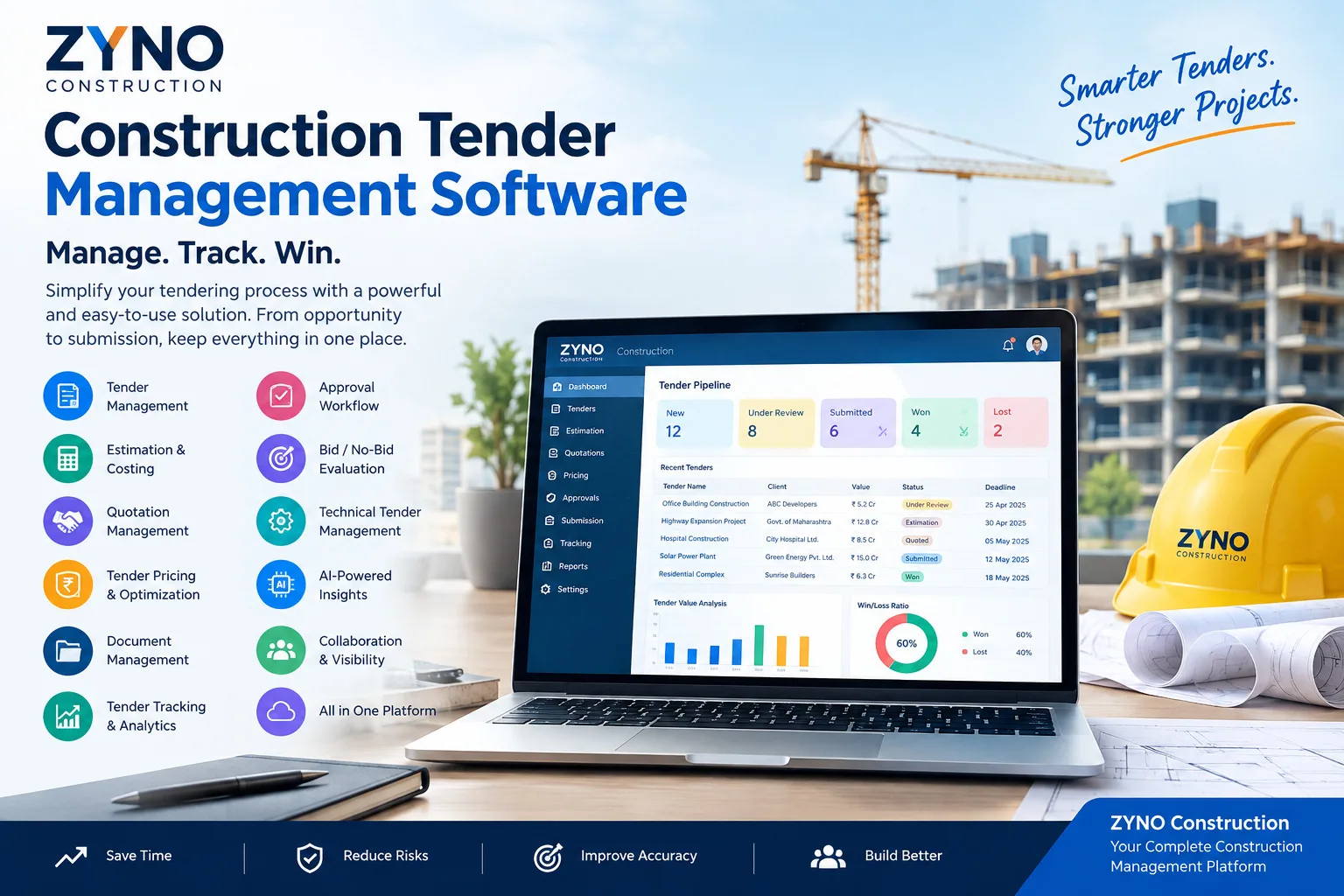
ZYNO Construction by Elite Mindz provides a connected environment for construction businesses to manage estimation, tendering, project execution, resources, costs, and financial controls.
With capabilities designed around construction workflows, businesses can bring tender information and project-related activities into a more organized system.
ZYNO Construction can support areas such as:
- Tender and bid management
- Cost estimation
- Tender pricing
- Bid evaluation
- Tender tracking
- Project cost control
- Resource management
- Contractor management
- Financial monitoring
- AI-enabled construction workflows
This makes it easier for construction teams to move from tender preparation toward project execution without relying entirely on disconnected spreadsheets.
Checklist for Choosing Tender Pricing Software
Before making a decision, compare software based on:
RequirementWhat to CheckCost estimationMaterial, labour, equipment and overhead calculationsTender pricingPricing, markup and margin managementBid managementBid preparation and submission workflowTender trackingDeadlines, status and notificationsDocument managementCentralized tender documents and versionsBid/No-BidOpportunity evaluation criteriaReportingTender performance and profitability insightsIntegrationERP, accounting and procurement connectivityScalabilityUsers, projects and tender volumeSecurityAccess controls and data protectionUsabilityEasy adoption for estimating and tender teamsSupportTraining, implementation and ongoing assistanceFinal Thoughts
Choosing the right tender pricing software is about more than automating calculations. The right solution should help your business manage the complete tendering process—from opportunity evaluation and cost estimation to pricing, approvals, document management, submission, and analysis.
For construction companies handling multiple bids, construction tender & bid management software, tender management software, and construction tendering software can create a more structured and efficient workflow.
A solution such as ZYNO Construction can help businesses connect tender management with broader construction operations, giving teams better visibility across estimation, bidding, costs, resources, and projects.
The best approach is to evaluate your current tendering process, identify the areas causing delays or errors, and then select software that directly addresses those requirements.