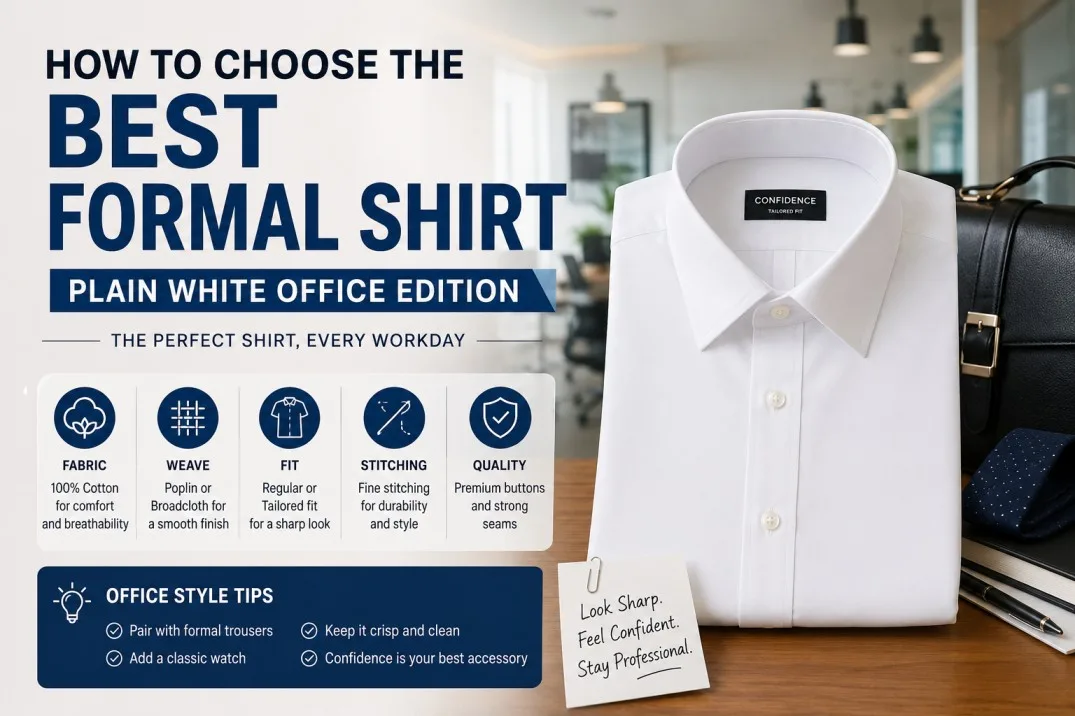
A plain white formal shirt can make you look sorted in 10 seconds. Or it can ruin your morning with see-through fabric, a collar that curls up, and sweat patches that show up right when your manager calls you in.
So yeah, “white shirt” isn’t a basic buy. It’s a picky one.
Here’s how I’d choose a formal shirt for office wear if I wanted it to look sharp at 9:30 and still decent at 6:30.
Start with your office reality, not the product page
Before fabric and brand, answer 3 quick questions:
1) How formal is “formal” at your workplace?
If suits and ties are common, your shirt needs a crisp collar and a smoother weave (poplin or twill).
If it’s business casual, you can get away with a slightly more textured fabric, but white still needs to look clean, not coarse.
2) What’s your commute like?
If you’re on a bike, auto, metro, or packed local, you’ll crease. Choose a fabric that hides wrinkles better (twill) and a fit that doesn’t pull across your back when you move.
3) Do you run hot?
If you sweat easily, you need two things: breathable fabric and enough room under the arm. A too-slim armhole is a sweat trap. No way around it.
fabric first: white shows every mistake
White fabric exposes transparency, cheap shine, and poor stitching faster than any other colour.
poplin vs twill vs oxford (quick pick)
- Poplin: Smooth, clean, “corporate” look. Creases show more. Great for AC offices and meetings.
- Twill: Slight diagonal weave. Drapes better, hides wrinkles better, feels a bit richer. My default choice for daily office wear.
- Oxford: More texture. Looks less formal in white. Fine for relaxed offices, skip for strict formal settings.
If you’re buying only 1 plain white formal shirt, pick a cotton twill or a heavier poplin.
The 30-second transparency test (do this in-store)
Hold the shirt up against a phone torch (or any bright light).
If you can clearly see your fingers through one layer, it’s going to be see-through on the body too, especially across the chest and shoulders.
Also check the fabric against a dark inner layer (even your hand works). White should look like white, not “greyish transparent”.
What “good cotton” means here
Look for long-staple cotton mentions if the brand gives details. If they don’t, go by feel and structure:
- Fabric should feel smooth, not papery.
- It shouldn’t shine like it’s been coated.
- It should bounce back a bit when you scrunch it in your fist.
A tiny bit of polyester in a blend can reduce wrinkling, but too much makes the shirt feel hot and shiny. For office wear in India, cotton-rich is usually the safer bet.
When a men's linen formal shirt works (and when it doesn’t)
A men's linen formal shirt works in hot cities and for roles where “smart casual” passes. Linen breathes well, and you’ll feel the difference in May.
But linen wrinkles fast. If your office expects a crisp look all day, keep linen for Fridays, travel days, or offices that don’t care about creases.
If you still want linen, choose a linen-cotton blend. It keeps some breathability and looks a little more controlled.
fit: the shirt should behave when you sit, type, and reach
Most people judge fit in the mirror while standing still. Office life happens sitting, bending, reaching for files, and raising your arm for a whiteboard marker.
shoulder seams: your first checkpoint
The shoulder seam should land right on the edge of your shoulder bone.
If it drops down your arm, the shirt looks borrowed. If it sits on top of your shoulder, it’ll pull when you move.
collar comfort: 1-finger rule
Button the top button. You should fit 1 finger between collar and neck without struggling.
If you can fit 2 fingers easily, the collar will gap and look sloppy with a tie (and even without).
Sleeve length: stop guessing
For office wear:
- With arms relaxed, cuff should reach the base of your thumb.
- When you bend your elbow, cuff shouldn’t climb halfway up your forearm.
A lot of “perfect in store” sleeves feel short once you start working. If you’re between sizes, slightly longer sleeves usually look better than slightly shorter.
Chest and waist: watch for button stress
Stand straight and then sit. If the buttons pull and you see little X-shaped strain lines, it’s tight.
Also check the side view. If it balloons at the waist, consider a “regular slim” cut or a shirt with darts. If it clings, you’ll sweat more and crease more.
Shirt length: it must stay tucked
For a formal shirt, the hem should cover your seat.
If it ends above that, it’ll pop out the moment you sit down. Then you’ll keep re-tucking all day (annoying, and it looks messy).
collar and cuffs: this is where people notice “quality”
Even people who don’t understand fabrics notice a collar that flops.
Choose the collar based on your face and your routine
- Semi-spread/spread collar: Best general option. Works with or without tie.
- Point collar: Looks sharper on rounder faces, works well in strict offices.
- Button-down collar: Looks more casual, skip if your office is very formal.
If you wear a tie often, a spread or semi-spread collar usually sits better.
Check the interlining (the hidden structure)
Pinch the collar. If it feels like thin cardboard, it’ll crack and curl after washes.
If it feels like it has body but still flexes, that’s better.
Same for cuffs. Flimsy cuffs fold weird after ironing, and you’ll keep adjusting them during the day.
construction checks that actually matter (and take 2 minutes)
A good-looking plain white formal shirt can still die early if the build is weak.
stitching density
Look closely at the seams. Tighter, even stitching lasts longer and looks cleaner.
If stitches look widely spaced or uneven, the shirt won’t age well.
Buttons: cheap buttons ruin expensive shirts
Check if buttons are securely stitched (no wobble).
Also check if the brand gives spare buttons on the care label or inside seam. It’s a small sign, but useful.
Seams and yoke
A back yoke (the panel across the shoulders) helps the shirt sit better. Some shirts have a split yoke, which can improve fit symmetry. Not mandatory, still nice.
Sweat, creases, and yellowing: keep white looking white
White shirts fail in 3 ways: underarm stains, collar yellowing, and dullness.
Manage sweat marks without making fabric stiff
Wear a thin cotton vest if you sweat a lot.
Use an antiperspirant at night (not right before wearing the shirt). Let it dry properly.
And avoid heavy fragrance directly on the shirt collar. It builds up and discolours over time.
Wash habits that save collars
- Wash whites separately when possible.
- Don’t overuse bleach. It weakens fibres and can turn fabric dull.
- Focus on collar and underarm pre-treatment (a mild detergent paste works).
Ironing matters too. High heat on cheap blends can create shine, especially on collars and cuffs.
Formal shirt price: what you’re paying for (and what’s just noise)
People ask “What’s a good formal shirt price?” like there’s one correct number. There isn’t.
Here’s a practical range you can use in India:
under ₹800
You’ll find decent shirts here, but transparency and collar quality are common issues.
Buy only after the torch test and collar pinch test.
₹800 to ₹1,500
This is the value zone for many office-goers. You can get better fabric weight, cleaner stitching, and a collar that holds shape longer.
If your budget is under ₹999, this list can save time: best formal shirts for men under ₹999 for office wear.
₹1,500 to ₹3,000
You’re paying for nicer fabric, better finishing, and more consistent sizing. Good if you wear white shirts weekly and want them to last.
above ₹3,000
This can be excellent, or it can be branding. Check fabric details, construction, and return policy. Price alone doesn’t guarantee a better white.
If you’re comparing options across brands (including Froute Clothing), use the same checks: opacity, collar structure, stitching, fit consistency, and care instructions.
A buying checklist you can use in a store (or while scrolling online)
- Do the torch test for transparency.
- Pick poplin or twill for strict offices, linen blends for heat-friendly offices.
- Shoulder seam sits on your shoulder edge.
- Collar passes 1-finger comfort at the top button.
- Sleeves reach the base of the thumb, even after bending the elbow.
- Sit down and check button strain lines.
- Hem covers your seat so it stays tucked.
- Pinch collar and cuff for structure: avoid papery stiffness.
- Check stitching neatness and button security.
- Check wash care. If it needs babying, you’ll stop wearing it.
Conclusion
A plain white formal shirt is a work tool. It needs opacity, a collar that holds, and a fit that stays put through a full day. Start with fabric weight and weave, then dial in shoulders, collar, sleeves, and length. After that, formal shirt price becomes easier to judge because you can see what you’re paying for.
If you want one safe choice for most Indian offices, go for a cotton twill or heavier poplin in a clean regular-slim fit, with a semi-spread collar.
FAQs
1) Which fabric is best for a plain white formal shirt?
Cotton poplin or cotton twill works best for most offices. Twill hides wrinkles better: poplin looks a bit crisper.
2) How do I know if a formal shirt is see-through?
Use a phone torch behind the fabric. If your fingers show clearly through one layer, it’ll likely look transparent when worn.
3) Is a men's linen formal shirt okay for office wear?
Yes, if your office is smart casual and you’re fine with wrinkles. Choose a linen-cotton blend if you want it to look more controlled.
4) How should a formal shirt fit at the shoulders?
The shoulder seam should sit right on the shoulder edge. If it drops down the arm or sits too high, the fit will look off.
5) What is a good formal shirt price in India?
For daily office use, ₹800 to ₹1,500 is a strong value range. Spend more if you want better fabric, finishing, and longer life, but still check opacity and collar structure.