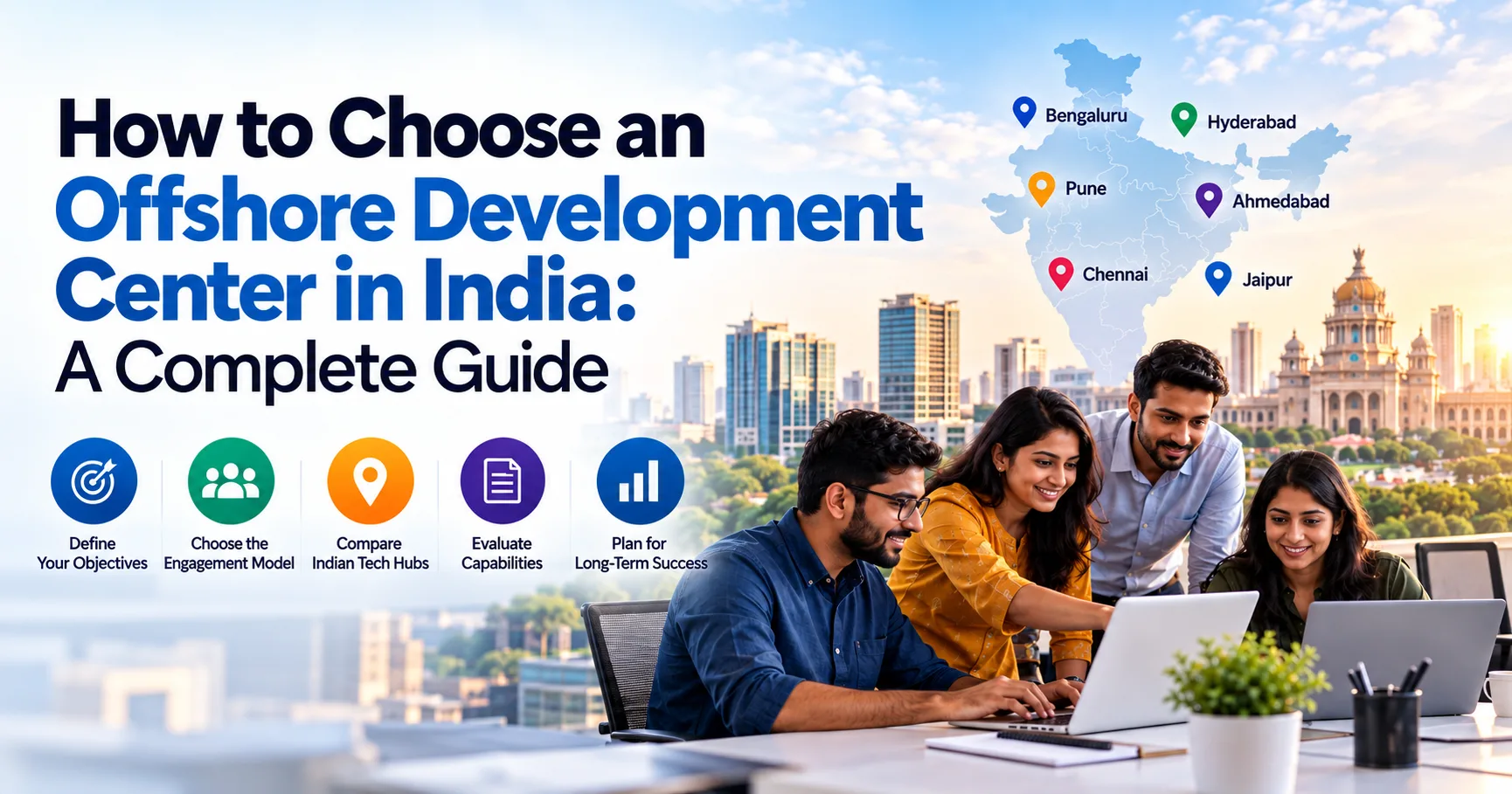
Choosing an offshore development center in India can help a company expand its engineering capacity, access specialized technical talent, and manage development costs. However, the outcome depends on more than the hourly rate or the number of developers a provider can supply. The right decision requires a clear understanding of business objectives, engagement models, team capabilities, communication practices, and long-term scalability.
For organizations planning sustained software development, an offshore team can become an extension of the internal engineering department rather than a temporary external resource. The challenge is finding a partner that can maintain technical consistency, protect intellectual property, and support the product roadmap as requirements change.
This guide explains how to evaluate your options and choose an offshore development partner in India that aligns with your technical and business requirements.
Understand What an Offshore Development Center Offers
An offshore development center (ODC) is a dedicated team of technology professionals located in another country and assigned to work on your projects. Depending on the engagement model, the team may include software developers, QA engineers, technical leads, project managers, and other specialists.
Unlike conventional project-based outsourcing, an ODC typically supports ongoing development. The same team can retain knowledge of your architecture, workflows, business rules, and technical decisions over time.
This continuity is valuable when you maintain enterprise applications, develop new product capabilities, modernize legacy systems, or operate multiple software initiatives.
Before approaching providers, determine whether you need a long-term dedicated team or a different model. A defined project with a clear endpoint may be better suited to outsourcing, while a temporary skills shortage may call for staff augmentation.
Step 1: Define Your Business and Engineering Objectives
Start by identifying the problem you want an offshore team to solve.
Common objectives include:
- Reducing the overall cost of software development.
- Accessing skills that are difficult to recruit locally.
- Increasing engineering capacity without extending local recruitment timelines.
- Supporting multiple products or application modernization initiatives.
- Establishing a long-term development capability.
Translate these objectives into measurable expectations. For example, a company expanding its .NET application may need two senior developers and one QA engineer to support a defined release roadmap. Another organization may need a cross-functional team to maintain several applications.
Identify the required skills, team size, expected duration, reporting structure, and delivery responsibilities before evaluating vendors.
Clear requirements make it easier to compare proposals and avoid paying for resources that do not address the actual business need.
Step 2: Select the Right Offshore Engagement Model
The structure of your offshore development center in India determines how much control you retain, how quickly the team can be established, and what operational responsibilities you must manage.
Vendor-managed ODC
A service provider recruits and employs the team while you direct development priorities. This model is suitable for organizations seeking a dedicated development team without establishing a local legal entity.
Employer of Record (EOR)
An EOR arrangement allows a third party to handle employment administration and related responsibilities under an appropriate legal structure. The precise division of responsibilities depends on the agreement and applicable law.
Captive center or Global Capability Center
A Global Capability Center (GCC) is an organization-owned operation established to support the parent company's activities. It offers substantial operational control but requires investment in legal, employment, finance, infrastructure, and management capabilities.
Build-Operate-Transfer
The Build-Operate-Transfer (BOT) model allows a partner to establish and operate a team before transferring the operation to the client under agreed terms.
Compare these structures based on ownership, speed, operational burden, scalability, and long-term plans. A vendor-managed ODC may suit a company testing the model, while a GCC may better fit an organization planning a substantial, permanent presence.
Step 3: Compare Indian Technology Hubs
India offers several technology hubs, but the best location depends on your required skills, budget, hiring plans, and talent-retention needs.
- Bengaluru: Consider it for broad technology ecosystems, product engineering, cloud platforms, and AI-related skills. Competition for experienced professionals can affect hiring costs and retention.
- Hyderabad: Evaluate it for enterprise technology, cloud engineering, and a balance between talent availability and operating costs.
- Pune: Consider it for enterprise software, product engineering, and application development teams.
- Chennai: Assess it when long-term team continuity and enterprise engineering capabilities are important.
- Ahmedabad, Jaipur, and Coimbatore: These cities may offer cost advantages for suitable roles, although the availability of highly specialized talent varies.
Do not choose a city based on general rankings alone. Ask prospective providers to demonstrate access to the exact skills you require, including the ability to replace or expand team members when necessary.
Step 4: Evaluate Technical Expertise and Recruitment Quality
A provider's technology list does not establish that its engineers can solve your problems.
Review case studies relevant to your industry, architecture, and development stack. Ask how candidates are assessed and whether you can interview the developers who will actually join your team.
Your evaluation should cover:
- Technical screening and practical coding assessments.
- Experience with your required frameworks and platforms.
- Code review, testing, and documentation practices.
- Experience maintaining existing applications, not just building new ones.
- Access to senior engineers for complex architectural decisions.
For example, an organization modernizing a legacy .NET application may need developers who understand existing integrations, database dependencies, testing gaps, and deployment constraints. General web-development experience alone may not be enough.
A strong screening process helps reduce mismatches between the proposed team and the work it must perform.
Step 5: Assess Communication and Delivery Management
Communication problems can undermine an otherwise capable offshore team. Time-zone overlap matters, but so do documentation, accountability, and decision-making.
Confirm which working hours overlap with your internal team. Establish regular sprint planning, daily or periodic stand-ups, demonstrations, and retrospectives as appropriate for your delivery model.
Ask the provider:
- Who manages daily coordination?
- How are blockers escalated?
- Which project-management and communication tools are used?
- How are progress and risks reported?
- How will technical decisions be documented?
A practical arrangement gives both teams predictable opportunities to resolve issues. It also assigns clear ownership for priorities, code reviews, approvals, and release decisions.
Step 6: Verify Security, Compliance, and Intellectual Property Protection
Security must be evaluated before development begins, especially when offshore teams access production systems, customer information, or proprietary source code.
Review confidentiality agreements, intellectual property assignment, access controls, secure development practices, credential management, and data-handling procedures.
Ask how client environments are segregated and how access is removed when a team member leaves. If your industry has specific compliance obligations, verify the provider's relevant experience and request evidence of applicable certifications or independent assessments.
Do not treat a general compliance statement as sufficient proof. Confirm the scope, validity, and applicability of any claimed certification, and establish responsibilities for incidents, audits, and regulatory obligations.
Step 7: Compare Total Cost, Not Just Developer Rates
An offshore development center can reduce development costs compared with hiring equivalent specialists locally, but savings depend on the roles, location, engagement structure, and services included.
Your comparison should include:
- Developer and technical leadership fees.
- Recruitment and onboarding.
- Project management and quality assurance.
- Infrastructure, software licenses, and security controls.
- Leave coverage and replacement arrangements.
- Knowledge transfer, documentation, and exit costs.
Request an itemized proposal rather than relying on a single blended hourly rate. Compare providers using the same team composition, experience levels, expected hours, and service assumptions.
The lowest initial quote may not be the best value if it excludes necessary management, requires extensive supervision, or introduces avoidable turnover and rework.
Step 8: Confirm Scalability and Knowledge Continuity
An offshore partner should support changing priorities without sacrificing delivery quality.
Ask how quickly the provider can recruit additional specialists, replace departing team members, and onboard engineers into an existing codebase. Request references that can speak to team continuity and responsiveness during difficult delivery periods.
Require documented onboarding, architecture records, coding standards, testing procedures, and knowledge-transfer plans. These practices protect the organization when team composition changes.
Common Mistakes to Avoid
Several decisions can weaken an otherwise promising ODC relationship:
- Selecting a provider exclusively on price.
- Choosing an engagement model before defining business goals.
- Skipping technical interviews and reference checks.
- Underestimating internal coordination responsibilities.
- Leaving security requirements and IP ownership ambiguous.
- Failing to define performance measures and exit procedures.
A successful partnership requires commitment from both sides. The client must provide clear priorities, timely decisions, and adequate documentation, while the provider must supply capable people and reliable operating practices.
How AllianceTek Can Support Your Offshore Team Strategy
AllianceTek provides dedicated developer hiring models designed to accommodate different levels of involvement, including full-time resources at 160 hours per month, part-time resources at 80 hours, and expert consulting through 40-hour blocks.
Organizations evaluating an offshore development company in India can compare these options against their roadmap, technical requirements, and internal management capacity.
Explore AllianceTek's dedicated developer hiring models or contact the team to discuss which arrangement may fit your requirements.
Conclusion
Choosing the right offshore development center in India requires a structured assessment of business objectives, engagement models, talent, communication, security, cost, and scalability. The right partner should offer more than access to developers: it should help preserve technical knowledge and support consistent execution as your roadmap evolves.
Define your requirements first, compare providers against consistent criteria, and validate their claims through technical interviews and references. A carefully selected offshore team can become a dependable extension of your engineering organization.
FAQs
1. What is an offshore development center in India?
An offshore development center in India is a dedicated team of technology professionals based in India who work on a company's software development and maintenance activities. Depending on the engagement structure, the team may include developers, QA engineers, technical leads, and project managers. Unlike a typical project-based outsourcing arrangement, an ODC is generally designed for ongoing collaboration, helping the client retain product knowledge and maintain development continuity.
2. How do I choose the right offshore development company in India?
Evaluate the provider's technical expertise, recruitment process, industry experience, communication practices, security controls, pricing transparency, and ability to scale. Request relevant project examples, interview the proposed developers, and speak with existing or former clients. Also, confirm intellectual property ownership, contractual responsibilities, replacement procedures, and knowledge-transfer arrangements before signing an agreement.
3. What is the difference between an ODC and a Global Capability Center?
An ODC can operate through a third-party provider that recruits and employs the dedicated team, while a Global Capability Center is generally an organization-owned operation established to support the parent company. An ODC can reduce the initial administrative burden, whereas a GCC offers greater direct ownership and control. The appropriate option depends on planned team size, long-term strategy, investment capacity, and operational requirements.
4. How much does an offshore development center in India cost?
Costs depend on developer seniority, technology specialization, location, team composition, and the engagement model. The total budget may also include project management, recruitment, infrastructure, security, and onboarding. Request itemized proposals based on identical role requirements and working hours. Comparing the complete cost of operating the team provides a more useful basis for decision-making than comparing developer rates alone.
5. How long does it take to establish an offshore development center in India?
The timeline depends on the engagement structure and hiring requirements. Your source article estimates approximately two to eight weeks for vendor-managed or EOR-supported arrangements, while a captive GCC may take three to six months or longer. Specialized roles, interview availability, contractual reviews, and security approvals can affect the schedule. Confirm a realistic onboarding plan with the provider before setting delivery expectations.