
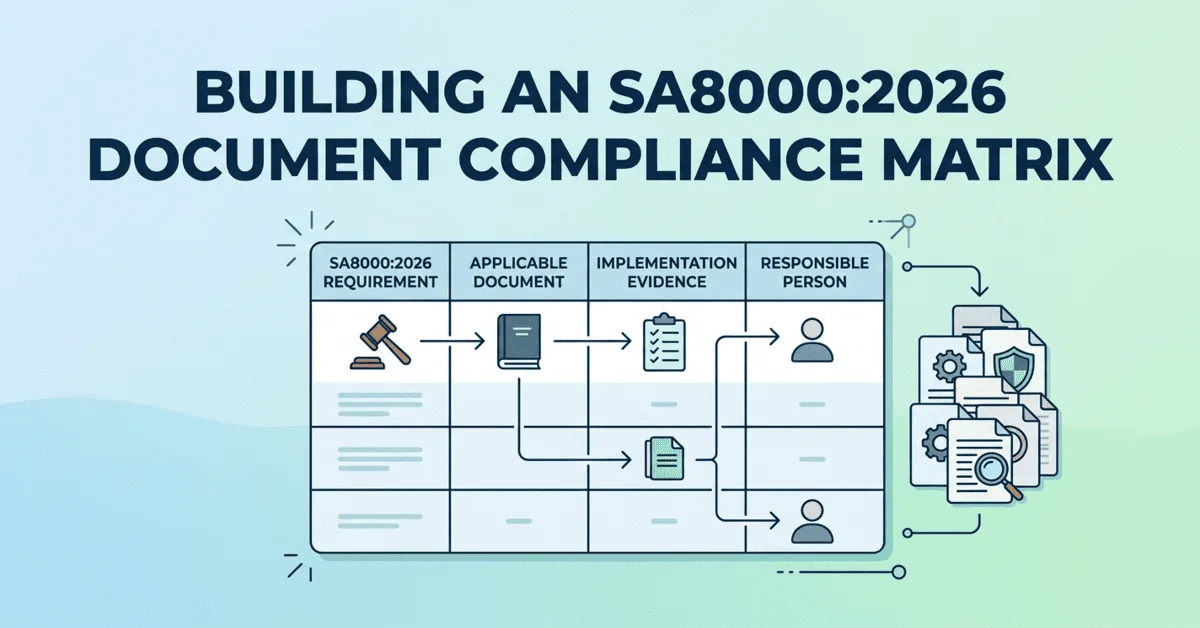
Implementing SA8000:2026 involves more than creating policies and procedures. Organizations need to understand how each requirement is addressed, where the relevant documented information is maintained, and what evidence can demonstrate effective implementation. A well-designed SA8000:2026 document compliance matrix helps connect these elements and makes documentation easier to manage and review.
In simple terms, the matrix shows which requirement must be addressed, which document supports it, what evidence demonstrates implementation, and who is responsible for maintaining it.
What Is an SA8000:2026 Document Compliance Matrix?
An SA8000:2026 document compliance matrix is a structured reference that maps the requirements or criteria of the standard to relevant documents, procedures, records, and other evidence maintained by an organization.
This approach is particularly useful because SA8000:2026 has a stronger management-system focus. Its management system criteria include leadership commitment, worker and stakeholder involvement, policy commitment, context and risks, objectives and resources, implementation, transparency, monitoring, grievance mechanisms, and continual improvement.
The matrix therefore becomes a practical bridge between SA8000:2026 requirements and actual implementation.
Why Is a Compliance Matrix Important?
Without a structured mapping system, organizations can easily create unnecessary documents while overlooking important evidence. A compliance matrix provides a clearer view of what has been addressed and where supporting information can be found.
It can help organizations:
- Identify documents related to each requirement
- Detect documentation gaps
- Avoid unnecessary duplication
- Track implementation more systematically
- Prepare evidence for internal and external assessments
- Make document reviews easier
- Assign responsibility for maintaining relevant information
The SA8000:2026 Indicator Library also provides examples of processes, documents, records, metrics, observations, and personnel or stakeholder statements that may help demonstrate conformity. However, SAI specifically explains that these indicators are not requirements and should not be treated as a checklist.
How to Build the Matrix
Start by identifying the applicable SA8000:2026 criteria and management-system elements. Then create columns for the requirement, applicable document, responsible function, supporting record, implementation status, and remarks.
For example:
SA8000:2026 requirement → Applicable procedure → Supporting form/record → Responsible person → Status
The next step is to verify that every listed document actually supports implementation. A procedure alone is not sufficient if the organization cannot demonstrate that it has been implemented and maintained.
Review the matrix with relevant process owners and update it whenever documents, responsibilities, processes, or organizational risks change.
Use the Matrix to Identify Documentation Gaps
One of the biggest benefits of a compliance matrix is its ability to reveal missing or weak documentation. If a requirement has no corresponding document or evidence, it becomes an immediate area for review. Organizations transitioning to the latest requirements can also review the SA8000:2026 transition to better understand the changes that may affect their existing documentation and implementation approach.
Organizations can then prioritize missing documents, update existing procedures, develop necessary records, and verify implementation before an assessment.
Simplify SA8000:2026 Documentation Preparation
Building the entire documentation structure from the beginning can require significant time and coordination. A practical documentation package can provide a useful starting framework that organizations can customize according to their size, activities, risks, and operating conditions.
A comprehensive set of SA8000:2026 documents can include manuals, procedures, policies, SOPs, templates, records, safety instructions, risk analysis tools, audit questions, and a document compliance matrix. Such resources can help organizations organize their documentation and identify areas requiring further development before an assessment.
Final Thoughts
An SA8000:2026 document compliance matrix should not be treated simply as a list of documents. Its real value is in showing how requirements connect with documented information and implementation evidence. When maintained properly, it can help organizations identify gaps, organize documentation, prepare for assessment, and maintain a more effective social accountability management system.