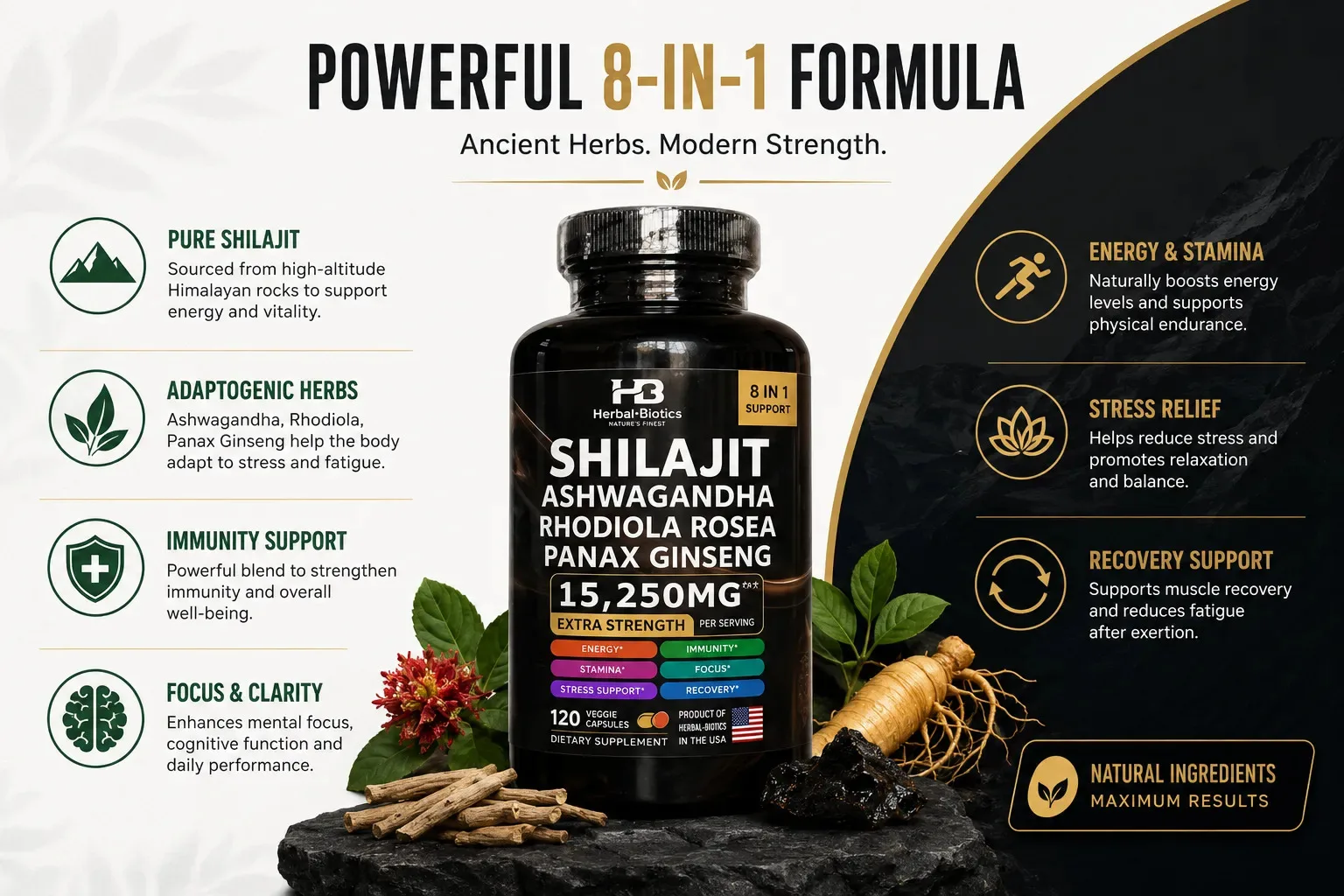
If you are wondering how should you take shilajit supplement, the short answer is this: take it according to the specific product's serving instructions, not according to a generic dose you found online. Shilajit is sold as resin, powder, capsules, tablets, and various extracts, and those products are not necessarily equivalent in strength or composition.
For a first-time user, the sensible approach is to choose a properly purified and independently tested Shilajit Supplement, check exactly how much shilajit or extract one serving contains, measure the recommended amount accurately, and use the preparation method stated on the label.
Resin may be dissolved in warm water or another permitted drink, while capsules and tablets are generally swallowed with water. Powder needs particularly careful measuring because a teaspoon is not a reliable substitute for a scale.
There is also a bigger issue that is easy to overlook. Shilajit is a naturally occurring material containing numerous compounds and minerals, and its composition can vary. Testing has found potentially toxic metals in some shilajit samples and commercial supplements, which makes product quality part of the dosage question, not an afterthought.
So, taking Shilajit Supplement in Nigeria correctly is not about finding the biggest dose you can tolerate. It is about using the right product, the right amount, and the right preparation method for that particular product.
How Should You Take Shilajit Supplement?
The simplest way to approach a shilajit supplement is to start with the label rather than the internet.
First, make sure the product is described as purified or processed shilajit and that the manufacturer provides meaningful information about its composition and testing. Then check the serving size. With a capsule, that might be expressed as a certain number of milligrams per capsule. With resin, the recommended amount may be given in milligrams or as a measured serving. Powder may have its own instructions depending on whether it is raw material, purified shilajit, or a standardized extract.
This distinction matters because two products can both be called "shilajit" while containing substantially different amounts of active material. A 250 mg capsule of one preparation should not automatically be considered equivalent to 250 mg of another preparation.
Once you know the product's intended serving, measure it accurately and use the recommended preparation method. If it is a capsule, swallow it as directed, normally with water. If it is resin, the manufacturer may instruct you to dissolve a measured amount in warm water or another beverage. If it is powder, use the supplied measuring device or a suitable scale when practical.
For someone taking shilajit for the first time, I would avoid the common temptation to start with a large amount "to see if it works." There is no good reason to assume that a stronger dose will produce proportionally greater effects. Human studies have used specific preparations and doses under controlled conditions, but those study doses should not be treated as universal instructions for every commercial product.
The goal is consistency. Take the same measured serving according to the product directions, pay attention to how you tolerate it, and do not increase the amount simply because you do not notice an immediate effect.
How to Take Shilajit Resin
Shilajit resin is the form that causes the most confusion because it is thick, sticky, and usually sold with instructions that involve measuring a small quantity.
The first thing to check is how the manufacturer defines one serving. Some products provide a small measuring spoon, while others specify a weight in milligrams. Use that measurement rather than estimating by eye. A blob of resin that "looks about right" is not a particularly reliable dosing method.
If the instructions say to dissolve the resin, a common practical method is to place the measured serving into warm water and stir until it disperses. Warm rather than very hot water is generally the more sensible choice when the product gives no special heating instruction. The purpose here is simply to make the resin easier to consume. There is no need to turn the preparation into a complicated ritual.
Can you take shilajit resin directly? Some products may be intended for direct oral use, while others specifically instruct users to dissolve the resin first. Follow the instructions for the product you actually purchased. There is no universal rule that every shilajit resin must be dissolved or that every resin must be swallowed directly.
Shilajit resin can also be mixed with milk when the product instructions permit it. This is a common traditional and practical way of taking it, but there is not good evidence that milk magically increases shilajit's effectiveness. Think of milk primarily as a vehicle for taking the supplement, not as a proven absorption enhancer.
One useful point from human research is that resin preparations have now been examined directly in small clinical studies, but those studies remain limited. A 2026 pilot study, for example, used 500 mg per day of a specific shilajit resin preparation for 28 days in healthy men. That tells us what was studied in that particular product and population, not what every resin user should take.
How to Take Shilajit Capsules or Tablets
Capsules and tablets are generally the easiest forms to use because there is no measuring or dissolving involved. Follow the serving size printed on the product and swallow the capsule or tablet with water unless the manufacturer gives different instructions.
Do not assume that one capsule equals one serving of resin. This is one of the most common mistakes people make when comparing products. A capsule might contain purified shilajit, a concentrated extract, a blend of ingredients, or a particular processed preparation. The number of milligrams on the front of the package does not tell you everything about equivalence between products.
Read the Supplement Facts or equivalent ingredient panel and look for the amount per serving. Also check whether the label specifies shilajit itself, an extract, or a proprietary blend. If the product does not clearly explain what you are getting, that is a quality concern.
Another mistake is taking extra capsules because nothing seems to happen after the first few days. Shilajit is not a stimulant that necessarily produces an obvious immediate sensation. Increasing the dose on your own simply because the effect is not noticeable is not a sound way to use it.
How to Take Shilajit Powder
Powder requires a little more care because volume measurements can be surprisingly inaccurate.
If the label says to take a particular number of milligrams, weighing the powder is more dependable than using an ordinary kitchen teaspoon. Powder density varies, so a teaspoon of one product does not necessarily contain the same mass as a teaspoon of another.
Use the measuring spoon supplied with the product if the manufacturer specifically provides one and gives a serving based on that spoon. If the recommended dose is given in milligrams and the amount is small, a digital scale capable of measuring small quantities can provide better accuracy.
Some shilajit powders can be mixed into water or another beverage. Whether that is appropriate depends on the formulation. A powder may be intended to dissolve, disperse, or simply be swallowed, so the manufacturer's instructions should take priority.
The word "powder" also tells you very little about concentration. One product might contain purified shilajit powder, another might contain an extract, and another could contain shilajit combined with other powdered ingredients. Treat the label, not the product's appearance, as the source of dosing information.
How Much Shilajit Should You Take Per Day?
There is no universally established shilajit dosage that applies to every commercial supplement.
This is worth emphasizing because online discussions often make dosage sound much more settled than it actually is. The amount used in a clinical study applies to the specific preparation, population, duration, and study conditions. It does not automatically become the correct dose for every person who buys a different product.
There are useful examples from human research. One randomized, double-blind, placebo-controlled study in healthy men aged 45 to 55 examined purified shilajit at 250 mg twice daily for 90 days. The researchers reported increases in total testosterone, free testosterone, and DHEAS compared with placebo.
Another study of processed shilajit in men with low sperm counts used 100 mg twice daily after major meals for 90 days. Again, that was a specific processed capsule preparation in a specific research population, not a universal recommendation for shilajit users.
More recent research has also examined 500 mg per day of a specific resin preparation, divided into two 250 mg servings. The study was small and open-label, so its findings should be interpreted cautiously.
These examples demonstrate why copying a number from a study can be misleading. The shilajit may have been purified or standardized differently, the participants may have been different from you, and the product may not match the one sitting in your cupboard.
For a beginner, the most sensible starting point is the manufacturer's recommended serving for that exact formulation. If the product gives a range, follow the lower end unless a qualified healthcare professional has advised otherwise. There is generally no reason to escalate the amount simply because you have used it for several days.
More is not automatically better. Higher intake can increase the chance of unwanted effects, and with poorly tested products it can also mean greater exposure to contaminants. Some published analyses have found concerning levels of toxic metals in certain shilajit samples and commercial supplements.
What Is the Best Time to Take Shilajit?
There is no strong evidence establishing one universally superior time of day for taking shilajit.
Morning is often recommended online, partly because some users associate shilajit with energy, alertness, or physical performance. If you personally tolerate it well and the product instructions permit morning use, taking it with breakfast or around that time is a perfectly practical routine.
Nighttime use is also possible for many people, provided the product does not cause unwanted effects that interfere with sleep and the label does not specify another schedule. Claims that shilajit must always be taken in the morning are stronger than the evidence currently supports.
The same applies to taking it on an empty stomach. You will frequently see this presented as a rule, but there is not a well-established clinical basis for saying that every person should take every shilajit formulation before eating.
Food can be useful if taking a supplement on an empty stomach causes nausea, stomach discomfort, or other digestive symptoms. Conversely, if the product specifically instructs you to take it between meals or before eating, follow those directions.
Interestingly, human studies have used different schedules. One testosterone study divided purified shilajit into two daily doses, while another study of processed shilajit administered capsules after major meals.
That is a good reminder that there is no single timing rule supported across all formulations.
In practical terms, consistency matters more than chasing a supposedly perfect hour. Choose a time you can follow reliably, unless your product or healthcare professional gives you a specific reason to do otherwise.
What Can You Mix Shilajit With?
Warm water is one of the simplest options, particularly when using resin that the manufacturer instructs you to dissolve. It is inexpensive, easy to measure, and does not introduce another complicated ingredient into the routine.
Shilajit with milk is another traditional and practical option when permitted by the product instructions. Milk may make the taste and texture easier for some people to tolerate. However, there is no need to assume that milk dramatically improves absorption or makes shilajit more powerful. That claim is commonly repeated but is not well established by clinical evidence.
Tea or coffee may also seem convenient, especially for people who take supplements in the morning. There is not good evidence that adding shilajit to coffee creates a special performance effect. If the manufacturer permits the combination, the main consideration is tolerability. If caffeine already makes you jittery or affects your sleep, adding a supplement to your coffee does not solve that underlying problem.
Water remains the simplest default. If you have a product that specifically recommends another preparation method, use that method instead.
The important point is that the drink is usually a practical delivery method, not the main determinant of whether shilajit works. Product quality, formulation, dose, and individual circumstances are much more important considerations.
How Do You Choose a Good Shilajit Supplement?
Choosing the product may actually be more important than choosing between morning and evening.
Look for a product that clearly states that the shilajit has been purified or processed for oral consumption. Raw, unprocessed material is not something I would treat as interchangeable with a tested commercial supplement. Shilajit can contain naturally occurring minerals and other substances, and contamination is a real quality-control concern.
Independent laboratory testing is particularly valuable. Ideally, the manufacturer should be able to provide a recent Certificate of Analysis, or COA, for the product or batch. A COA can provide information about what was tested and whether the sample met specified limits. It is much more useful than a website simply saying "lab tested" without providing meaningful details.
Heavy-metal testing deserves particular attention. Published analyses have detected elements including lead, arsenic, mercury and other potentially toxic metals in some shilajit samples. A 2025 study also reported measurable thallium in some shilajit supplements, reinforcing why contamination testing should not be dismissed as a theoretical concern.
A transparent label should also tell you how much product constitutes a serving and what ingredients are actually present. Be cautious when the dosage is vague, when the product hides the amounts of individual ingredients in a proprietary blend, or when the manufacturer makes dramatic health claims without explaining the evidence.
Words such as "pure," "natural," "Himalayan," and "premium" are marketing descriptions, not laboratory results. Geographic origin can be interesting, but it does not prove purity or safety.
The same principle applies to claims about FDA approval. In the United States, the FDA does not approve dietary supplements for safety and effectiveness before they reach consumers in the way it approves drugs.
A boring-looking product with transparent testing is preferable to an impressive-looking jar covered in promises.
What Are the Potential Benefits of Taking Shilajit?
Shilajit has been investigated for several possible effects, but the evidence is much less definitive than many supplement advertisements suggest.
Energy and physical performance are among the more commonly discussed areas. A 2019 randomized study examined 250 mg and 500 mg daily in recreationally active men over eight weeks and investigated measures related to muscular fatigue and strength. A newer 2026 pilot study using a particular resin preparation reported improvements in several physical-performance measures over 28 days, but it involved only 25 healthy men, lacked a placebo group, and therefore cannot establish that the changes were caused by shilajit.
Testosterone has received considerable attention. A randomized controlled study of purified shilajit in healthy middle-aged men reported increased total and free testosterone after 90 days. That is an interesting human finding, but it does not mean shilajit guarantees higher testosterone or that someone with low testosterone should use it instead of obtaining an appropriate medical evaluation.
Male fertility has also been studied. Research involving processed shilajit reported changes in semen-related measures in men with low sperm counts, but this was a relatively small clinical study and should not be interpreted as proof that shilajit treats infertility.
Cognitive and antioxidant effects have been investigated in laboratory and preclinical research, but that evidence does not translate automatically into proven improvements in memory, concentration, or neurological health in humans. Reviews have repeatedly pointed out that well-controlled human research remains limited.
So the realistic position is neither "shilajit does nothing" nor "shilajit does everything." There are some interesting human findings, but the evidence base is still relatively small, product standardization is an issue, and larger independent trials are needed before many of the popular claims can be considered established.
What Are the Possible Side Effects of Shilajit?
Shilajit may be tolerated by many people, but "natural" does not mean side-effect-free.
Some users may experience digestive discomfort or other unwanted symptoms after taking a supplement. The exact frequency of individual side effects is difficult to establish because shilajit products differ considerably and clinical studies are generally small. A study reporting that no serious adverse events occurred with one standardized preparation does not prove that every product will have the same safety profile.
There is also a distinction between the shilajit itself and contaminants in poorly controlled material. Research has identified potentially toxic metals in some shilajit samples, including lead, arsenic, mercury and thallium.
If you develop a concerning reaction after taking shilajit, stop using the product and seek appropriate medical advice. Severe symptoms, signs of an allergic reaction, persistent vomiting, significant weakness, confusion, breathing difficulty, or other urgent symptoms warrant prompt medical attention rather than an attempt to manage the problem by changing the dose.
People should also remember that the safety data available for a purified, tested preparation cannot necessarily be applied to raw or poorly characterized shilajit. The identity and quality of the product are part of the safety equation.
Who Should Avoid Shilajit?
Some people should not start shilajit without discussing it with a healthcare professional.
Pregnancy and breastfeeding are two situations where self-directed supplementation deserves particular caution because adequate safety data for shilajit are not established. The same principle applies to children and adolescents unless a qualified professional specifically recommends its use.
People with existing medical conditions should also check before taking it, especially when the condition affects hormones, blood pressure, blood sugar, the kidneys, the liver, or other systems that could potentially be influenced by supplements.
Prescription medication use is another reason to ask first. Supplements can interact with medicines or alter how certain physiological systems behave. The fact that shilajit comes from a natural source does not make those possibilities disappear. FDA consumer guidance similarly recommends discussing dietary supplements with a doctor, pharmacist, dietitian, or other appropriate healthcare professional because supplements can interact with medications and cause adverse effects.
Extra caution is sensible when someone is taking hormone-related medicines or using treatment for fertility, endocrine disorders, blood pressure, blood sugar, or other chronic conditions. That does not mean shilajit is proven to be dangerous in all of these situations. It means the evidence is not strong enough to justify assuming compatibility.
People who are about to undergo surgery should also disclose supplement use to their healthcare team. A supplement that has effects on physiological systems may be relevant to perioperative care even when the interaction is not well documented.
Can Shilajit Interact With Medications?
Yes, interaction is possible, although the problem is that we do not have a comprehensive interaction database for shilajit.
Natural products contain biologically active compounds, so the word "herbal" or "natural" should never be used as a guarantee of compatibility with prescription drugs. Interaction evidence for shilajit specifically is limited, and the lack of documented interactions does not prove that none exist.
Hormone-related medicines deserve particular attention because some human research has investigated shilajit's effects on testosterone and other hormone-related measures. That does not establish a dangerous interaction with every hormone medicine, but it is enough reason not to combine the two casually.
The same caution applies when someone takes several supplements at once. Combining multiple products makes it harder to determine which ingredient is responsible for a side effect and can create unnecessary overlap.
If you take prescription medicines regularly, the sensible approach is to show the exact shilajit product and ingredient label to your doctor or pharmacist. The product's full formulation is much more useful than simply saying, "I take shilajit."
How Long Should You Take Shilajit?
There is no universally established period for taking shilajit indefinitely.
Human studies have generally examined defined periods rather than lifelong supplementation. For example, one testosterone study used 90 days, while a study involving physical performance examined eight weeks. A recent resin pilot study examined 28 days.
That means we have considerably more information about short-term use of particular preparations than about continuous use for many years.
If you decide to use shilajit, it makes sense to periodically ask whether there is a clear reason to continue. If you are taking it for a specific health concern, it is better to address that concern directly rather than treating the supplement as a permanent substitute for medical care.
Longer use also makes product quality more important. Even if a particular purified preparation appears well tolerated in a short study, that does not automatically establish the safety of every formulation over years of use. Concerns about contaminants make this especially relevant when choosing a product.
What Happens If You Take Too Much Shilajit?
Taking more than the recommended amount is not a sensible way to try to accelerate results.
If you accidentally take a larger amount once, do not automatically compensate by taking less for several days or attempting to calculate a new schedule yourself. The appropriate response depends on how much was taken, what product it was, and whether symptoms occur.
If a substantial overdose was taken or symptoms develop, contact a healthcare professional or an appropriate poison-information service for advice rather than waiting to see what happens.
A missed dose is much simpler. Do not normally double the next dose just because you forgot the previous one. Resume the regular schedule according to the product directions.
The key point is that shilajit is not something where a larger amount can reasonably be assumed to produce a larger benefit. Research doses are controlled amounts attached to specific products and study conditions, not evidence that progressively increasing the dose is beneficial.
Common Mistakes People Make When Taking Shilajit
One of the biggest mistakes is buying raw or poorly verified material because it is described as more "authentic." Authenticity and safety are not the same thing. Shilajit can contain metals and other naturally occurring substances, and testing has shown that some samples can contain potentially concerning levels of toxic elements.
Another common mistake is guessing the dose. This happens particularly with resin and powder. A small-looking piece is not necessarily a small dose, and an ordinary kitchen spoon is not an accurate scientific measuring device for a low-dose powder.
People also assume that every shilajit product has the same strength. It does not. Resin, purified resin, powder, capsules, standardized extracts, and combination products may differ in composition and concentration. Copying the serving size from another brand can therefore produce a completely different intake.
Increasing the dose too quickly is another poor strategy. Some people expect to "feel" shilajit immediately and then keep taking more when they do not. The absence of an obvious sensation does not mean the supplement is ineffective, and a noticeable sensation is not proof that it is working.
Ignoring medication use is another problem. Someone may carefully research shilajit itself while forgetting to consider the prescription medicines, hormone treatments, or other supplements already being taken.
Finally, marketing language can distract from the information that actually matters. "Premium," "ancient," "Himalayan," and "100% natural" sound impressive, but none replaces a clearly stated serving size and credible contaminant testing.
Shilajit Resin vs Capsules vs Powder: Which Is Best?
There is no universally best form. The better choice is the one that gives you a clearly characterized product, an understandable serving size, credible quality testing, and a method you can follow consistently.
FormPractical advantageMain considerationResinTraditional format and flexible preparationRequires careful measuring and preparationCapsulesConvenient and portableCapsule strength and formulation can varyPowderEasy to mix when designed for that useAccurate measurement can be difficultTabletsConvenient and simpleCheck the exact ingredients and serving sizeResin can be appealing to people who want a traditional preparation and do not mind dissolving and measuring it. Capsules are usually better for someone who travels or wants the simplest routine. Powder can be convenient when the manufacturer provides a clear serving method, but estimating tiny quantities with a kitchen spoon is not ideal.
I would not choose between these forms based purely on claims that resin is automatically more powerful or that capsules are automatically weaker. What matters is what is actually in the product and whether the manufacturer can demonstrate appropriate quality control.
A well-tested capsule is a more sensible choice than an attractive jar of unverified resin. Likewise, a transparent resin product is preferable to capsules with an unclear proprietary blend. Form matters, but quality and transparency matter more.
Conclusion
The practical answer to how should you take shilajit supplement is much less complicated than many websites make it sound. Choose a properly purified and tested product, find the exact serving size for that formulation, measure it accurately, and follow the preparation instructions. Resin may be dissolved in warm water or another permitted drink, capsules and tablets are generally taken with water, and powder should be measured carefully rather than guessed with a kitchen spoon. There is no strong evidence that everyone needs to take shilajit at a particular hour or that everyone must take it on an empty stomach. A consistent routine that agrees with your product instructions and your tolerance is usually more sensible than chasing an internet "perfect time."
The bigger lesson is that dosage cannot be separated from product quality. Human research has investigated specific preparations at specific amounts, including purified shilajit at 250 mg twice daily and particular resin preparations at 500 mg per day, but those research protocols should not be converted into a universal prescription for every supplement on the market. Shilajit's evidence base also remains relatively limited, particularly for many of the broad claims made about energy, testosterone, fertility, cognition, and long-term health. Some findings are interesting, but interesting is not the same as proven.
If I had to reduce responsible shilajit use to one practical principle, it would be this: do not optimize the dose before you verify the product. A clearly labeled, appropriately purified product with credible testing and a sensible serving instruction is a much better starting point than an unverified "extra-strength" product. This matters because analyses have found potentially toxic metals in some shilajit samples and supplements. If you are pregnant, breastfeeding, taking prescription medication, managing a medical condition, using hormone-related treatment, or simply unsure whether shilajit fits your circumstances, get individualized advice from a qualified healthcare professional before starting it. The aim is not to take as much shilajit as possible. The aim is to use a product you can actually identify, measure, and trust, while remaining realistic about what the evidence does and does not show.
FAQs
How should you take shilajit for the first time?Start with a purified, appropriately tested shilajit product and follow its stated serving instructions carefully. Use the correct measuring method for the form you purchased. If it is resin, dissolve the recommended amount according to the product directions, often in warm water or another suitable drink. If it is a capsule, take the stated number with water. Avoid starting with a large amount simply to see how strongly you feel, as more is not necessarily better.
For your first few uses, it is sensible to pay attention to how your body responds. If you experience stomach discomfort, headaches, dizziness, or other unwanted effects, stop using it and review the product's instructions or seek professional advice. Choosing a product with clear testing and ingredient information is also important because shilajit quality can vary considerably between products.
What is the best time to take shilajit?There is no universally proven best time to take shilajit. Morning is a convenient choice for many people because it fits easily into a daily routine, while some people prefer taking it later in the day. The available human studies have used different dosing schedules, so online claims that shilajit must be taken at one specific hour should be treated cautiously.
Consistency is generally more practical than trying to find a perfect time. If you notice that taking it late in the day affects your sleep or makes you feel unusually alert, moving it to the morning may be more suitable. Always prioritize the serving directions provided with the particular product you are using.
Can I take shilajit every day?Daily use can be appropriate for some products because some human studies have examined daily supplementation over several weeks or months. However, the exact serving and duration depend on the formulation, concentration, product quality, and individual circumstances. A product designed for daily use should still be taken according to its recommended serving rather than adjusted upward without a good reason.
Daily use should not be interpreted as permission to take an arbitrary amount indefinitely. If you plan to use shilajit for an extended period, particularly alongside medications or other supplements, it is worth discussing it with a qualified healthcare professional. This is especially important when you have an existing health condition or are unsure whether the product is appropriate for you.
Should I take shilajit on an empty stomach?Not necessarily. There is no strong evidence that every shilajit product must be taken on an empty stomach to work properly. Some people may prefer taking it before breakfast because it fits their routine, but others may find that taking supplements without food causes stomach discomfort. If that happens, taking it with food may be easier to tolerate when the product instructions permit it.
The most important point is to follow the specific label because different forms and formulations can have different directions. There is also little reason to force yourself to take shilajit on an empty stomach if doing so consistently causes digestive discomfort. A routine that you can tolerate and follow correctly is usually more practical.
Can I take shilajit with milk?Often, yes, when the product instructions permit it. Milk can make shilajit resin easier to consume and has also been used as a traditional preparation method. For resin products, the recommended amount can be mixed into warm milk if the manufacturer specifically allows this method. Capsules, however, should generally be taken according to their own directions rather than opened and mixed into milk.
There is not convincing evidence that milk dramatically increases shilajit's absorption or effectiveness. It is better viewed as a practical beverage that may improve the taste and make resin easier to consume rather than as a required enhancer. If you tolerate milk well and the product directions allow it, using milk is a reasonable option.